Blue Collar Holiness

Jay Kim encourages us to embody holiness in everyday life.
Transcripción
This transcript was generated automatically. There may be errors. Refer to the video and/or audio for accuracy.
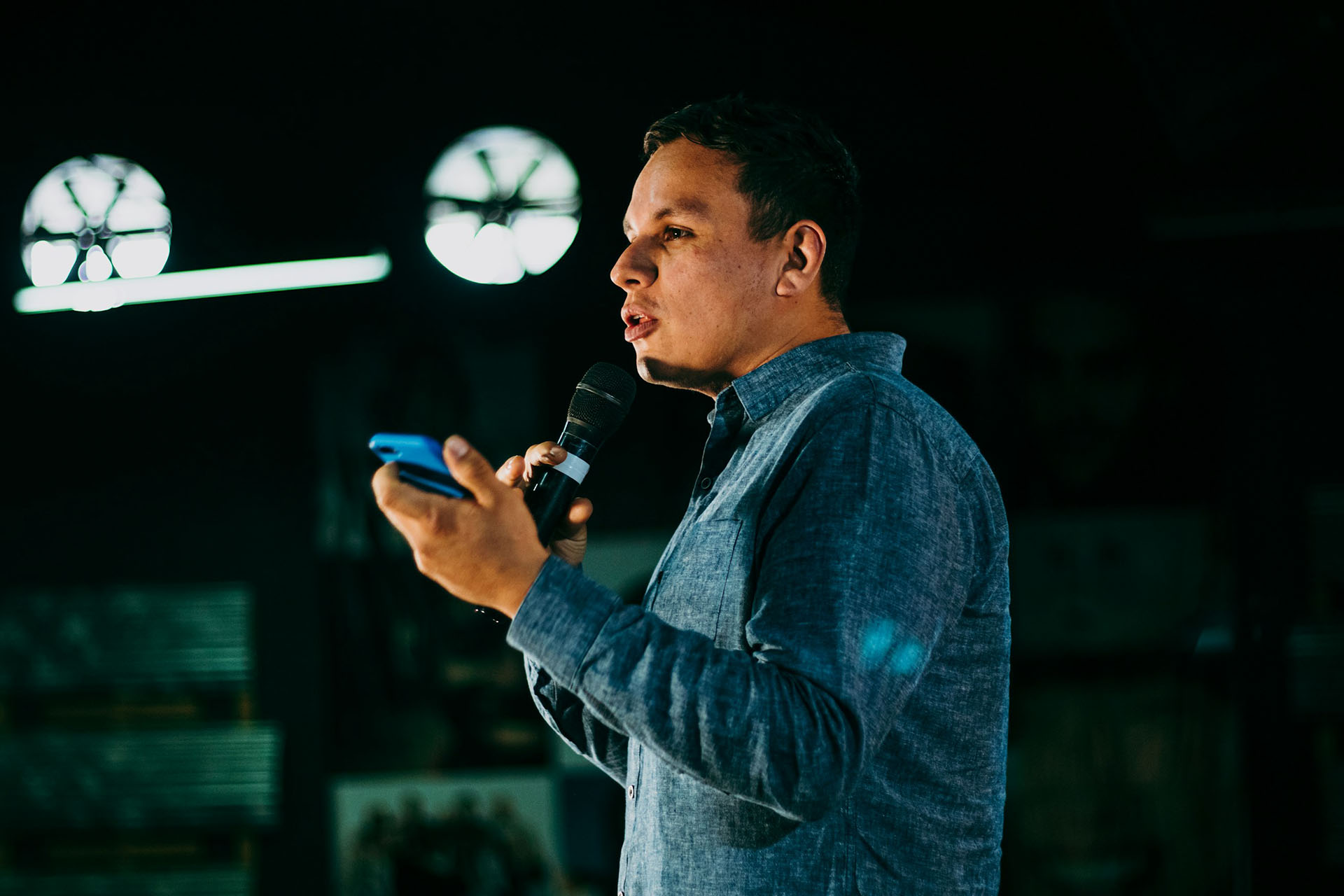
Jay Kim is a pastor at Vintage Faith Church, just up the road from us. He oversees teaching and church leadership. He's also an author. His works have been featured in magazines like Christianity Today and Relevant and several others. He and his wife, Jenny, live over the hill and they have two young children, Harper, who's four, and Simon, who is one. And so it's with some sacrifice that he came over here today, leaving his wife, Jenny, with their little ones. And so you're gonna really enjoy and be inspired by what he has to say. Let's give a very warm Twin Lakes welcome to Jay Kim.
Thank you guys. Appreciate that. Hi. It's good to see you. How are you? I've heard great things about the 10:45 service here at Twin Lakes. I've been told you're the best. So here we go. You know, honestly, it's I'm really truly, I'm not just saying this because it's a thing to say. I really genuinely mean this. I am so thrilled and honored to be here with you all. Like Mark said, I am on staff at a church not far from here, over on the west side of Santa Cruz called Vintage Faith, and I've been on staff there for exactly three years.
And before that I was on staff at a large church in San Jose. And when I was on staff there, I, because of a relationship and some friendships, I had the chance to actually still come over to Vintage Faith and guest teach there on a pretty regular basis. So I feel like I have in one way or another been connected to the faith community of Santa Cruz County for the last five or six years. And in those five or six years, my appreciation and gratitude for Twin Lakes Church has just grown and grown. And there's lots of reasons for that.
You know, long before I met René in person, long before we had a personal relationship, I had great admiration for him just as a leader. But as I've gotten to know René on a personal level and his team, this incredible leadership team here, Mark, Val, and so many others, man, you guys don't quite know how good you have it, you guys. Your leadership team here is, they're the real deal. And what you see up here is really just a smidge of how incredibly generous and passionate about Jesus they are.
And their investment and help and love and care for our church, our little church on the west side of Santa Cruz has meant a great deal. And in addition to that though, my admiration is not just for René and the team here, my admiration actually extends a great deal to you. And there's a reason for that, very specific reason. The reality is we live in a time in human history when following Jesus is challenging. Following Jesus has always been challenging, but it is uniquely challenging in the year 2019.
And in particular, in a place, in a strange, weird place like Santa Cruz County, it is especially challenging to be a Christian, to follow Jesus faithfully. And you know, it doesn't take long, just a quick scroll of your Twitter feed or a quick viewing of the evening news reveals to us that there are so many caricatures in the culture and in the world today about what the church is and about what Christians are. And the caricatures are nasty. The news is not kind to Christianity. And because of that, again, it is challenging to follow Jesus.
But you, Twin Lakes Church, in the way you love and care for not just yourselves but for Santa Cruz County at large, in your partnerships with nonprofits, in the way you give to those who are in need, and in the way you interact in your everyday lives, in your workplaces, and in schools, and amongst your friends and social circles, you are changing the narrative. You're changing the story of how people understand and perceive what Christians are like. And you're shining light into darkness, into the darkness of Santa Cruz County. And for that, as a church leader, I am incredibly grateful for you.
And here's the deal. We live in a dark world that needs light. Mark mentioned it earlier as we were praying, but just a week ago in Gilroy, California, our neighbors, this is the senseless tragedy at the Garlic Festival where lives were lost. Just yesterday in El Paso, Texas, and then we wake up this morning to new news of another tragedy in Dayton, Ohio. The onslaught of darkness in our world is relentless. And so we need light. We need some sort of light to break that darkness.
Now most of us in this room, I think, would consider ourselves followers of Jesus, Christians. And if that is you, what that means is that you believe that the light that can break the darkness, the only light that can break the darkness, is the light of Jesus Christ who came, lived, died, and came back to life to change the human story. There are some of us in this room who are not followers of Jesus. We would not consider ourselves Christians or maybe even religious. We're just here because someone invited us or we're looking, we're searching for hope and for meaning.
Whatever reason brings you here. One, if you are not a follower of Jesus, you just need to know we are thrilled you're here. And our hope and prayer is that this place eventually begins to feel like a home for you. Here's what you need to know. You are surrounded by men and women in this room who believe that there is an answer to the problem of darkness in our world and that that answer is found in the life, death, and resurrection of this ancient Jewish rabbi, Jesus from Nazareth.
But here's where we can agree. Whether you are a Christian or not, we can and must agree that there is darkness in our world and we need light. Whether you are religious or not, a follower of Jesus or not, we can't agree there is darkness in our world and we need light. Now here is the attention. When you read the Bible, what you discover is that although Jesus is the light of the world, the means by which he chooses to shine that light into the darkness of our world is us, Christians, as followers.
And this is a daunting task because again when you watch the evening news or scroll through your Twitter feed, what you realize is that we have a hard time doing this work and often it feels like we're failing. But it is possible. Let me tell you a story. About a thousand years ago in modern-day Russia, a man that they called Vladimir the Great ruled the land and Vladimir the Great decided that he wanted to try to unify his people and the idea he came up with was why don't I institute a national religion to unify my people.
So what he does, he gathers together all of these different delegations and he assigns them to all parts of the known world and he says go into the known world, each delegation, and I want you to research and experience all of the religions around the known world and return back to me with a report and we're gonna select together a national religion to unify our people. And so he sends these delegations out and months later they return and they begin giving their reports to Vladimir the Great.
And these reports basically describe all of these world religions throughout the known world with words like depressing, strict, abstract, theoretical, not pleasant. And Vladimir the Great is sort of at his wit's end, he's like serious, there isn't like one awesome religion out there, what is the deal? And then his delegation that had visited a city called Constantinople, which was the capital of the Byzantine Empire at the time, they returned and they said in Constantinople we spent time with Christians.
And this was their report, this is what they said of their experience of Christians, followers of Jesus in Constantinople. They say this, "Then we went to Constantinople and they, the Christians, led us to the place where they worship their God and we knew not whether we were in heaven or earth, for on earth there is no such vision nor beauty and we do not know how to describe it. We only know that God dwells among men. We cannot forget that beauty." Is this how the world would describe us today?
We sort of feel uncomfortable because our assumption is like, "No, I don't think so." Like when I watch the news, that's certainly not how they talk about Christians. When I think about my non-Christian friends or colleagues or neighbors, that certainly is not how they describe Christians. But what is this description? There's actually a biblical idea, we sang about it moments ago, this idea of like a beauty and a vision that you can't even quite describe, something you've never seen before, something that seems so uncommon and unique and set apart and yet it's mesmerizing.
There's a biblical word for this idea and it is the word "holy." Just moments earlier we sang that song, "Holy, holy, holy, Lord God Almighty." What we are saying in that song is that God is totally set apart, that He's totally uncommon, He's totally other. That's what the word "holy" means. And listen, it's a big idea but it's an idea that we're comfortable with, the idea that God is holy. But here's the challenge. What the Bible tells us is that not only is God holy, followers of Jesus are called in response to God's holiness to then be holy.
And this is daunting because holiness feels like it's really startling, even supernatural, right? But I feel really ordinary. How can I be holy? What does that even look like or mean? This is 20th century Jewish rabbi named Abraham Joshua Heschel and he says this, "Holiness is the most precious word in religion and was only used to describe what was believed to be an undeniable manifestation of a certain being of a startling supernatural quality." So if I am called to be holy, I am called to live my life in such a way that my life exudes a sort of startling supernatural quality.
But here's the problem. I know myself. I know how often I fail as a husband and try and try as I may. I know how often I fail as a father. I even know how often I fail as a pastor and as a church leader. I certainly fail often as a friend. I know these things about myself. I am incredibly, extremely, startlingly, supernaturally ordinary. So how could someone like me be holy?
The great hope I find in the biblical story is this though. When Jesus, during his three or so years of what we call his earthly ministry, the stories we read in the first four books of the New Testament that we call the Gospels, he chooses, he hand picks some young men who would come alongside him as his, what we call his disciples. That word just means his students or his apprentices. And these young men that Jesus chooses, if you read the stories carefully, you very quickly realize Jesus does not choose the best of the best.
Jesus does not choose like the Harvard graduates. If you're a Harvard grad, that doesn't mean he's not going to choose you. I just mean in the Gospels, he doesn't choose the Harvard grads. He actually chooses the young men who are at the bottom of the socioeconomic ladder. He chooses the least of these. And through these extremely ordinary young men, he eventually launches the Christian movement. And one of these young men is a man, if you know the Bible a little bit, a man you may know, a young man named Peter.
This is the same Peter who's like, "Jesus, I'm never gonna deny you." And then a couple hours later he's like, "Uh, denies Jesus." This is the same Peter that was like, "Jesus, if that's you walking on water, tell me to come to you because I'll totally walk on water to you." Jesus is like, "It's me, come to me." And Peter steps out, he takes a few steps and he sinks. Right? That Peter, extremely ordinary, that young man eventually becomes one of the key leaders who launches the entire Christian movement. The fact that we're gathered here together as a church finds its roots, if you trace it back far enough, finds its roots in Peter's leadership.
And Peter wrote a few letters that made their way into what we call the New Testament today. And in one of his early letters, a book that we call First Peter, he actually writes about this conundrum that our holy God wants to shine the light of Jesus into the darkness of our world through ordinary people like us. He addresses this. And he's the perfect person to address it because he is in some ways so incredibly ordinary. But God uses him to do extraordinary things.
This is what he says in First Peter chapter 1 verses 13 to 15. He writes, "Therefore with minds that are alert and fully sober, set your hope on the grace to be brought to you when Jesus Christ is revealed at his coming. As obedient children, do not conform to the evil desires you had when you lived in ignorance, but just as he who called you is holy, so be holy in all you do."
Listen, when I hear the word "holy" or the idea of holiness, automatically my mind conjures up images of old men with long flowing beards who live in mountain monasteries and speak in poetic idioms. You know what I'm saying? That like make no real sense, you know? I imagine like mystics and sages and gurus, you know? That's often how culture understands the word holiness. Oh, that's, he's a holy man because he lives in a mountain, doesn't wear shoes or whatever, right? That's often how we understand holiness.
And yet Peter says here, no, no, no, no, to everybody, to the common person, be holy, just as God is holy, be holy in all you do. In fact, to reiterate the point at the beginning of the text, when he says with minds that are alert, that word alert, this text is originally written in an ancient form of Greek called Koine Greek and that word alert in the original language is a very specific word. The English translation alert actually doesn't quite do it justice.
The word alert is actually in the original language an action word, it's a verb that was used to describe a very specific action. In the first century ancient Near Eastern world, you guys have probably seen flannel graphs of this, men wore these long flowing robes. Like imagine any image of Jesus you've ever seen, right? He's wearing kind of a sash and a robe type thing, right? That's kind of what they wore back then. But remember it was also in the first century ancient Near Eastern world, it was an agricultural society. They farmed, everybody farmed, or fished, or something agricultural or something active with your hands and your feet.
And so when they would go about their work, men would always take their long flowing garments, gather them up, and tuck the garments into their belt. That action is the word Peter uses when he invites us to be alert as we pursue holiness. What does that mean? It means that the life of holiness is not a life of intellectual assent or theological elitism. It means that the work of holiness requires very basic, what I would call blue collar work. It's like wrap up your garments, tuck them into your belt, get ready to get your hands dirty.
And in order to reiterate the point, what does he say at the very end? He says, "Be holy in your thoughts. Be holy in your theology. Be holy in the way you understand, you know, ancient Hebrew." Like no, you didn't say any of that. He says, "Be holy in all you do." Like be holy in the way you parent your children. Be holy in the way you stay faithful to your spouse. Be holy in the decisions you make at work. Be holy in the way you study. Be holy in the way you speak with your friends. Be holy in the way you honor people.
Be holy in the way you smile to your barista or your banker. Be holy in that moment at the grocery store when you're in the Express Line and the guy in front of you has 13 items when you know the Express Line says 10. Be holy in that moment, in every moment, in all things, in the ordinary mundane moments of your life. Be holy. Holiness is in every day in the minute details of life reality. It's not reserved for the sages and the mystics and the gurus. It is an everyday choice we make. It's what I would call blue collar holiness.
In fact, there's the late great writer Eugene Peterson who he was famous for, really well-known for lots of books, but he might be best known for what is called his paraphrase of the Bible. So it's not a translation. He's not actually translating the words directly. He's paraphrasing the ideas in the Bible so that the modern mind can understand them. And I love his paraphrase of 1 Peter chapter 1 verse 13. He says, "So roll up your sleeves." I mean that is the modern imagery of the original word "alert." Roll up your sleeves. This is like basic ordinary everyday stuff. Roll up your sleeves and get ready to do the dirty work. Roll up your sleeves and be holy.
If you continue reading Peter's letter, you find later in chapter 1 and on into chapter 2 that he explains what this sort of blue collar everyday holiness looks like. He says this, "Now that you have purified yourselves by obeying," pay attention to these words, "the truth so that you have sincere love for each other. Love one another deeply from the heart, for you have been born again not of perishable seed but of imperishable through the living and enduring Word of God. For all people are like grass and all their glory is like the flowers of the field. The grass withers and the flowers fall but the Word of the Lord endures forever." And this is the word that was preached to you, "Therefore rid yourselves of all malice and all deceit, hypocrisy, envy, and slander of every kind like newborn babies crave, pure spiritual milk so that by it you may grow up in your salvation now that you've tasted that the Lord is good."
Listen, what does holiness in our life look like? Again, it doesn't mean becoming a mystic or a guru or a sage. It's not some theological or spiritual elitism or assent to some far off distant place that none of us could possibly reach. Holiness, as God calls us into, is an everyday roll up your sleeves action. To live a holy life so that God might reflect and shine the light of Christ into a dark world means ridding ourselves of all malice. That's like hatred and ill will toward people.
It means ridding ourselves of deceit and hypocrisy, envy and slander. You want to live a holy life? You want to be the sort of holy person that God uses to shine the light of Christ into the darkness of our world? Then rid yourself of malice, of hatred, and ill will toward people. Rid yourself of deceit, those opportunities you have when that little white lie would make your life just a little more convenient. Rid yourself of that desire and that longing. Make a better choice. Rid yourself of hypocrisy. Stop living one way on Sundays from 10:45 to 12 and another way Monday to Saturday and instead just be the person God has called you to be at all times and in all places. Rid yourself of slander, that opportunity that is so tempting when you're sitting with a friend to talk about that other person who isn't there to give that little poke or that little jab that feels kind of good in the moment. Rid yourself of that destructive tendency. That's holiness.
And in fact if you go back in the passage, Peter actually lays out the lens through which we can accomplish ridding ourselves of these destructive realities in our lives. He said, remember in verse 22, "Now that you have purified yourselves by obeying the truth so that you have sincere love for each other, love one another deeply from the heart." That's holiness. That every choice, every decision, every tension, every circumstance, every situation of your life that you come across, the lens through which you make your decisions are truth and love, the truth of God and the love of God.
When you're in that circumstance at work and you're not quite sure what to do, this path would be easier but it doesn't seem like the right thing to do. Ask yourself, what's the most truthful thing I can do and what is the most loving thing I can do? When you are struggling and wrestling in your marriage and those thoughts are creeping into your mind, man, maybe it'd be easier just to bail on this whole thing. Ask yourself, what is the most truthful thing I can do and what is the most loving thing I can do? In each and every circumstance of life, let that be your filter. Truth and love, that's how we cultivate blue-collar holiness in our lives. And those are the people that God uses to shine the light of Jesus into the darkness of our world, a world that so desperately needs light.
Last October, October of 2018, my mother turned 70. 70 is a big one, you know, and my mom is a single mom. She and my father separated before I can remember. She never remarried and she only had me, a single child. And so all my mother has really is me. And so I knew she was turning 70, so she's got this bucket list for her life and on that bucket list was she wanted to go to Hawaii. She'd never been, I'd never been. And so I saved up and on leading up to her 70th birthday, I surprised her. I said, "Mom, we're going to Hawaii. I'm gonna take you to Hawaii." And she was thrilled and so we went and we stayed right off Waikiki Beach. It was very touristy but it was awesome and it was great. I took my mom to Hawaii for her 70th birthday.
Now here's something you need to know, some stuff you need to know about my mom. My mother lost her father when she was nine years old. She lost her mother three years later when she was 12. She was the youngest of four children, two older brothers and an older sister. She lost both of her older brothers to sickness by the time she was in her early 20s. My mother has known nothing but loss. Shortly after she lost her older brother, she married the man who would become my father. And my father had, he wrestled with really dark destructive demons his entire life and addictions and vices. And my mother wasn't a Christian growing up but she encountered Jesus in a really powerful way when I was two.
And she just passionately began following the Lord and so she went to her husband, my father, and said, "Listen, we cannot live this way anymore. We cannot raise our son in this sort of environment for the sake of his emotional and physical health as well as his spiritual health so that he might come to know, love, and follow Jesus someday." And my father did not listen and so after two and a half years of crying when I was about four, my mother separated from my father and we lived, I was born in South Korea at the time, my mother packed our bags, she had about $40 cash in her wallet, her sister who lived in California paid for a ticket for her and I and we moved to California when I was about four.
And so my mom was a single immigrant mother with very little education trying to forge a life for herself and her young son in a country that was completely foreign to her where she did not speak the language. You can imagine what that's like. My mother was a seamstress and so I remember as a child growing up all throughout elementary school, every day she would pick me up after school in her old Oldsmobile and we would drive around for hours from shop to shop and she would pick up these giant bags of clothes, shove them into her trunk and into her backseat, we would go home, she'd fix us dinner and I would do my homework and then play Nintendo and she would just be doing her work, alterations on clothes all night long till I fell asleep into the wee hours of the morning and the morning I would wake up she would pack these bags back into the car, drop me off at school, drop the bags off, work her other job at this dry cleaners, pick me up at school, go pick up more bags and on and on and went. That was our life.
I remember on those drives my mother would write these little Bible verses on these flashcards and she would give them to me at the beginning of every week on Monday and she would say, "J, if you memorize that Bible verse by the time we're like by the end of the week on Friday, I'll buy you a happy meal at McDonald's." And I was you know a chubby American boy so like I liked happy meals so I memorized a lot of verses you guys. But also she would ask me every day how things were at school, she would ask me what God was teaching me and how things were with my friends and she would pray for me and she would tell me even though our life was hard how much God loved us and cares for us and how much he is protecting us and guiding us. Every day she did this.
You know if you if you saw my mom on the street you would not think anything of her, she's a five foot nothing Asian lady. My mom has never written any books or spoken at conferences. You wouldn't know her from anyone. She's just normal. She's an ordinary woman who's had a hard life. But if there's anything, a single thing I've said today that has helped you, it is because a five foot nothing immigrant woman rolled up her sleeves and lived a holy life with her son.
You know our second day in Hawaii out of our hotel balcony we could see this mountain, this little mountain called Diamond Head. Anybody been there? It's this beautiful hike but it's like 700 feet elevation. I looked at pictures before we went. The stairs look like ladders. I mean they're just like straight up. It's so intense. I looked at my mom one day and I said mom do you want to hike that mountain? And she's like yeah. I was like are you sure I want to but are you sure you want to? You're 70. And she said yeah let's do it. And so the next morning we packed our bags with water and snacks and we drove over and we started hiking and it was difficult especially for her. Got about halfway through and she is just sweating more than I've ever seen her sweat and she's breathing heavy and her legs are sore and we see a little bench. We're about halfway up and she sits on the bench and I look at my mother and I said mom you know the view here is pretty nice. Why don't we just call it a day? Let's just head back down and you know what she does? Cannot make this stuff up. She rolls up her sleeves. She stands up and she says no let's keep going.
And we climb and we climb and people were passing us by and we were taking it slow but eventually we made it to the peak of Diamond Head.
This is a microcosm of her life and I share this story about my mother with you not because I want to elevate her or make it seem like she's some incredible spiritual giant or special. She's incredibly special to me because she is my mother. But I share this story with you because I want you to know on paper my mother is so utterly ordinary. She's just a normal non-descript everyday person with problems like you and me. But she follows Jesus with everything she has and she's never written books and she doesn't have a blog or a podcast. She doesn't speak at conferences and you wouldn't know her if you saw her on the street. But she has changed my life and any life I've impacted she's impacted. That's blue collar holiness.
I share her story with you not because she's special but because she is ordinary and God is in the business of using ordinary people like my mother, like you, like me to change the world. And so my invitation to you Twin Lakes Church, roll up your sleeves and be holy. Let's pray together.
God we were so grateful that you sent your son Jesus to bring the hope that only he could bring to our dark broken hurting world. And Jesus we are totally overwhelmed but incredibly grateful that you choose to bring about that healing, to shine that light into the darkness of our world through ordinary people like us. We pray today this morning that you would give each and every one of us courage and conviction to roll up our sleeves, to pursue holiness, to ask the question of truth and love in every decision we make so that our ordinary lives might be used by you to shine extraordinary light into the darkness. We love you and we thank you. In Jesus name we pray. Amen.
Sermones
Únase a nosotros este domingo en Twin Lakes Church para una comunidad auténtica, un culto poderoso y un lugar al que pertenecer.