Good Friday 2020

Mark reflects on Jesus' sacrifice and our unity as a church family.
Transcripción
This transcript was generated automatically. There may be errors. Refer to the video and/or audio for accuracy.
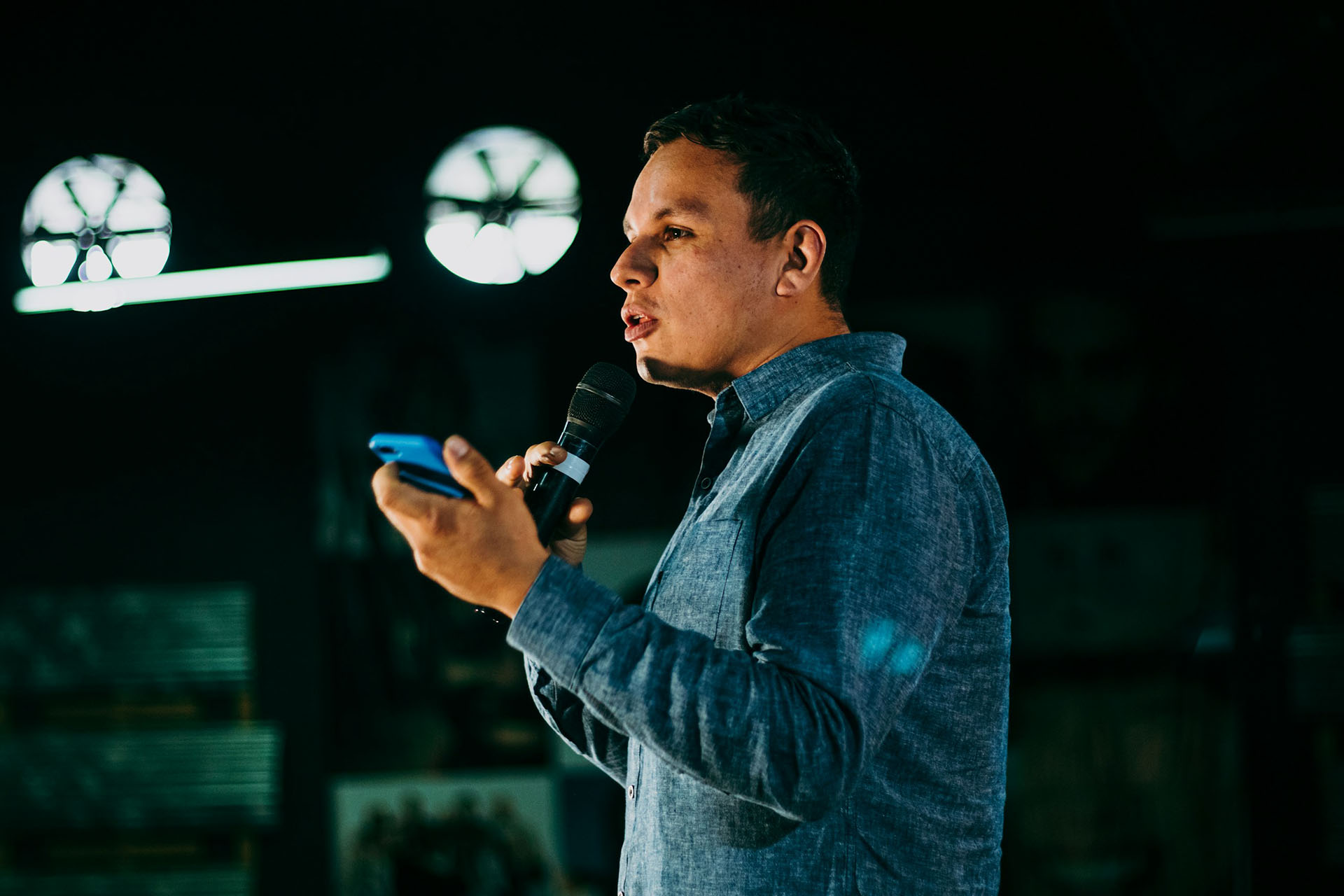
Good evening, my name is Mark. Thank you so much for gathering with us here on this Good Friday. We are so grateful for that and I wish you could see what I see right now. A couple guys in the church, Jim Holderman, Mark Fornow, Bob Sleeper, they printed out over 600 of your pictures and they are taped throughout the pews, most of you in your normal spots and I have to tell you it's overwhelming. I wept when I walked into this room today. So thank you guys. Thank you for the reminder that even though we're in our separate homes, we are together as a church family, whether you're here in the Santa Cruz area or you're tuning in from beyond.
We're just so glad you're with us and as Elizabeth said at the top of the service, I hope you've had an opportunity to prepare for communion. We'll be receiving that together a little bit later. Again, we're separated by distance but we are united around the table of Christ. So make sure you have some bread or crackers, juice, water. Don't let the technicalities be the issue. It's about the attitude of the heart as we remember the sacrifice of Jesus Christ on the cross for us.
Before we gather for communion though, I just want to share a couple thoughts with you. In fact, I want to take you back to the song that we just sang about the reckless love of God because the song kind of suggests that God's not terribly cooperative when it comes to social distancing. I don't know if you caught some of the lyrics but it talks about him breathing on us, about kicking down walls and climbing mountains just to get to us. And you see this with Jesus. He touches lepers. He shares meals with tax collectors and notorious sinners and invariably there's more than 10 people tucked around the table.
This is one of the reasons why Jesus was often at odds with a group called the Pharisees. They were really the champions of social distancing. In fact, the name Pharisee means one who is separated. Specifically separated from the sin and impurity of others. This was their goal because the Pharisees among others, they saw sin as a contagion. So if you touched the wrong person or associated with them too closely, you became ritually defiled.
And so for example, when Jesus invites Matthew, the tax collector of all people to be one of his disciples, it's scandalous. Tax collectors worked for the Romans. They ripped people off. They were scum. And none of this seems to bother Matthew. He's so excited by the Lord's invitation that he decides to immediately throw this huge party where Jesus is the guest of honor. And in Matthew 9, it says this. It says that while Jesus was having dinner at Matthew's house, many tax collectors and sinners came and ate with him and his disciples.
So are you getting the picture here? There's a huge party. And other than Jesus and his disciples, well, actually his disciples weren't exactly perfect either, but the only people that come are fellow outcasts like Matthew. And guess who notices all of this next verse? When the Pharisees saw this, they asked his disciples, "Why does your teacher eat with tax collectors and sinners?" I mean, doesn't he know that if he gets too close to them, he'll get their sin germs on him? I mean, talk about reckless behavior.
One of them has to be thinking, you know, someone should find Jesus a thousand bucks for not observing safe distances because this is just the way they thought. And of course, they started with the best of intentions. They didn't want their connection with God to be contaminated by sin. And so over time, they adopted more and more religious rules and precautions that were all designed to keep them pure, but it eventually became kind of ridiculous.
In fact, this is something that wasn't lost among those within their own movement. There's an ancient Jewish document called the Talmud, and there's a section, has somewhat of an in-house debate among the Pharisees, and some of them are labeled with somewhat disparaging names, ones who they thought maybe were taking us a little bit too far, this whole separation thing. For example, there was the bleeding Pharisee. They called that kind of Pharisee the bleeding Pharisee because when this Pharisee is walking down the street or going through the marketplace, if he were to see a woman, he would close his eyes in order to avoid having impure thoughts only to then walk into walls or trip over things, hence the name the bleeding Pharisee.
There was also the pestle Pharisee. Their posture resembled how a pestle lays kind of on a diagonal in a mortar bowl. They also called them hunchback Pharisees because they were slumped over trying to show their piety, but really the point of it all was to advertise their holiness so that no one would touch them and defile them.
And I want you to think about that for a moment, because right now, you know, sheltering in your homes, washing your hands every day more times than you can even count or remember, observing social distances, you're in a position at this moment to understand the Pharisees like you never can or never could at any other time in your life. Now, of course, we're doing a good thing by trying to avoid a physical contagion. They were trying to avoid a spiritual one. So it's really the same strategy. You just separate yourself from others.
The problem is what works for a physical disease is really kind of worthless when it comes to avoiding sin, because we don't just get sin like out in the world through the influence of culture or the actions of other people and how that might influence us. That's part of it, but it's not all of it, because when it comes to sin, it's something that we are born with. And from the very beginning, it infects our thinking, our behavior, our relationships. And you know this from your own experience, just as well as I do.
So I don't need to belabor that point, but we all know that we have this disease of sin in us. And what's God's response to all of this? Does He just keep a safe distance? Far from it. In fact, He draws near. In Christ, He actually becomes one of us. And throughout the gospel, you see that when Jesus touches people, He doesn't become defiled. They become clean, healed, forgiven. And not only that, but also changed.
Because after all, the love and holiness of Jesus is also contagious. And it's out of that love that Jesus ultimately will die on the cross in order to cure us from the mother of all diseases. And that's sin. And on the cross, just hours before, you may know that all, or at least most of His followers, His friends, they desert Him. They scatter like mice out of fear and self-protection. They're looking out for number one, right? And that impulse is still alive and well today.
You see that it motivates people to hoard things like toilet paper and, as ridiculous as it is, that's how the human mind works in its sinful state. It's crazy. In fact, I read a few days ago an article that said in Australia right now there's a cafe that's accepting toilet paper as currency. It's like, "Here's your latte. That'll be one roll." They also mention in Hong Kong, a group of men armed with knives, they go into a store to rob it, but it doesn't say anything about them going for the cash register. Rather, they leave with 600 rolls of toilet paper.
You know, I think if they catch those guys, the penalty should be that they have to go at least 600 days without toilet paper, see how they like it. But fear, it's so often inflames sin in all of us. Remember Simon Peter? You know, on the night before Jesus would be crucified, during the Last Supper, he brags, "I will die for you, Jesus." And then just a couple hours later when a teenage girl says, "Hey, aren't you one of those who was with Jesus?" He tries to deny it over and over again, and meanwhile, Jesus is just a stone's throw away. He can hear and see what's going on with Peter and this girl.
While Jesus is being interrogated and tortured, Simon Peter is calling down curses and saying, "I never knew the man." Just flat out rejection, perhaps the lowest point of Peter's entire life. But amazingly, not too long after that, we see Peter emerge as the leader of the disciples with just Christ-like boldness. I mean, he becomes fearless in the face of sin, evil, even death. I mean, what happened? Well, make sure you join us for our Easter services because René is going to be talking specifically about how Peter and the other disciples went from being fearful to literally unstoppable.
But years after all of this, Peter is looking back on the day that Jesus died and no doubt he's thinking about perhaps his greatest failure that happened at the same time. He would write some words in a letter that we call 1 Peter. It's in the New Testament. And in chapter 2, he says this, "He himself bore our sin in his body on the cross, so that we might die to sins and live for righteousness by his wounds. You have been healed."
In other words, while Jesus was dying on the cross and Peter and the other disciples were gripped by fear and their own sinfulness, Jesus was providing the cure. In fact, look back at this verse here because notice the quotation marks. Those are there because Peter is actually quoting the prophet Isaiah, specifically Isaiah 53. And what's so amazing about this is that Isaiah wrote these words over 600 years before the crucifixion. And yet when you read Isaiah 53, you'd think that he was an eyewitness.
And so as he writes about how and why the Messiah would suffer and die, he includes details like this in verse 4 and 5. "Surely he took up our infirmities and carried our sorrows, yet we considered him stricken by God, smitten by him, and afflicted. But he was pierced for our transgression. He was crushed for our iniquities. The punishment that brought us peace was upon him, and by his wounds we are healed."
So as we focus on the cross tonight, I want you to take a moment to think about the sins that that haunt you, that even overpower you at times. Sins you can't wash off no matter how hard you try. I want you to know that Jesus took all of those sins upon himself. And when they were piercing his hands and his feet, and when each breath became more and more difficult to the point that ultimately life was crushed out of him, Isaiah says that in that moment the punishment that brought us peace was upon him. And by his wounds we are healed.
Don't miss that because on the cross we are healed. That means now that nothing, neither life nor death or anything can separate us from God's love. The real question is this, have you personally received what Jesus Christ did for you on the cross? In other words, have you received the cure?
I've been thinking the last couple days about what it's going to feel like when a vaccine is developed for the coronavirus. I mean, can you imagine that? The entire world will be celebrating and people will line up by the hundreds of millions, if not billions, to receive that vaccine. I mean, even my good friend, René, who is terrified of needles, he will roll up his sleeves and say, "Bring it on!" Because you have to receive it, right? And if you've never received what Jesus did for you on the cross and taking your sin upon himself, you can do that tonight.
And when we gather for communion in just a moment, this could be your very first communion. I'm going to pray with any of you who would like to do that in just a moment. But first of all, I want to say to all of us who have already done that, you've placed your faith, your trust, your hope in Jesus Christ. May your life be defined by what Jesus did for you on the cross. May all of us, may we become more and more like Him such that His love, His character, becomes all the more contagious in each and every one of us.
Because you know this, people are afraid, people are starving for hope, and you carry the greatest cure to fear and despair. It is the life and love of Jesus Christ that is in you, church. So may it spread to everyone you touch, even if for the moment it has to be over the phone or online or through the fence or six feet apart. Let's keep pointing people to Jesus because it's in Him and by His wounds that we are healed.
Would you pray with me now? Heavenly Father, we thank You for this day. Really, the most important weekend in the entire year for us as believers when we focus on what Your Son did for us on the cross. Lord, thank You for the mystery that as we see Him suffering and dying on our behalf, it fills us with hope. It heals us. It sets us free.
And so for all of us who call You Savior and Lord, we thank You, we praise You for what Your Son did for us. But for any of those who are watching right now who have not yet placed their faith in Him and they want to do that, if that's you, you can simply say, "Lord, I admit I need You. I know that sin has infected me, that it has shaped the way that I have lived and behaved and treated others. And yet I believe that You took all of my sins and they were nailed to the cross as You took them upon Yourself in Your body, as Peter said. And now, Lord, I want to be a follower of Yours. I want to be like Matthew and just with joy and enthusiasm follow You wherever You lead. I don't understand it all, but as much as I do, I receive You, Jesus. And I ask You to be my Savior and Lord from this moment forward. We pray this in the name of Jesus Christ, our Savior and Lord. Amen.
Sermones
No More Sermons in Series
Únase a nosotros este domingo en Twin Lakes Church para una comunidad auténtica, un culto poderoso y un lugar al que pertenecer.