Trust is Something You Build
Trusting God requires building a strong foundation of faith.
Transcripción
This transcript was generated automatically. There may be errors. Refer to the video and/or audio for accuracy.
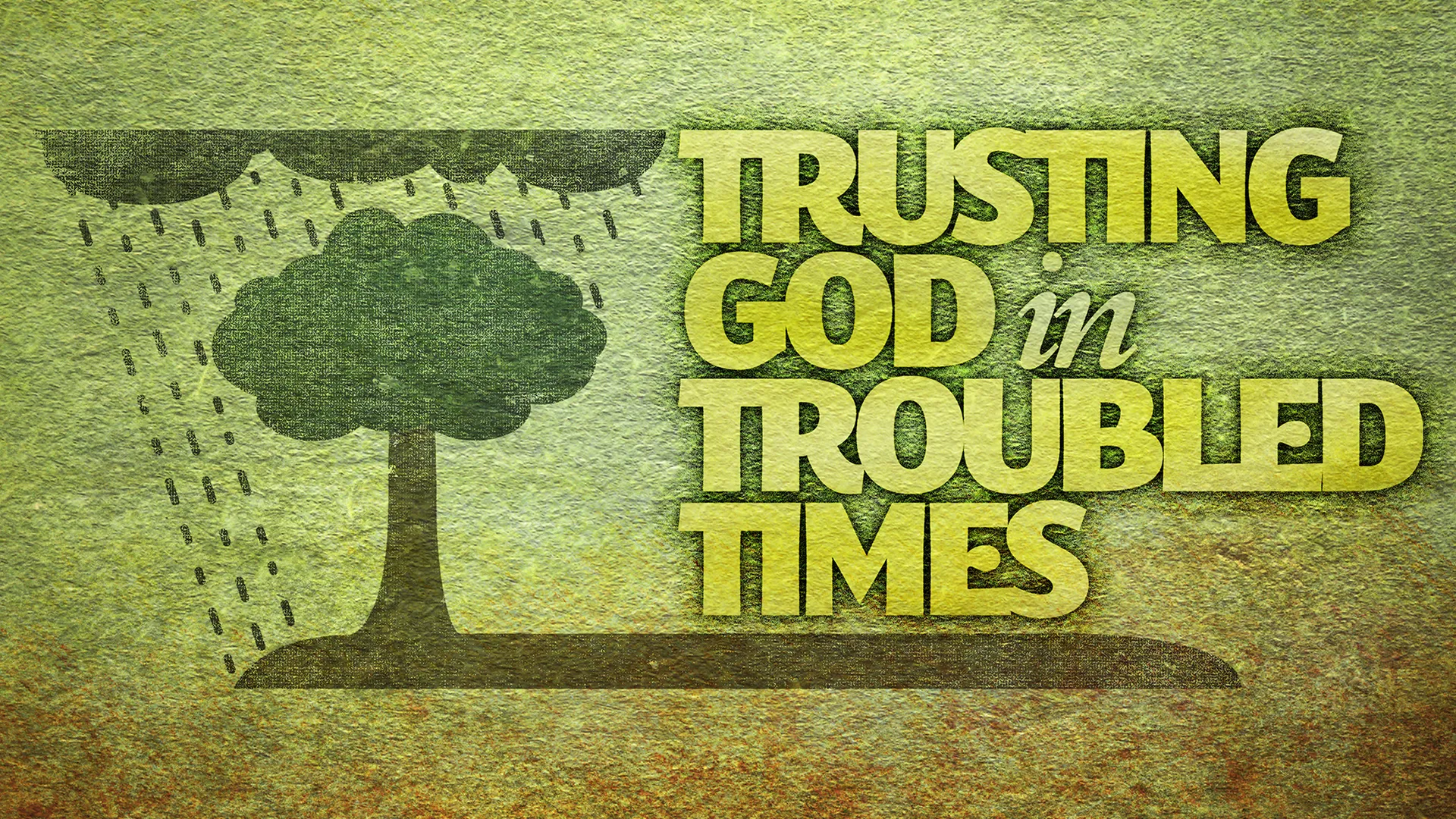
We are kicking off a brand new message series called Trusting God in Troubled Times, and I would imagine that most if not all of us here today would like to have the kind of faith that can withstand whatever life throws at us. I mean, who makes it their goal to have weak faith, right? Or says, you know, God, I want to trust you a little. I reserve the right to cave at the first sight of trouble. I mean, nobody does that. But tough faith, the kind that can withstand whatever life throws at us, doesn't exactly fall out of the sky either. That's why today I want to share why I think that trust is something you build.
You might want to get out those message notes if you haven't already, and I would like to be totally clear, as clear as I can be about something: it is only by God's grace that you or I are willing or able to trust God—only by His grace. The last thing that I would want you to walk out of here with is the idea that trusting God simply comes down to knuckling down and trying harder. But again, it's not like we're just passive participants; we're not robots. We make choices every day that either build our trust muscles or weaken them. I mean, this dynamic between God's grace and our response—does that make sense?
Okay, that said, show of hands: how many of you remember Giants pitcher Dave Dravecki? Remember him? Great guy. Then you also remember when he lost his arm to cancer. It was right around the time we had the big earthquake, and it was kind of a wild time, like it seems like it always is. Well, raise your hand if you were here when he spoke a couple of years later right at Twin Lakes Church. You would remember that was ten years ago exactly this week. Dave was just such a great speaker and a dynamic personality. In fact, some of us had the privilege of taking him to lunch after he spoke here, and I was just impressed with him all the more. I mean, cancer may have taken away his arm, but it certainly didn't take away his sense of humor or his upbeat outlook on life. He was just a genuine guy.
I remember thinking at the time when we were talking with him—I never said this to him directly—but I remember thinking to myself, I wonder how I would respond if something like that happened to me. You ever do that? Ever ask yourself how would it affect my faith if the other shoe were to drop in my life? I think that's something that the young ask themselves because, sooner or later, pain and suffering touches down in all of our lives, and we find out. For us, it happened just a couple of months later when my wife and I, expecting our second son to be born, discovered that he died in my wife's womb just two to three weeks before his expected birth. I can't believe that was ten years ago; it just has flown by. So many of you were here then as well, and you grieved with us. Laura and I will never forget how much you loved us as a church and how much you supported us. Such a vivid memory of that.
I think part of my surprise over the fact that ten years has passed is due to the fact that those memories are still so vivid. I'm sure for you, you have painful memories as well that have burned themselves into your memory, and it seems like it just happened yesterday. One of the things that I remember so well about that experience in our lives is how a couple of passages of Scripture, in fact, just jumped right out of the Bible. It was as if we were living them in those moments. One of them is in Matthew 7, where Jesus talks about how we can build our lives on one of two different kinds of foundations: on the rock or the sand. We're not going to spend a lot of time there, but I would like to read that for you. It starts in verse 24:
“Therefore everyone who hears these words of mine and puts them into practice is like a wise man who built his house on the rock. The rain came down, the streams rose, and the winds blew and beat against that house, yet it did not fall because it had its foundation on the rock. But everyone who hears these words of mine and does not put them into practice is like a foolish man who built his house on sand. The rain came down, the streams rose, and the winds blew and beat against that house, and it fell with a great crash.”
Now, I am not claiming to be wise or a spiritual giant—far from it—but when our baby was stillborn, it revealed our foundation, plain and simple. There was no avoiding it. What we discovered in that moment was that there was, in fact, a foundation there supporting us that brought us through that storm. That experience not only reminded me of how incredibly important our foundation is—what we believe, what we value—but it also points to a very fundamental truth. Because if there is one thing that you and I can trust in life, it's this: storms will come. Storms are going to come, and I don't have to convince you of this; you know this as well as I do.
So storms are the given in the parable that Jesus shares in Matthew 7. For some of you, this is where the hang-up is right here because perhaps God has allowed too many storms to enter into your life, at least to your way of thinking, or into the life of someone that you love. You wonder if God can be trusted at all. If you're in that place this morning, if that's where you're at, I want to first of all say I'm so glad that you are here, and I trust that God will continue to work with you in that area of your life. I've included on page two of your notes the titles and dates of a number of messages that were given by either René or myself that address the issues of pain and suffering directly. They're listed there where it says resources, and you can just go to our website TLC.org, find those dates—it's the easiest way to do it—and then the title. Click on those; you can listen or watch for free.
But today, I'm not going to deal so much with the philosophical issues—we've done that on a number of occasions—that are related to evil and suffering. Today, I want to focus on the practical sides because we obviously can't keep storms from entering into our lives, but there is something we can do to lay a foundation that will help us, in fact, support us when those storms blow in. So for the remaining minutes, I would like to look at just a couple of things that we can do to invest in a foundation of faith that will support you in troubled times. We've got the next several weeks to flesh all of this out, but here's a crash course—something I like to call Trusting God 101.
A prime example is the case of the Thessalonian Christians. You might not even be aware of this group of amazing believers, but when it comes to trusting God, the Thessalonians were model believers—amazing, you'll see. But really, they were just people just like you and I, no different. In fact, they lived in a city called Thessalonica that was about 200,000 people—kind of like Santa Cruz County. But here's an amazing difference: prior to when Paul and Silas arrived in Thessalonica, there were probably few, if any, Christians there at all. Then Paul and Silas initiated this little evangelistic crusade, and in Acts 17, it says that Paul preached on three consecutive weekends, three Sabbaths, and people were coming to faith in droves over the course of those three weeks. So much so that a mob forms that's opposing Paul, opposing his message, and they literally chase Paul right out of town. He has to run for his life. In fact, this mob is so worked up that they chase him to the next town, and he's got to flee from there as well.
So picture this: this brand new church in Thessalonica is all of three weeks old, and suddenly their senior pastor has to flee. He's gone, and so is the associate pastor, Silas. Now, adding to this, these Thessalonians were living under Roman rule; they were in a completely pagan culture. With Paul and Silas gone, the only people left to persecute are these baby Christians, and they did. Now, what kind of odds would you put on the success of this church? I mean, every reasonable expectation would be that they would just close up shop and pretend like Paul and Silas never came by preaching the gospel. I mean, Jesus—who? Never heard of them. Meanwhile, Paul is going crazy wondering what has become of these little baby Christians that he led to the Lord, that he prayed with. Finally, he's able to send Timothy, and Timothy comes back with a glowing report. I mean, they're not just surviving; they are thriving.
So when Paul gets an opportunity to write them his first letter, he is, in theological terms, completely stoked. I mean, he is just so happy. Starting in 1 Thessalonians 1:2, which you can find in here on page 835 in those pew Bibles or 810 in venue—good morning to all you in venue—1 Thessalonians 1:2: “We always thank God for all of you and continually mention you in our prayers. We remember before our God and Father your work produced by faith, your labor prompted by love, and your endurance inspired by hope in our Lord Jesus Christ.” Now, before we go any further, circle those words: faith, love, and hope.
I find this fascinating because that same combination of words, that triad between faith, love, and hope, appears in about a half a dozen other passages in the New Testament. It's fascinating to me. Some are written by Paul; for example, perhaps the best-known one is in 1 Corinthians 13, where it says the three most important things to have are faith, hope, and love. Here's another example from Paul in Colossians: “We have heard of your faith in Christ Jesus and the love you have for all God's people—the faith and love that spring from the hope stored up for you in heaven and about which you have already heard in the true message of the gospel.”
Now, I've listed a couple of other examples in your notes, and you might be thinking to yourself, well, what does this have to do with trust? Well, it turns out everything. Because in every single one of those instances—and I invite you to look this up for yourself—the context is either where we place our trust or how trust is lived out. Here with the Thessalonian Christians, it was their faith that produced their work, their acts of service and ministry. Their love prompted their labors; they were willing to bear the burdens of each other because of their love. Now, do you think that inspired greater trust that God was real, that God was working in their midst? You better believe it. Their hope inspired endurance, even in the midst of very troubled times. In other words, it all adds up to trust in action.
So if we are going to build our trust in God, it's going to happen in these same three areas: faith, love, and hope. That's the foundation. We think of trust like a three-legged stool, and the trust rests on these three legs: faith, love, and hope. So along these lines, I want to ask three foundational questions that are going to help us gauge where we are in terms of these three pillars. I hope that you won't just write these down but that you'll really think today and this week about whether or not these foundational qualities, or graces you might call them, are active in your life.
The first one is this: where do I place my ultimate faith? Where do I place my ultimate faith? What is the bedrock of your life? What matters more to you than anything else? Sometimes people say, well, as long as you have your health, that's all that matters. Well, being healthy is certainly a blessing and nothing to be taken for granted, but what happens if you don't have your health? Do you still matter? Can your life still have meaning and purpose? Can you still have joy? Or again, people will say family comes first, and family certainly should be one of our top priorities. I have a family that I love more than I can even begin to express, but if you put your ultimate faith in family, you're going to find that that foundation is sometimes shaky—maybe shaky a lot. If nothing else, you will find that it is always temporary. The same is obviously true of wealth, success, prestige, pleasure. There's got to be something more enduring than these foundations.
So look what Paul says about the foundation that was laid in Thessalonica, verses four and five: “For we know, brothers and sisters loved by God, that he has chosen you because our gospel came to you not simply with words but also with power, with the Holy Spirit and deep conviction.” Now remember, Paul had to flee after just three weeks, so when he hears how genuine their faith is, he can only conclude, you know, they're the real deal. There's only one explanation for the transformation that occurred there: God has chosen them. The gospel has become a reality; the good news about Christ is taking hold in their hearts and lives. I think this is where Paul's own faith comes in because when Paul arrives and starts telling them about the new life that they can have in Jesus Christ, it was with power, with the Holy Spirit, and with conviction. Paul didn't think a whole lot about his preaching talent, by the way, but he had ultimate confidence in the reality of Jesus Christ, and that was unmistakable to the Thessalonians. That's why I think he had such a huge impact.
There's no way that anybody can trust in God to that degree unless they take His word seriously. So Paul says, man, I was preaching to you the Word of God. I wasn't just making this stuff up. And he wasn't alone. Look what he says in chapter 2, verse 11: “When you received the Word of God, which you heard from us, you accepted it not as a human word but as it actually is, the Word of God, which is indeed at work in you who believe.” Here's the bottom line: if we want to have the same kind of faith the Thessalonians have, then we have to have the same attitude towards God's Word that the Thessalonians had. Trusting God's Word is always going to take us out of our comfort zone, you know what I mean? We're always going to feel a little bit stretched, and that's why faith is involved. Because when God's Word comes into our lives, we're challenged by it. We realize that we've got to make some changes.
For the Thessalonians, it meant turning away from their pagan religions; it meant really changing wholesale things in their lives, the previous way of living. For us, when we place our faith and trust in God and we take His word seriously, inevitably, there's going to be changes too as God comes in and says, that's not the way I want you to live anymore. That's all part of trusting God.
Laura, the kids, and I had an opportunity to experience a little different kind of trust exercise this past week, but it relates, I think, to what we're talking about this morning. We were up in Yosemite this past couple of days, and my kids, my boys in particular, wanted to experience a lesser-known attraction in Yosemite. They wanted to go through what's called the spider cave. Anyone aware of the spider cave? You know, it's a pretty well-kept secret. It's just a stone's throw away from that main path that takes you right up to the lower Yosemite Falls. We knew about this cave, and so we're checking it out. There happened to be a group of sixth graders that were being led through as part of their outdoor science class or something like that, so we figured it couldn't be too treacherous, although there was a teacher there that was trying to dissuade us. I think he didn't want us to ruin their experience, so he pretty much described it like a death trap. But you can't tell us Burlock not to do something and think that they'll take heed of that.
So the next day, my boys and I and our daughter, armed with a flashlight and a cell phone camera—I can't say we had the phone that was any good to us—but we decided to go on a little expedition. So I'm going to ask that we lower the lights so that you can get a sense of what it feels like to enter the spider cave. There's the entrance, and here's Luke descending into the abyss. There's my little daughter Anna as well, and up in front, Jack, the expedition leader, has the flashlight—all of 11 but quite capable. Patiently, I'm taking up the rear with the camera documenting all of this, and my wife Laura, who is no fan of dark, confining spaces—she's kind of quasi-claustrophobic—was more than happy to just sit outside and watch the backpack. So we go through—no problem, no incidents. In fact, we decide, let's do it again, this time without a flashlight, and that was even more cool because it is just pitch black. This, by the way, what you're seeing is with the full flash. I mean, without a flash, you can't see; you're just like, I can't see anything.
But you get about halfway through, and then you see the proverbial light at the end of the tunnel, and you just crawl through that. The kids are all excited as they come out the other side at the exit, and again, Laura is more than happy just to stay outside while we kind of go laps through this spider cave. But the kids go, come on, Mom, come with us. You know, they're just working on her. Even though, again, this is like the last thing on earth that she would want to do—you know, go under a couple million tons of granite in the pitch black and worm your way through this place—somehow they managed to convince her. They evangelized her, is what they really did, and they converted her. So she agrees, and here's Laura now taking the plunge. You can see how excited she is.
Again, these pictures don't do justice because you just can't see anything when the flash goes off. The only thing that Laura could do once she got in there is trust Jack's voice, who was ahead of her. In fact, she put her full faith in him, which led to really hope based on the fact that he loves her and he wouldn't leave her in the lurch. You know, a few minutes later, she sees the light at the end of the tunnel for herself, and here she comes out. There's that light right there. Here she comes out. See, she's a changed woman—big smile on her face. I neglected to tell Laura that right before you get to the end, you look through that little window that provides the light back up, and it's completely covered with spider webs. That's when you realize, oh, that's why they call it the spider cave. Now I get it. That somehow was omitted from our pitch to Laura to go with us.
But that's basically what God asks us to do, right? To follow Him, to trust His voice, to go where He leads us. You may be well down that path, and so this affirms what you already know. In fact, I'm betting that He's already brought you through a couple of dark and scary caves. But it's in those caves that you learn to trust Him more, didn't you? Trust Him in ways you never would have otherwise. But if you've never placed your ultimate faith in Jesus Christ, perhaps that's why He has you here this morning: so that you could ponder what life would look like if it was resting on a foundation other than you and your strength and your goodness, however you might measure that. Rather, what a life founded on Jesus Christ might look like—upon His strength, upon His perfection, His goodness—makes a huge difference.
The second foundational question to ask ourselves is: who or what do I love most? One time, a journalist was doing a story on Mother Teresa, and after spending some time with her, the journalist says, no offense, but pulling dying people out of the sewers? I wouldn't do that for all the money in the world. Mother Teresa replies to him, neither would I. I do it because in their faces, I see the face of Jesus, who did this for me. See, just like the Thessalonians, Mother Teresa was motivated out of her love for Jesus. When we love Jesus, we can't help but love others. In fact, Paul says elsewhere in 1 Corinthians 13 that we can have so much faith that we could move mountains; we could have the greatest faith in the world, but if we don't have love, we are nothing. Our faith is defective.
I find this incredibly challenging because when I think about these three areas of faith, love, and hope, this is where I'm the weakest—no question, right here. What this reveals about me is that probably I love my own comfort or being in control of my circumstances more than people sometimes, or maybe much of the time. Because people often get in the way of our sense of control, or they mess up our circumstances, right? Because people come with their own agendas; they're unpredictable; they've got their own problems. My instinct is to withdraw, and I'm not saying this to be a martyr; I'm just telling you because it's the truth. If you don't believe me, just ask the people that I've counseled on. They'll vouch for me on that one. You know, they learn really quickly: pastoral counseling is free.
But by way of contrast, look what it says in these next verses, chapter 1, verses 5 and 6: “You know how we lived among you for your sake. You became imitators of us and of the Lord, for you welcomed the message in the midst of severe suffering with the joy given by the Holy Spirit.” You know, Paul didn't just show up and preach on the weekends; he lived with the folks. He rubbed shoulders with them; they hung out so much so that it was just natural for the Thessalonians to start imitating him. In fact, they even imitated him after he was gone. Despite their sufferings, that couldn't dissuade them. It's amazing. So he continues, chapter 2, verse 6: “So we cared for you because we loved you so much. We were delighted to share with you not only the gospel of God but our lives as well.”
We've got a pastor on staff who has made this verse right here, 1 Thessalonians 2:8, his life verse—Dave Hicks. As long as I've known him, this has been foundational for Dave. “We were delighted to share with you not only the gospel but our lives as well.” That's why just about every single Monday night of the year, Dave is here with a recovery group sharing his life. That's why every Wednesday night, Dave is here sharing his life. That's why he said every man can share his life. How much does that look in your life? Well, maybe you see a pile of laundry stacking up, and the neighbor kids are there undoing every effort that you've made to keep the house clean. Yet you make it a priority to make those kids feel welcome because you know you don't want to just share the message; you want to share your life as well.
Or you have a co-worker who drives everyone else in the workplace crazy, and so most people just avoid this person because that's the easiest thing to do. But you step out of your comfort zone, and you try to reach out to this person because you trust that God wants you to have an impact in this person's life, and you have a burden for them. So out of love for Jesus, you're willing to share not just the message but your life. It's like the old saying: nobody cares how much you know until they know how much you care. When we devote our lives to others and serve them as we would serve the Lord, a strange thing happens to us: it centers us, it matures us, and lo and behold, we find our lives becoming more substantive and less shallow. Let me think about it: can you or I build our lives on anything more meaningful than the kind of love that God calls us to? Is there anything more enduring than that?
So if you want a foundation that will never fail and the joy and peace that comes with that, then ask yourself again: what do I love most? What do I believe most? And finally, what is my vision of the finish? The Thessalonian Christians were like black belts in their ability to trust, and again, despite all the odds against them, what kept them going? What was their secret? Paul says they had endurance inspired by hope in our Lord Jesus Christ, and this is key to the entire equation. Because we all get weary; we all get beaten down. But when you have a vision of something better, when you know your efforts are leading to a future, man, it's amazing what you will endure, how that fuels your motivation.
I read an amazing story, if it was a familiar story, about the power of having hope and a vision of the finish. You might remember this, but in 1981, a businessman named Eugene Lang returned to PS 121, the elementary school he had attended in East Harlem some 50 years earlier, to address a class of graduating sixth graders. He had been there in like 1930; he's there in 1981. Lang, who is a successful entrepreneur, intended to tell the students, work hard and you'll succeed. Those very students you're seeing on the screen right behind me. But on his way up to the podium, the school principal tells Lang that three-quarters of the school students would probably never finish high school, prompting Lang to make an impromptu change to his speech. He promised college tuition to every sixth grader who stayed in high school and graduated.
Lang told the class about witnessing Martin Luther King's famous “I have a dream” speech at the 1963 March on Washington. He urged the students to dream their own dreams and promised to do all that he could do to help them achieve them. Well, as he got to know these kids, whom he called his dreamers, Lang realized that he needed more help than he could give to all 61 of them on his own. So he hired a full-time coordinator and enlisted the support of a local community-based organization to support the children through their high school graduation. By August of 1985, all of Lang's dreamers were still in school. A front-page story in the New York Times and a piece on 60 Minutes led to widespread national attention. In 1986, Lang formed the National I Have a Dream Foundation, which now supports thousands of students.
But what about Lang's original 61 dreamers? Well, of the 54 that stayed in contact, 90% earned high school diplomas or GED certificates, and 60% pursued higher education. Almost all of the PS 121 sixth graders are living lives well beyond what they or anyone else ever dreamed. What an amazing story of the power of having a vision of the finish. But you know what? You and I have something even better than a dream; we have a future that is guaranteed by Jesus Christ.
You know, I mentioned at the beginning about the loss of our son and how that caused Matthew 7, the parable of the foundation, to just pop into my brain. But there was another one, another passage that came at perhaps the most difficult time in that entire experience. It happened when Laura was laboring to deliver a baby that we knew we had already lost. Those of you who are fathers, you know that perhaps you're never more proud of your wife than to see her delivering your child. I've had that privilege four times; I was never more proud than with Joseph and Laura's courage. But as her contractions intensified and the moment was drawing near, I'm looking down at her, holding her hand, and then the words of the Apostle Paul from 2 Corinthians 4:9 just exploded into my brain: “We are struck down but not destroyed.” We were struck down; it felt like a truck had just run us over. But I knew we would not be destroyed because there was a foundation there.
I have to tell you, we weren't trying to be anything but what we were in the moment. One of the most amazing things about this church is you gave us permission to grieve, and so we weren't trying to be heroic; we weren't trying to be examples of faith. We were simply being who we were in the moment, but God was giving us peace and encouragement and strength that was completely from Him. Part of that was based on a vision of the finish because we believed in that moment—and we believe it to this day—that someday we will see that child again, and we're going to see Jesus. I mean, that's my vision of the finish. In that moment, Jesus Christ is going to say, “Welcome home, Mark. We have been looking forward to your arrival—every single one of us, especially Him, your son Joseph.”
When you have that kind of vision of the finish, that kind of hope, it'll allow you to trust God in the daily circumstances of life. It'll allow you to trust God even in the hard circumstances of life. That's why Paul says to the Thessalonian Christians, “You guys did so well. In fact, you became a model to all the believers in Macedonia and Achaia. The Lord's message rang out from you; your faith in God has become known everywhere, even here.” That's the kind of faith that I want to have, and I trust that's the faith that you want to have, where the message of Christ rings out and we are known for trusting God even in troubled times.
Would you pray with me towards that end? Let's come before the throne of God. Heavenly Father, we thank you so much for your sustaining grace in our lives. We realize, Lord, in a moment how helpless we actually are. So, Father, I pray for every single person here in this room, in venue, anyone who might be hearing my voice in some way, that Lord, by your Holy Spirit, you would enter into their lives with power and give them a deep conviction of the reality of who you are and that you can be trusted. So, Father, that's my simple prayer. I pray that you would strengthen our faith this morning. Lord, I pray that you would fill us with love—love that comes first from you, but then flows from our lives and touches others. And God, give us endurance that is inspired by hope, hope of a glorious finish when we see you face to face and there is a grand reunion of all of God's people. Lord, we thank you for all of these things. May you strengthen the faith of each one of us today. In Jesus Christ, we pray, amen.
Sermones
Únase a nosotros este domingo en Twin Lakes Church para una comunidad auténtica, un culto poderoso y un lugar al que pertenecer.