Good News of Great Favor
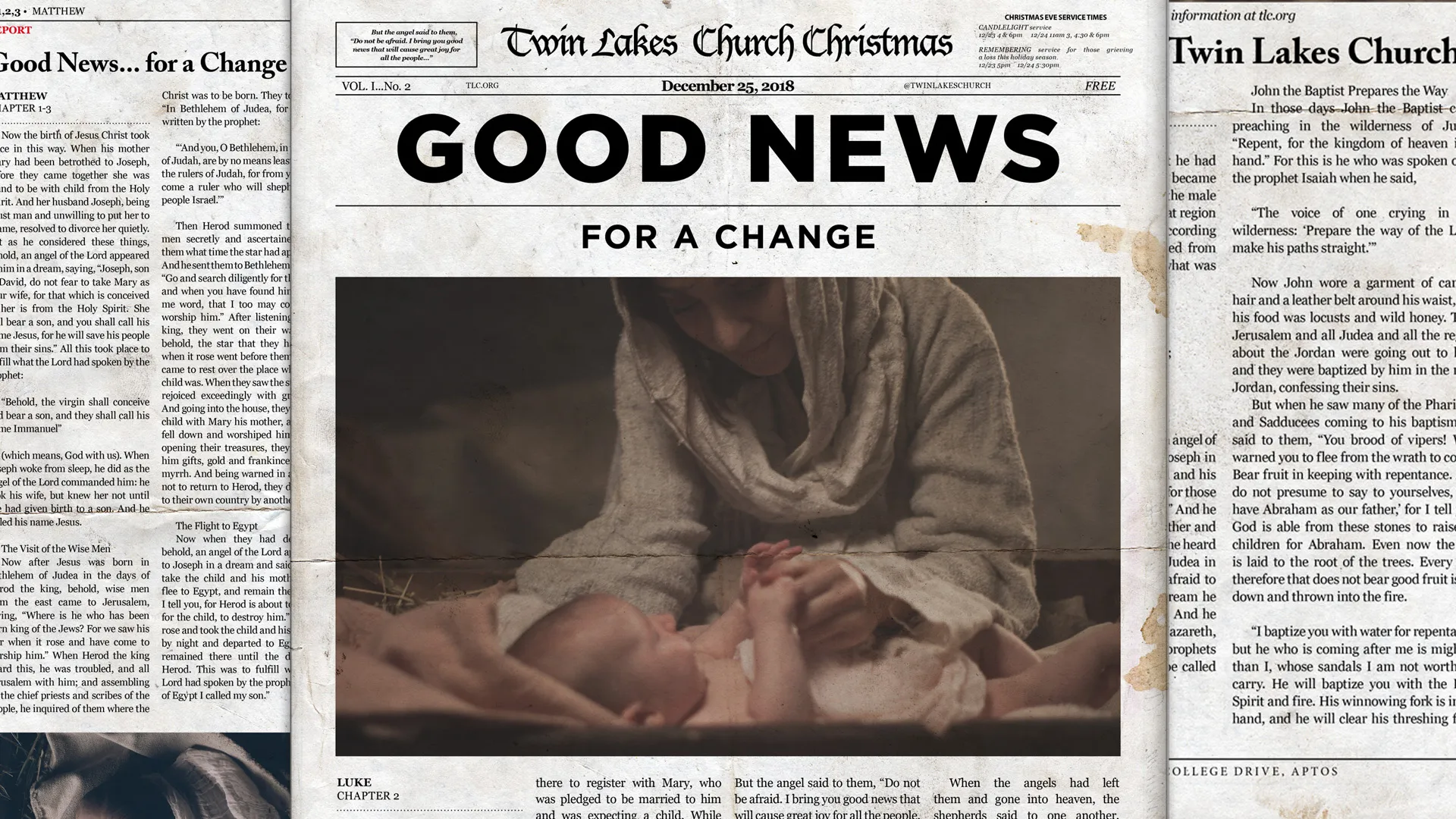
Exploring the unexpected favor of God through the Christmas story.
Transcripción
This transcript was generated automatically. There may be errors. Refer to the video and/or audio for accuracy.
My name is Adrian, one of the pastors here, and usually I'm up here for just like two minutes; they let me talk, but today I get a little longer. Welcome to Twin Lakes Church! If you're here live in the Auditorium next door in venue, maybe joining us on Facebook Live or sometime in the future from TLC.org and your flying car or whatever that is, welcome! Glad you're here. When I get extra time to talk, I like to sort of give you an update on my family and to introduce myself.
So this is us on Thanksgiving Day. That's me on the left, by the way, with the beard. Anyway, to my wife on the right, this is Jamie. We've been married 13 years, and it's her birthday today. She's not here right now, but happy birthday! If you're watching, she is very young. That is our seven-and-a-half-year-old Ella, who's in second grade here at TLC, and then our five-year-old Penelope, who's in preschool here. We appreciate your prayers anytime you see us or think of us; we need them.
Well, the other day I came across this quote by the famous philosopher Charlie Brown, and it says, "I think I'm afraid to be happy because whenever I get too happy, something bad always happens." Have you ever felt that way? Good news comes your way, and you get a little suspicious, like, "Hmm, what's going to happen now?" You're kind of waiting for the other shoe to drop. Or maybe you're like me, and good news comes in the form of a compliment, and you have a hard time receiving that. Does anybody have a hard time receiving a compliment? Alright, just me.
If you've attended Twin Lakes Church for any time or have known me for any time, or for the last few years, I've gone through a little bit of a transformation physically. This is a picture of me a few years ago. This is actually on my honeymoon. A few years ago, I had a little health scare, and so I thought, "I'm going to get my act together," and went on this journey of health and fitness. So this is me today. We all—thanks! Yeah, thank you. Hope I just need more applause in my life.
But understandably, people will come up to me, especially because I'm up here, and they'll say lots of different things, mostly nice. It's taken a while for me to just simply say thank you. When people would come up and say something like, "Oh, you're looking great," or "healthy," or "I'm proud of you," I'd always come back with something like, "Well, you know, dark clothes really thin a person," or "Hope it's nice that it's dark in here," or "Don't catch me at the beach." Some self-deprecating thing because of something going on inside of me. I think that goes on inside a lot of us, inside of Charlie Brown, and it's the thought that I'm not good enough or I'm not special enough or I don't have enough or this thing that I've done isn't going to stick. It's like New Year's resolutions are coming up, and a lot of people don't tell anybody just in case, right?
That thought process, thinking that way, can affect the way we see ourselves in relationship to God. We start to think and ask, "Oh, if God only knew. If God could only see what's going on in my heart and in my mind and in my life." We begin to think, "I'm not good enough to be accepted, to be loved by God. I'm not special enough to be used by God." And listen, we can arrive at that place. We can get to those thoughts for lots of different reasons, like low self-esteem from whatever, you know, growing up. A lot of us blame our parents, but whoever you want to blame. But we get to that place because maybe people have told you, "You're not good enough, and you're not special enough," or maybe you have some trauma in your life or a history of letdowns or a history of bad news, or you've gone through an illness or you're going through one right now. The list can go on and on, and we can think there's something wrong with us.
Well, if that describes how you feel, I want to encourage you that you're not alone. Not only do people in this room and around the world sympathize and empathize with you, but the story—the character in the story we're going to look at today—felt the same way. We heard the Nettles family read the passage earlier about Mary, and we're going to look at her story. Her story is a story of someone who receives some good news but has a hard time believing it. So we're going to take a look at that. Take out your message notes that are in the bulletin that you got when you walked in if you'd like to take notes.
Today we're going to look at the amazing message Mary receives that God wants to tell you today, and it's good news of great favor. Like I said, we heard the passage already read. What I'm going to do right now is walk through that passage sort of section by section and unpack what we see going on with Mary in this interaction she has with this angel. What we're going to see is that she comes up against three obstacles, and these are three obstacles that you and I face when receiving good news of great favor.
We'll start in Luke 1:26. If you want to open your Bible there or your app, or it's right in your notes, also on the screen. It's everywhere. Okay, here we go. In the sixth month, the angel Gabriel was sent from God to a city of Galilee named Nazareth, to a virgin betrothed to a man whose name was Joseph, of the house of David. And the virgin's name was Mary. And he came to her and said, "Greetings, O favored one! The Lord is with you." But she was greatly troubled at the saying and tried to discern what sort of greeting this might be. And the angel said to her, "Do not be afraid, Mary, for you have found favor with God."
So Gabriel kicks off this meeting between him and Mary in this epic way. He says, "Greetings, O favored one! The Lord is with you." He tells her, "You're favored. The Lord is with you." That sounds really good, right? I would like to hear that. But then there's something wrong. This amazing greeting Mary receives, but it says she was greatly troubled. What was causing this trouble? As we look at trying to find out why she's feeling this way, I think it's important to look at not only this story but the story before it. If you were here last week, Mark preached a great message on Zechariah. If you missed it, you can listen to that one and all of our messages forever on our website TLC.org on your app. Definitely check that out.
But the interesting thing is Luke writes these two stories back to back, and I think it's because he wants you to sort of compare them because they are parallel stories. Gabriel, the same angel, comes to these two people, Zechariah and Mary. They both react kind of freaked out, and then he calms them down and tells them some good news. They both have some questions, and he responds to them again. Some things happen, and they both sing a song at the end. It's like the same story but with some really important differences. Zechariah, last week, is freaked out by this angel that just appears out of nowhere. He's in the temple, and poof! There's this floating, glowing angel, and he's scared, and Gabriel has to calm him down.
So is Mary troubled because of who's in front of her, this majestic angel? No. If you look at what it says, it says that she was troubled at not who was telling her this message but what Gabriel said to her. She was greatly troubled at the saying and tried to discern what sort of greeting this would be. "Favored one? Who, me?" How could this message be for me? And here's where we get to our first obstacle. The first obstacle when receiving good news of great favor is, "I am not qualified." It's because she doesn't think she deserves this honor. She can't imagine why she would be greeted this way. As we read this passage, we get a glimpse into why she kind of arrives at that thought, at that fact.
The first thing we see is she's thinking about where she's from. In the beginning of this book, Luke describes the setting of the story and says that she is in a city of Galilee named Nazareth. She's in a no-place town that people didn't really know about. Historians say there's about two to three hundred people living in Nazareth, so the word "city" is sort of a generous word to use here. It's more like a town or a village. If you look at the way that it's described, a city of Galilee named Nazareth, why does he do that? It's like when I—I'm not—we're not a written. My wife and I moved here 12 years ago, so we're not locals. My kids are locals, so maybe we kind of ask by osmosis we claim that so we don't get beat up. We're not from the valley; we're from the East. I don't know if being from the East Coast is better or worse, but anyways, we were from Florida. When we first moved here, people would ask, "Oh, where are you working? Where do you live?" And I would say, "Oh, we live in Aptos," and they'd say, "What is that?" I'm like, "Oh, that's in Santa Cruz." "Where is that?" I'm like, "It's 35 minutes south of San Jose on a good day." What does that mean? And then I have to go down the list until I got to a city that they knew, like, "We're an hour and a half south of San Francisco." Okay, I got it. That's the same idea here—Nazareth—because Luke is writing this letter for everybody to read, and he knows that people haven't heard of this place. So he tries to orient them. You might not have heard of Nazareth, but I know you know Galilee; it's in there somewhere.
So she's from this no-place town that people will know, and if people knew about Nazareth, they did not think highly of it. We see this in the next book of the Bible, the Gospel of John, in the first chapter. He's describing when Jesus calls his disciples, and he's calling all these guys, "Hey, come follow me!" And this one guy, Philip, is like, "Oh, this is the guy! The Messiah is here! I'm going to go tell other people; let's go follow him!" And so we read in John 1 where he goes and tells this guy Nathaniel, "Watch this!" Philip went to look for Nathaniel and told him, "We have found the very person Moses and the prophets wrote about. His name is Jesus, the son of Joseph from Nazareth." "Nazareth!" exclaimed Nathaniel. "Can anything good come from Nazareth?" I feel like Philip's a little annoyed here because he's like, "Did you not hear the other part of not where he's from but who he is? He's like, 'Come and see for yourself!'
So if people didn't know about it, and if they did know about it, nothing good comes from Nazareth. So where she's from. The second thing that she thinks about is her gender. I don't have to tell you this, but you know women at that time weren't seen as equals; they were seen as a lesser sex, the lesser gender. I mean, if we're honest, we're not where we should be today, but at that time, women couldn't vote; it's a given. Women couldn't give their testimony in court because their word couldn't be trusted. Women were seen outside of the home, and if they were seen out, they had to cover themselves; they couldn't speak to other men. In fact, they were owned by the men in their lives, first by their fathers and then eventually transferred over to their husbands.
So I'm a woman from this no-place Nazareth, and then third, we find out her age. Luke says that she's betrothed to Joseph, or engaged, and at that time, where we are in the world, women or girls got betrothed around the age of 13. So Mary is this 13-year-old girl from Nazareth, and she thinks to herself, "Mr. Angel, you have the wrong house. You're in the wrong town. What do you mean I'm favored?" How does Gabriel respond to her trouble? He tells her, "Don't be afraid, you have found favor with God." It's interesting because the first greeting is, "You are highly favored; the Lord is with you." And then she's troubled, and basically he just repeats himself, "You are favored." I think what Gabriel is trying to do with Mary is to shift the focus off of herself because she's thinking about why would I receive this and to shift her focus to God.
But to better understand this, you know, to better understand these words, I think we have to look at the original language, the Greek. In the Greek, this word for favor or highly favored is the Greek word karatahō. Mark told me how to say this because it looks like cherry, but it's karatahō, and you Greek people in here, I don't want to offend you. The definition is to be kind or to be gracious, but in this specific instance, it's to be on the receiving end of God's grace. Now, I don't know about you, but when I've read this story and I see these words, you know, "You are highly favored," or even now this grace that God has bestowed upon her, I think, "Oh, is this like special grace that only is for Mary? Is there something about Mary that I don't know about, something special? Is there something she has on me, something more?"
I think, "Oh, of course God uses Mary because she has something special," but not me. But then a way we can really try to pull what the definition really means is we look at other instances in the Bible where this word karatahō is used, and we find it in only one other place in the book of Ephesians. Paul is writing to the church in Ephesus, and in his greeting, he uses the verb karatahō. Ephesians 1:6, watch this: "So we praise God for the glorious grace He has poured out on us who belong to His dear Son." This same word karatahō is grace He has poured out on us. This word, this greeting, this favor is talking about God's grace for all.
Because this is the truth, Church: grace comes to you, grace came to Mary, and it comes to us because of His love. Even when you feel unqualified, He isn't compelled by something you've done, where you're from, what you look like; His grace comes to us freely. So Gabriel helps her get over that first obstacle, and then we move on to our next, continuing in verse 31. "And behold, you will conceive in your womb and bear a son, and you shall call his name Jesus. He will be great and will be called the Son of the Most High, and the Lord God will give to him the throne of his father David, and he will reign over the house of Jacob forever, and of his kingdom there will be no end." We're going to pause right there. There is a lot going on right here.
Mary was troubled by, like, "Hello, you are favored!" Now Gabriel drops this crazy thing on her: "You are going to become pregnant." Okay, this baby will be the Messiah that has been prophesied for years, and he will be the Son of the Most High, and his kingdom will never end. She's like, "What?" How does she respond? I think like many of us would. Verse 34: "And Mary said to the angel, 'How will this be, since I am a virgin?'" This is what she's asking; this is what she's thinking. I don't think I can do that. She's saying, "I don't think I can handle that. I'm not married yet. I haven't had sex with my husband. I mean, is the Son of God going to be a normal-sized baby? How big is this baby? I don't think I'm going to be able to handle it. I don't think I have what it takes." We get to our second obstacle when good news of great favor comes our way: we think, or I can think, "I am not capable." How many of you have ever felt that way? I know I have. "I can't believe I can't serve. I don't know enough. I don't have enough. I'm incapable."
So we have Mary thinking that she doesn't have what it takes, and Gabriel responds to her like this in verse 35: "And the angel answered her, 'The Holy Spirit will come upon you, and the power of the Most High will overshadow you; therefore, the child to be born will be called holy, the Son of God.'" I want to take us back to the story before because now we have this section where good news has come, the person asks a question, and Gabriel responds. It's a little different than what happened last week in our story with Zechariah. Last week, Zechariah receives news that his wife is going to become pregnant, and they're in her old age, and she's barren, and this son that will be born is going to be great, and God will use him to lead the way for the Messiah.
Now, the way Zechariah responds to this news is he looks at Gabriel and says, "How's this going to happen? I don't think so. I don't know if I didn't light enough candles, but I'm super old. Maybe you can't see me and my wife. I mean, we're so old. I don't think that stuff's going to work. I mean, I don't think it's working anymore unless you can handle it. I mean, if this is really going to happen, you're going to have to give me some kind of sign." Now, I haven't spoken to an angel before, but I'm imagining Gabriel is annoyed because he's like, "He's an angel! He's like, 'Look, one of the angels!' And he comes and brings this message, and this guy is doubting him, doubting the Word of God." I'm imagining Gabriel responds to Zechariah, "Hey, do you not remember who I told you who I was? I'm Gabriel! I told you I was with God, and then I left to come here to talk to you! Remember just a second ago? Nobody was here, and well, I'm here! Not only that, I'm floating and I'm glowing! Have you ever talked to an angel before? Has an angel ever calmed down and talked to you? No, I don't think so!"
And then I imagine Zechariah is like, "Oh, no, no, I'm sorry!" And he was like, "You know what? Zip it! Zip! You know what? Don't talk anymore! Oh, you want a sign? You can't talk! Say something! There's your sign! And you know what? Don't say anything! The baby's coming out! When that baby comes out, then you can talk! I'm out of here!" Like, flies away. As Zechariah is like, "Whoa!" Okay, thank you. I thought I was talking to Renee and told him that story. He's a loss funny. Do you think Gabriel went to heaven and God was like, "A little harsh, Gabriel?" And he thinks, "Maybe on the next one, be a little more gentle. If she has any questions?"
So how does Mary—how does Gabriel respond to Mary's question? Way more gently. Gabriel takes the time to explain what's going to happen. So what was different? Gabriel—God—that we just made all that up, okay? I don't think—I don't know what God said or if Gabriel acted that way. But Mary's question was different than Zechariah's. Zechariah was saying, "I don't think this is not possible." Mary was asking, "How is this going to happen?" Not, "This can't happen." "How is this going to happen?" Because, again, I don't think I am—I can handle it. And Gabriel responds again by shifting her focus to God. He reassures her, "I know you don't have power; you don't have what it takes to do this on your own. God will be the source of that power." What does he say? He says, "The Holy Spirit will come upon you; the power of the Most High will surround you. And when that baby is born, he will be the Son of God because he came here not by human means but by God's power."
What Gabriel told Mary, what he's telling you and me today, is, "I know you don't have the strength. I know you're not capable. But listen, don't worry. I will give you the power. It starts with me." You know, and Gabriel doesn't end there. Zechariah asked for a sign; Mary doesn't, but Gabriel gives Mary one. Verse 36: "And behold, your relative Elizabeth in her old age has also conceived a son, and this is the sixth month with her who was called barren. For nothing will be impossible with God." Gabriel takes his explanation to Mary one step further because before he was just giving her information on how it's going to happen, how the Holy Spirit's going to come; he's going to make this happen. But then he takes it a step further because he understood she had one more obstacle to overcome. That brings us to our third one: when good news of great favor comes to you, obstacle number three is, "I still have questions." I still have questions.
What I appreciate about the story is Mary, right at this moment, isn't jumping for joy. She's not kicking down her door and telling her little no-name town, "The Son of God is coming to my house!" She's still processing. I mean, remember, she is a human 13-year-old girl, and God—Gabriel just told her this crazy story. So she's still processing it. And what I love is that Mary isn't chastised for her question. Gabriel doesn't tell her just to have faith; he embraces that question, and he encourages her to think. He encourages her to discover. Gabriel, after he tells her how it's going to happen, invites her to investigate further. He gives her a clue or a sign. He tells her, "Go talk, you know, your old aunt Elizabeth. She is pregnant, you know, she couldn't have a baby; she is pregnant. I want you to go and talk to her. Her husband is not going to say much, but just go over there." And he tells her, "She's six months pregnant." Why is that important? Because she's showing. She's not going to go show up, and Elizabeth's like, "Yeah, I'm pregnant." She's like, "Okay, but she's going to see this amazing miracle that God has done." And how does he end? He says, "Because nothing is impossible with God." Gabriel's telling her, "Yeah, I know this sounds out there, but not only is God going to be the power behind all of this, and he's going to be the way this is going to be accomplished through you, but he's going to help you process through it. He's going to help you with those questions you still have."
This part is so encouraging to me. When I became a Christian when I was 12, many years ago now, and I was a 12-year-old, I thought I knew everything, and I had 12 years of life, and so I'm like, "I know how the world works! I know everything!" And then I became a Christian, and I started reading the Bible and learning about God, and so I started to come up against what I believed before, and so I started to have questions. I would go to my pastor and my mentors at this church I was at, and I would ask, "Okay, if God is real and He is love, then what about this? How? Why is this happening?" Instead of my question being embraced, I was told, "You know what? How can you doubt God? You need to take that question and stuff it down or get it out of here. Jesus died on the cross for you; you can't just believe; just have faith." I'm like, "Okay." My left, and I was discouraged. I felt guilty.
But what we see today in Mary's story is that it is okay to have questions. It is okay to have doubts. God isn't scared by your doubts. But what we see in this story is don't stop there. When you have a question, when you have a doubt, because I'm telling you, even as a Christian, those things still come up. But when they come up, when those questions and those doubts come up, don't stop there. We're encouraged to investigate. God doesn't want you to throw away your intellect and your brain; use it! So many people have told me, "You just have to have faith and don't think." God gave me a brain; He gave me intellect; He gave me logic. And God wants you to embrace that and use that and investigate further because this is worth investigating. The good news of great favor for you is worth investigating.
I love Mary's story. It shows us that nothing is impossible with God. Your inadequacies, your incapabilities, your questions, your doubts—they aren't too much for God's powerful love and grace. Because this is the truth: God loves us, He calls us, He uses us. Because He is love, He can use whomever, whenever, and however He wants. I love how the theologian N.T. Wright says that in his commentary, "Luke for Everyone." He puts it like this, kind of summarizing what we've been talking about: "When He takes the initiative, God, it is always a matter of love—love which will care for us and take us up into His saving purposes. Mary is to that extent the supreme example of what always happens when God is at work by grace through human beings. God's power from the outside and the indwelling Spirit within together result in things being done which would have been unthinkable any other way. God makes what seems impossible possible."
So then now we get to Mary's response. Verse 38: "And Mary said, 'Behold, I am your servant. I am the servant of the Lord. Let it be to me according to your word.'" And the angel departed from her. Simple. She says, "I'm your servant." She's saying, "God, I'll do whatever you say. I'll go wherever you lead." And then she says, "Let it be to me according to your word." What she isn't saying is, "I get it all. I understand every single part of this. I know exactly how this can work." But she says, "I'm your servant," and I pray and I believe that what you say can happen. And so in Mary's response, I mean, Mary has the way we should respond. She's the perfect example of the way we respond to good news.
So how do we respond? We respond humbly. You know, next week you're going to have a really cool opportunity to experience something I think great. You know, Trent, like you heard in the announcement video, I wrote this mini-musical Christmas short story, and I want to really encourage you to come out. It's going to replace the sermon with Renee's narration and these songs, and we're going to look at different characters of the Christmas story, one of them being Mary. Trent sent me the lyrics to the song that Mary sings, and it's called "Make Me Brave." It's a beautiful song, and it basically is this message in a song form. I want to share with you the last chorus of the song because I think it perfectly describes Mary's humble response and how we should respond to God. It says, "If you have chosen me, then this will be my call. You know my destiny and future after all. You are God, and who am I to tell you what to do? All I can say is help me, Lord. If I have found favor, show me your grace. I'm willing, but I'm so afraid to face this alone. I need your strength, your help to make me brave. Make me brave. You will make me brave."
That is the posture we need to take. We just need to humble ourselves before God and admit we are not qualified on our own. We can't do it on our own; we can't earn it. All our questions and all our doubts might not get answered right away, but God makes a way. You know how He does that? That baby inside of Mary that's coming will be born and will grow up and live a perfect life. And then to pay the penalty and the price of the sins of the whole world, He goes up on a cross and He dies innocently and sheds His blood, and then miraculously, He rose from the dead, defeating death. And in that work, in the finished work of Jesus on the cross and His resurrection, it is Jesus Christ who qualifies you. It is Jesus Christ who is the answer to the question, "How can this happen?" God's good news of great favor is coming to you today, maybe for the first time. Maybe God is calling you to something.
And when you feel inadequate, when you feel incapable because of whatever reason people have told you, "You can't do anything; you're not special, and you don't have what it takes," let me tell you what: it doesn't matter because God makes a way. It is through Jesus Christ. When you feel that way, I want to encourage you. Paul the Apostle felt the same way. God, help me, help me! I am struggling. And in 2 Corinthians 12, he describes how God responded to him and how God responds to you in those moments. He says, "I am all you need. I give you my loving favor; my power works best in weak people." Other versions say, "My strength is made perfect in weakness." Church, this is the message God, through Jesus Christ, gives you every single day: "Greetings, highly favored one! The Lord is with you. Nothing is impossible with God." And all you have to do is reply humbly, "I am your servant. May it be as you say." Let's pray.
With all of our eyes closed, if you're here today and maybe you've come to church and you've sat in that pew for a long time, but you haven't taken that next step to put your faith in Jesus Christ for whatever reason, maybe you think you're not good enough. Maybe you think you've done too much. Well, let me tell you what: it doesn't matter. God's love and His grace can overcome anything you think about yourself, and it is for you today. You are highly favored. And if you feel God's call in your life today to come to faith, all you have to do is reply humbly: "God, I believe you died on the cross. You rose from the dead. Save me." And the Bible says you will be saved. So if that's you, that's all you have to do. You can do that simply in your heart: say, "I believe." Or maybe you're here today, and God is calling you to something, but you are scared because you don't think you have what it takes. Well, let me tell you: you are highly favored, and nothing is impossible with God because the Lord is with you. All you have to do is reply humbly: "May it be as you say." Father, we thank you for your love and for your grace, and God, that your love for us is independent of what we can do, what we have to bring. But God, it is because you are love, and you are gracious, and you are merciful. I thank you for the finished work of Jesus Christ on the cross, His resurrection from the dead. And like that, God, in that and through that, Lord, we have found acceptance and belonging fully. Would you encourage hearts and lives in this room and wherever people are watching today? In Jesus' name, we pray. Amen.
Sermones
Únase a nosotros este domingo en Twin Lakes Church para una comunidad auténtica, un culto poderoso y un lugar al que pertenecer.