The Upper Room Discourse
Jesus' final teachings emphasize love, unity, and serving others.
Transcripción
This transcript was generated automatically. There may be errors. Refer to the video and/or audio for accuracy.
We need to talk. There's a lot of stuff going on this weekend, but we need to talk about what is likely the most eagerly anticipated event, obviously, of the weekend, and that's my new sermon series. So grab your message notes, let's go. Famous last words. They have always fascinated me, what people say on their deathbed, and they reveal a lot about the people, right? Like P.T. Barnum, you know the man they made the movie The Greatest Showman on Earth about, the circus proprietor, his final words were, how were the receipts today at Madison Square Garden? And he died.
Raphael, the famous Renaissance artist, I love this, he had one final word, happy, and he died. That's a good one, right? We're already thinking, what's gonna be my, I wanna have a good one, I wanna plan for this, right? Richard B. Mellon, so he was an American billionaire, he was the chairman of Alcoa, the Carnegie Mellon Foundation from his family, and his whole entire life, he and his little brother had had a game of tag that started when they were kids, and every time they saw each other at Christmas, or at holidays, family reunions, they would re-resurrect the game of tag, and this is an absolutely true story, I checked it out on Snopes and all of that. Seven decades later, he is on his deathbed, and he calls his brother over, and he whispers, last tag, you're it, and he dies, true story.
Arthur Conan Doyle, who wrote the Sherlock Holmes stories, his last words, he turned to his wife and said, you are wonderful, isn't that beautiful? According to Steve Jobs' sister, Mona, his final words were, oh wow, oh wow, oh wow, I wonder what he was saying. And then finally, Harriet Tubman, the famous abolitionist and the underground railway organizer, her last words, they gathered all her friends and family around her, and they were singing hymns from church, and then these were her actual last words, give my love to the churches, tell the women to stand firm, I go to prepare a place for you. And of course there, in that last sentence, she was quoting the last words of another, arguably even more famous person, and that was Jesus Christ.
And today we begin a series in those words. They're known as the Upper Room Discourse, they're in the Gospel of John, chapters 13 through 17, and let me give you the context of that. This is really, really fascinating, because the Upper Room Discourse is his, it's not technically his last words on the cross, but his very last teaching, right, that he gave to a group of people. And as I say, they're in several chapters in the Gospel of John, it made such an impression on him that they take about a quarter of his Gospel is just this last hour that he has together with his disciples.
So the timing is, this happens around nine or 10 p.m. on a Thursday. By midnight, Jesus Christ will be arrested over in the Garden of Gethsemane. After a series of kangaroo court trials, by nine in the morning when the town is kind of waking up, he is hanging on a cross. By three p.m., the Bible says he is dead. So he has less than 24 hours when he says these words. And the Bible says he knew it. He knew this was about to go down. And so he looks at his disciples who really have no clue. And he thinks, I gotta give these guys one last pep talk, right, one final, like if you forget everything else, don't forget this type message.
And the themes that he keeps circling back to again and again in this talk are anxiety, because he knows that they're about to freak out, disunity, because he knows there's already division among the disciples, and he knows without him there, they will descend into partisan bickering and so on, which does happen, and so he preaches about unity. And then distraction from their mission, from his mission. And he just keeps circling back to these three themes over and over and over again. Now, look at those three, anxiety, disunity, distraction. Is there a little bit of this going around in the atmosphere these days? You think we need to hear Jesus Christ's words about this? Well, he is an antidote to these three things in your life, in the world, in the church, in these chapters.
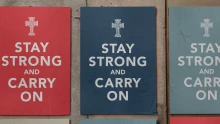
Now, for the series title, we went to that old World War II era poster, Keep Calm and Carry On, right, in the UK. But we figured that the message of Jesus is much more than just keep calm and carry on. It's really stay strong and carry on. And let me just give you a sample of where we're going. These chapters, chapters 13 through 17, they are stuffed with great quotes from Jesus. Just absolute gems. If there had been Twitter, now no-no's ex. Back in those days, they would have been sending these things out. They're so memorable.
Verses like this, by this, everyone will know that you're just my disciples if you love one another. Or, do not let your hearts be troubled. You believe in God, believe also in me. Or, I am the vine. You're the branches. If you abide in me and I in you, you will bear much fruit. Or, greater love is no one than this, to lay down one's life for his friends. Or, this is my command. Here it is, love one another. Or, in this world, you'll have trouble. But take heart, I have overcome the world. And that's just a sample. It is just like one great quote after another. Jesus is like, guys, guys, I wanna make this memorable because I know how you are. And I wanna make it very, very clear what we are here on earth to do as believers.
And so, does that sound good? And so, for all the 40 days or so leading up to Easter, and traditionally those days are called Lent in the church, what we're gonna do is to dive into this last talk, this final pep talk of Jesus Christ. Now, if you wanna follow along verse by verse on page three of your notes, there's this reading plan. And there's a way to just kinda stay up to date with the text and then every weekend, what we're going to do is we're going to dive further in to some verses in each chapter. Does that sound good? All right then, let's dig in. I am so excited about this.
I have studied so much material on this. All kinds of pastors, writers, people like Tim Keller, Craig Richel, Andy Stanley, Charles Stanley, many, many, many more. So, I just wanna kinda give overall credit. I got a lot of great ideas from all of them. And I wanna start this series though by just telling you the story. It's a story of that one night. It's a story that has rocked the world. It's a story that rocked my world again as I was studying this. And it's a story that starts around 30 A.D. And the Jewish people in Israel are being terrorized really by the Roman occupation. The Romans are by far the most powerful nation on earth. They've got a military machine and they are bringing it to bear on the Jewish people.
And so the Jewish people are longing for what they see as God's prophesied warrior Messiah who is going to come down, sent from heaven, and he's gonna trample the Romans, and he's gonna get back to the Romans, what they've been giving to those, to their people, and he's gonna set their land free and overcome them with absolutely irresistible military power. They're waiting for a revolution. And it's clear that Jesus is welcomed into Jerusalem on that Passover week at the triumphal entry with this kind of revolution in mind. You've heard me say before the palm trees were the national, palm branches rather, were the national symbol of the nation of Israel. You see it on the coins that they minted back in those days.
And so when Jesus is welcomed into Jerusalem by palm branches, why does the Bible keep telling us that detail? It's because that's their national symbol. They're waving their flag. They're cheering him on for revolution. And all that week for the next few days the tension is building, expectations are mounting. And the elites don't like this. The Romans don't like this. And Jesus knows that they're conspiring against him. And so he gathers his 12 closest followers together for a meal. It's the Seder meal, the Passover meal. And he gathers them together and that sets the scene for this. John 13:1. It was just before the Passover festival, hours before. It says Jesus knew, and this is a phrase that comes up a couple of times in this chapter, Jesus knew a few things.
What did Jesus know? Well, for one thing, Jesus knew that the hour had come for him to leave this world and go to the Father. He knows his time is short. His hours are few. And so he looks at these disciples who have no clue, I mean they are clueless in every way. He looks at these characters who've been frankly disappointments, kinda 12 bozos, you know? And what is he thinking in this moment? The Bible says he looked at them and having loved his own who are in the world, he loved them to the end. And let me just say, we live in a culture right now where it seems like very few people love to the end. And maybe somebody once told you in your life, you know I used to love you, but I don't love you anymore. Jesus Christ will never ever say that.
You say, but I'm such a disappointment, but I blow it, but I don't get Jesus. Think of who he's talking to. Jesus has loved you, Jesus does love you, and Jesus will always love you. He loves you to the end, amen? So it says the evening meal was in progress and the devil had prompted Judas, the son of Simon Iscariot to betray Jesus. Now do you ever wonder why in the world would anybody betray Jesus Christ? Right, what an amazing person. Well I think part of the clue is in the historical context I just gave you and the name Judas. Judas was likely named for the most famous Judas in Jewish history, to that point Judas Maccabeus who was a national hero, the last great Jewish revolutionary.
He led a revolt almost exactly 200 years before the events of that night. He defeated the Syrian Greeks, just one generation removed from Greek domination of the world, these were troops trained by Alexander the Great, and he leads a revolt of people from up north in Galilee, brings down his brothers, and kicks out the Gentiles and for about 100 years there was an independent Jewish state. And what's brewing at the time is people are longing for another Judas Maccabeus. And you gotta know Judas with that name, he grew up on these stories. It was like being named George Washington in the United States. And now it's clearly slowly dawning on him, if you read the gospels carefully you'll see his little criticisms of Jesus increase. Jesus Christ is actually not the least bit interested in leading this kind of revolution.
You can say that Judas betrayed Jesus, but I'm sure from his perspective Judas was the one who felt betrayed by Jesus. And so he's sitting there with this conspiracy brewing in his head, and meanwhile the other disciples are preoccupied too. Luke tells us that at this exact moment, as he puts it, a dispute also arose among them as to which one of them was considered to be the greatest. They're all arguing about who's the most important. They're like, yeah when Jesus comes into his kingdom, I'm gonna be the secretary of state, you're gonna be the secretary of the interior. You know whatever they're arguing about. And Jesus looks around at these characters as they're fighting or sulking, and again John uses the phrase Jesus knew.
They're all arguing about power or conspiring about power. What did Jesus know? Here's what else he knew. That the father had put all things under his power, and that he had come from God, he was returning to God. Jesus knew exactly who he was, and he knew as they're all arguing about power, he has the most power of anybody in that room. He's got the most power of anybody in the city. He's got the most power of anybody in the country. He's got the most power of anybody in the world, of anybody in the cosmos. Now if you knew that, if you knew that God had put all things under your power, what is your next move? Well what is Jesus Christ's next move? Look at the next word in the sentence. So, and that word is the most important word in this chapter, because that word is the hinge that the whole upper room discourse kind of swings on.
He knows he has all power, these guys aren't paying attention, they're bickering or sulking, so what does he do? He doesn't shout at them, will you please shut up? He doesn't display some grandiose, you know, lightning bolts. So, he got up from the meal, took off his outer clothing, and wrapped a towel around his waist, and they start to stop their conversation. Look, what's he doing? And then when the next thing happens, you gotta know all the arguments just stop, and there's an awkward silence for quite some time. After that, he poured water into a basin and began to wash his disciples feet, drying them with the towel that was wrapped around him. Are you kidding me, foot washing? In those days, foot washing was considered so beneath you that get this, there was actually, in some Roman provinces at the time, there were laws prohibiting you from making your own servants wash your feet.
Now, this was in a Roman culture where you could make your servants do almost anything, but washing feet, man, now that's going over the line. Now, in some very, very, very wealthy families, they would hire people from the town to come in and wash people's feet, but those people, they were like the lowest castes, so to speak, the lowest of the low, but they needed to earn some money, so they would come in and they would wash feet, and here's Jesus Christ who knows he is all power. And imagine what these feet were like. Remember, the Passover says that it was filled, the Bible says it was filled at Passover with hundreds of thousands, probably historians say, millions of people coming for the pilgrimage, just like people go to Mecca these days, and they're coming with their sacrificial animals, so there's livestock everywhere, so when he is washing sandals' feet, what is he washing off of those feet? Just imagine that.
And by the way, why do they even have to have their feet washed? Because they were too proud to wash one another's feet, and too dirty to wash their own feet. So the one to whom all power has been given washes their feet. Well, when he came to Simon Peter, Peter said to him, "Lord, are you gonna wash my feet?" And Peter gets this, he's like, "With those hands, you're gonna touch my dirty feet? "Those hands that have healed people, those hands that I've seen, you put those hands on blind people's eyes, and the eyes like worked again. Those hands picked up the lifeless hand of a little 12-year-old girl, and her hand came to life again. When that hand touched it, that hand's gonna touch this? "I don't think so." And Jesus replied, "You don't realize now what I'm doing, but later," I feel like at that point, Jesus probably thought to himself, "As usual, you don't understand what I'm doing, but later you will understand." No, said Peter, you will never wash my feet.
And Jesus answered, "Unless I wash you, you have no part with me." What he's saying is, "You need to be washed of your sin, Peter, and believe me, that's gonna cost me a lot more than washing your feet." Well then, Lord, Peter replies, he still doesn't get it. "Not just my hands, not just my feet, but my hands and my head as well. "Like, give me a bath." And sometimes I wonder, is Peter really saying this sincerely, or he's just like, "Oh, you just washed the other guy's feet, but I wanna be the top dog, so can you give me a shampoo and a rinse?" You know, Peter's just, they're always jostling for position. And Jesus answered, "Those who've had a bath need only to wash their feet, their whole body's clean. "You are clean, though not every one of you, for he knew who was going to betray him, and that was why he said not everyone was clean." Remember that, he knew.
When he had finished washing their feet, their feet, just imagine this, all of them, all of them. He knows this one is going to come back in a few hours with an armed mob and betray him with a kiss, and he washes his feet. He knows this one is going to look at him while he is being tortured and deny him with a curse three times, and he washes his feet. He knows all of the rest of them, all of the other 10, are going to run like scared rabbits the minute he is arrested, and he washes their feet, and his feet, and just think of the time it took. Wash, wash, dry, wash, wash, dry, wash, wash, dry. Wash, wash, dry. And all these guys have been in their own heads or arguing, they're just quiet.
And when he had finished washing their feet, he put on his robes again, his clothes, his outer clothes, and he returned to his seat, and he says, "Do you understand what I have just done for you?" And there's no recorded answer, because I think they're all going, "You just said to Peter that we don't understand, so I'm not saying a thing, I'm not saying a thing, I don't want to be corrected." And then Jesus explains it, he says, "You call me teacher and Lord, and rightly so, for that's what I am." You know Jesus, when people called him Lord and even God, Jesus didn't say, "Oh no, no, no, no, no, "you shouldn't say that, I'm just a guy." And Jesus, who was so humble, was like, "No, actually that's okay to call me Lord, because I am.
Now that I, your Lord and teacher," and the word there really means master, "have washed your feet, you should also wash one another's feet. "I have sent you an example, you should do as I have done for you." You don't have to be a Bible scholar to understand this. Jesus is saying, "You guys are gonna get so off mission when I'm gone, and so let me just give you a graphic display that you are never ever going to forget. This is the strategy. We go out into the world and we love the world, and we serve the world. You think you got better ideas? You think you want to do the Julius Caesar thing, or the Judas Maccabeus thing? No, you're doing the Jesus thing, if you're a Jesus follower." He says, "Truly I tell you, no servant is greater than his master, nor is a messenger greater than the one who sent him." What's he saying? He's saying, "You think you're no better than Jesus? You do not know better than Jesus Christ. You do not have a better strategy than this."
He says, "Now that you know these things, you will be blessed, blessed. "You'll get blessings if you," what? "Study them. "If you memorize the verses only. "You know, if you're in a Bible study that reads all about this, no. "You will be blessed if you do them." He's saying, "This is what Christians are supposed to be all about. "We are not the people who are about doing things Julius Caesar's way. "We are the people who are doing things the Jesus way. "We're not the ones who wrestle for political power. "Our job is not to change the world their way. "Our job is to influence the world Jesus." Christians, these are our marching orders.
You know, when people think Christians, they should think, "Well, maybe I don't believe what they believe, but I'm sure glad they're here in the Santa Cruz community, because what they're, they're not about wielding power like everybody else's on the planet. "They are about serving." And in case you're thinking, "Well, you know, "I don't know if that really works. "If we Christians decide we're gonna stop arguing politics and we're gonna stop taking sides and we're gonna focus on serving my neighbor." Does that really work? Well, I want you to realize this is exactly what the first Christians did. The first Christians living in that brutal Roman empire, they didn't have any political power, they didn't have military power, they didn't have microphones, they didn't have giant screens behind them as they taught, they didn't have internet.
What did they do? They went around picking up babies that had been left for dead on the river banks of the Roman cities and nursing them back to life and adopting them in a Roman culture that did not believe in the sanctity of life at all. They believed human life was disposable. And they went around into cities where the plague was killing everybody and survivors were streaming out of the cities and Christians were like, "Excuse me, excuse me, "excuse me," swimming upstream and going into the cities and nursing the sick back to health in a Roman culture that was pure survival of the fittest. They did not fight the Romans with force. They served and they served and they served and they served. And within 300 years, the Romans turned and looked at the Christians and said, "You know, we actually like that value system better than the animal kingdom value system that Rome is based on." And a whole value system and culture turned upside down.
Not because they outfoxed the Romans, not because they outmaneuvered the Romans, not because they outpowered the Romans, not because they outspent the Romans, because they served. And that still happens today. Here's a great example of this. As you know, this past week was WOW World Outreach Week and I was talking with Dr. Suresh, who's veterinary medicine director at Prakash for India, which our church supports. And Dr. Suresh told me that right now in India, things are getting more and more restrictive against Christians, more tense, more violent. And so what is his strategy as a follower of Jesus? Well, he told me he is doubling down on what Jesus just taught the disciples. He said, "I just go out and serve." And I talked to him about this in our office this week.
Watch this. Dr. Suresh, your ministry is quite amazing. You go out into the villages and do veterinary medical care for the animals. Actually we provide veterinary assistance, medical help, educational help, counseling, to show the love of Jesus and compassion of God through all our activities. And there are so many. My phone start ringing at 5:30 till 6:30. And I'm getting busy all day helping them. This help is only to show them Jesus Christ somewhere. And I will try my best to show Christ through all these deeds.
First through actions, and then they begin to trust you and ask you some questions. It took me five years to touch one boy from the tribal community. And when he saw my life, he wanted to get baptized. And after that, he met with the accident and he died. But then his wife, now she connecting me on there, they have a special app. These tribal people, they know each other. So because of her 86,000 young people are connecting with me from this tribe.
After years of gaining credibility through service, you're now gaining a hearing for your Christian testimony through your friendship with them. Isn't that wonderful? I just find Dr. Suresh to be such an inspiration. You know, he also has a chicken gifting program and a goat gifting program. What he does is he gives people a male and a female, and then he teaches them the livestock business. And his goal is their complete self-reliance. And all of this, remember, is supported by this church, by Twin Lakes Church. Well, one day at precaution, another young man becomes a follower of Jesus, and he thinks, you know, I'm reading the words of Jesus. I think Jesus wants me to serve my village by feeding them because they're all starving, and then I can teach them self-reliance.
So Dr. Suresh thinks that's a good idea. He gives him two goats, teaches him animal husbandry. As I speak to you this morning, those two goats have now turned into 30 goats, and he is feeding his entire village as a Christian in the name of Jesus. And by the way, you know how old that wise man is? He's 18 years old, but it gets better. Because a while ago, this 18-year-old is trying to explain to the people in his village why he loves Jesus, that in Christ there's no slave or free, black or white, there's no caste system, we're all one, it's all grace, and they just don't seem to get it or believe it.
And so he says, I think I just need to show them that I really believe this, you know, with the passion of a new young believer. And so he and his young wife see a homeless, starving orphan girl from a lower caste tribe even than theirs, and they adopt her into their family as one of their own. And the whole village looks at this girl living in the house of a tribe that by custom shouldn't even be speaking to her, and suddenly they all get it, and the whole village decides they want to follow Jesus. Isn't that beautiful, and you know why? Well, Jesus tells us why a few verses later. Everyone will know that you are my disciples, if what? You love one another. That's the strategy.
You know, we've been calling this year the Year of Living Jesusly at TLC. So when I'm like Jesus, what have we seen in this text? Well, first I love to the end, as he did. I don't give up on anybody. I know who I am as he did. Remember it says Jesus knew who he was and where he was going. So along these lines, and here comes the legally mandated Super Bowl weekend football illustration, I was watching an interview with Brock Purdy the Niner quarterback this week, and this was really good though. He was asked, how do you handle all the pressure? Because you've only been playing a year and a half. Here's his answer. Understanding who I am. I'm rooted in that, I know who I am. My identity isn't in football or the things that come with it, it's been a blessing, I'm grateful for it, but I try to hold it loosely. For me, it's my faith in God and that's it. I am who he calls me to be, and I want to love others well, whatever the circumstance, and I think, God, if you want me to do this, great. If not, let's go do something else, wherever you need me.
And you know what I loved? All day, the sports talk hosts were talking about his answer because it was so unique. I know who I am and my identity isn't in football. Do you know who you are in Christ? Here's why that's so important. When you know who you are, what your father says about you, then you walk with dignity, then you walk with honor, and consequently, serving's not demeaning. Foot washing isn't demeaning because you know who you are, who the father says you are. I love to the end, I know who I am, and I serve to the max. I serve my neighbors and those around me.
So let's take it from the theoretical to the practical. How do I do that? How do I start? Well, start serving in your current relationships, right? Don't start by thinking, I will feed all the poor in India. Just take out the cat litter. Then serve in your church, serve in the children's ministry or the pantry, hundreds of ways, and then in the community. And again, just keep it simple. Start with a neighbor. Make 'em cookies. Be nice to them. Call 'em from Costco and ask if there's anything you can pick up for them. Now here's the cool thing, and here's what I love about our church. So many of you do this exact thing in ways that blow my mind like our people's pantry, feeding 480 people every single week, over 7,500 different families a year. So many other ministries to our ministry to adults with special needs, our ministry to people going through recovery.
But we have a looming problem. And I wanna take just four minutes to talk about this. And at first I thought I wouldn't talk about this in the message, I'd do it all on the info meeting after the service, but I changed my mind. Because I just want you to feel my heart about this. Those portable buildings over there where so many of these ministries happen are literally falling apart. And it's sad because this is where so much serving happens here at this church. Support groups, adult classes, people's pantry, our class for adults with special needs, which already had to be relocated because the portable they were in fell to pieces. What if we gave them all a permanent home? Let's call it the TLC Hope Center. A building specifically designed for these ministries for once with like walk-in fridges and covered drive-through food pickup lanes and much, much more. People need hope. And the good news is they are already finding hope here.
Natalie, our director of women's ministry showed me a text she got last week. This was so powerful. A young woman in our addiction recovery group, she wrote, "This group has not only saved my life, but my unborn son's life. When I entered the group, I was scared. I was lost. Today, I have a second chance of living a new life in Christ. The chains of my addiction have been broken." Doesn't that just make you rejoice? Praise God. I mean, really, there's only one obstacle. It's expensive to build stuff in California. But here's the good part. We got that children's building built. We got the College Ministry Center and Loft built the same way we hope to get this built through simple monthly pledges over four years. And there's a pledge card in those brochures you got. And you can also grab it online at tlc.org/hope. And this explains kind of how it works.
But here's the schedule. And you'll be hearing more about this for six weeks. Just take that brochure and the pledge card. Take it home. Read it. Just pray about it. That's all. And fill out the middle part with your pledge. And then on Palm Sunday weekend, we will bring in our four-year pledge cards in these envelopes. And by the way, no pastor will ever know your pledge. This is for the business office to tally up so that we know what the heart of the church is on this. And if we get enough pledges-- this is not about bringing in money on Palm Sunday. This is just your promise, your pledge, about what you will be giving over a four-year period. And if we get enough, we'll build. If we don't get enough, we'll regroup and redesign the building. Does that make sense? Very simple way of discerning the Lord's direction on this.
Again, more details at tlc.org/hope. Listen, there's no hype. I don't believe in hype. There will not be a giant thermometer on the wall that excruciatingly inches up over like two years until we get the money for this. It's like six weeks till Palm Sunday. We're going to be talking about it, praying about it for then. And then we won't talk about it anymore, just like the other two buildings. But will you promise me that you'll pray about this? Pray about how we can serve our community in permanent buildings, ministries that are already just taking off. In fact, let's just pray about it right now. Lord, we just ask that you would bless the Hope Center. We don't want to do anything outside your will. So we're just asking you to guide us through this pledge drive. And in your name we pray, amen.
All right, let's wrap up with one more Dr. Suresh story. This just happened a few weeks ago. He gets to know this family. They make their living selling from their hand cart. Problem, their hand cart is broken. Repairs are 8,000 rupees. Dr. Suresh doesn't have the money. They don't have the money. So Dr. Suresh awkwardly says, well, I will pray for donors. As he says this, this man sees him from across the intersection. He hasn't seen Dr. Suresh in years, years before. Dr. Suresh provided this man who was living in poverty with a male and a female cow and taught him the dairy business. Now he has a herd. He has a successful running dairy. And he just crosses the streets to say hi to Dr. Suresh. And he overhears part of this conversation. And he says, Dr. Suresh, come to my house for tea today.
And at tea that afternoon he says, you know the Lord has truly blessed me through this. And it is my privilege to help somebody else in need. Open up your hand. And he puts into Dr. Suresh's hand all 8,000 rupees needed to fix the cart, which is now as good as new. What happened there? Exactly what Jesus told us. The world starts to get changed as we wash everybody's feet. One foot at a time, whatever it is, whatever way that they are dirty, whatever they need. And as we help them, the world starts to see something in us. And they don't know what to call it at first. But as they get to know us, they realize that what they're seeing is Jesus leaking through.
And as our community sees that, they're drawn to faith in Jesus Christ that changes their lives. And then they're drawn into serving others. And the ripples spread like little seeds, like yeast and dough, like little children singing songs to each other. And it spreads like wildfire. You can choose the Judas Maccabeus way, the Julius Caesar way, or the Jesus way. And I know what I hope our church chooses. Let's pray together. Heavenly Father, thank you so much for these last words of Jesus Christ in the upper room. We want to live the Jesus way. May that be the reputation of this church, love and service. Not because we're trying to do good works to earn your favor, of course not, but because we know you have loved us to the end already, despite our flaws. You save us by grace. And now we want to be like that. We want to be like you, Jesus. And Lord, I pray that if anybody needs to receive you today, I just invite them to pray right now. Lord, I choose to follow you as my Lord and master and teacher because that is who you are. And I don't understand it all. But as much as I understand, I want to be a Jesus follower. Help me to learn more as I follow you. And we pray this in your name. Amen.
Sermones
Únase a nosotros este domingo en Twin Lakes Church para una comunidad auténtica, un culto poderoso y un lugar al que pertenecer.