Finding Hope in Times of Chaos
Discovering hope amidst chaos through Hannah's story and David's journey.
Transcripción
This transcript was generated automatically. There may be errors. Refer to the video and/or audio for accuracy.
Well good morning. Welcome everyone here at TLC. Everybody joining us this morning on Facebook live. Everybody over in the venue service this morning. My name is René, another one of the pastors here at TLC and I want to invite you to grab your message notes because I am so excited. If you are new, you picked a great time to join us because fall is always an exciting season here at TLC. We always launch a new series that ties into small groups and the intent is to kind of gather us all together again after a whole summer off and this year we're gonna start a series on David.
This is very personal for me. I have always been fascinated by King David. We even named our two sons David and Jonathan, David's best friend, and I know it's not just me. David has inspired art by people like Michelangelo, music by people like Leonard Cohen and Bono and Veggie Tales and many more. David is mentioned in the Bible more than anyone except Jesus. No one else even comes close. Abraham is only mentioned in 14 chapters. Joseph in 14, Jacob in 11. David is in 66 chapters of the Bible and I kind of feel like if David is that important to the Bible we need to get to know him better, right?
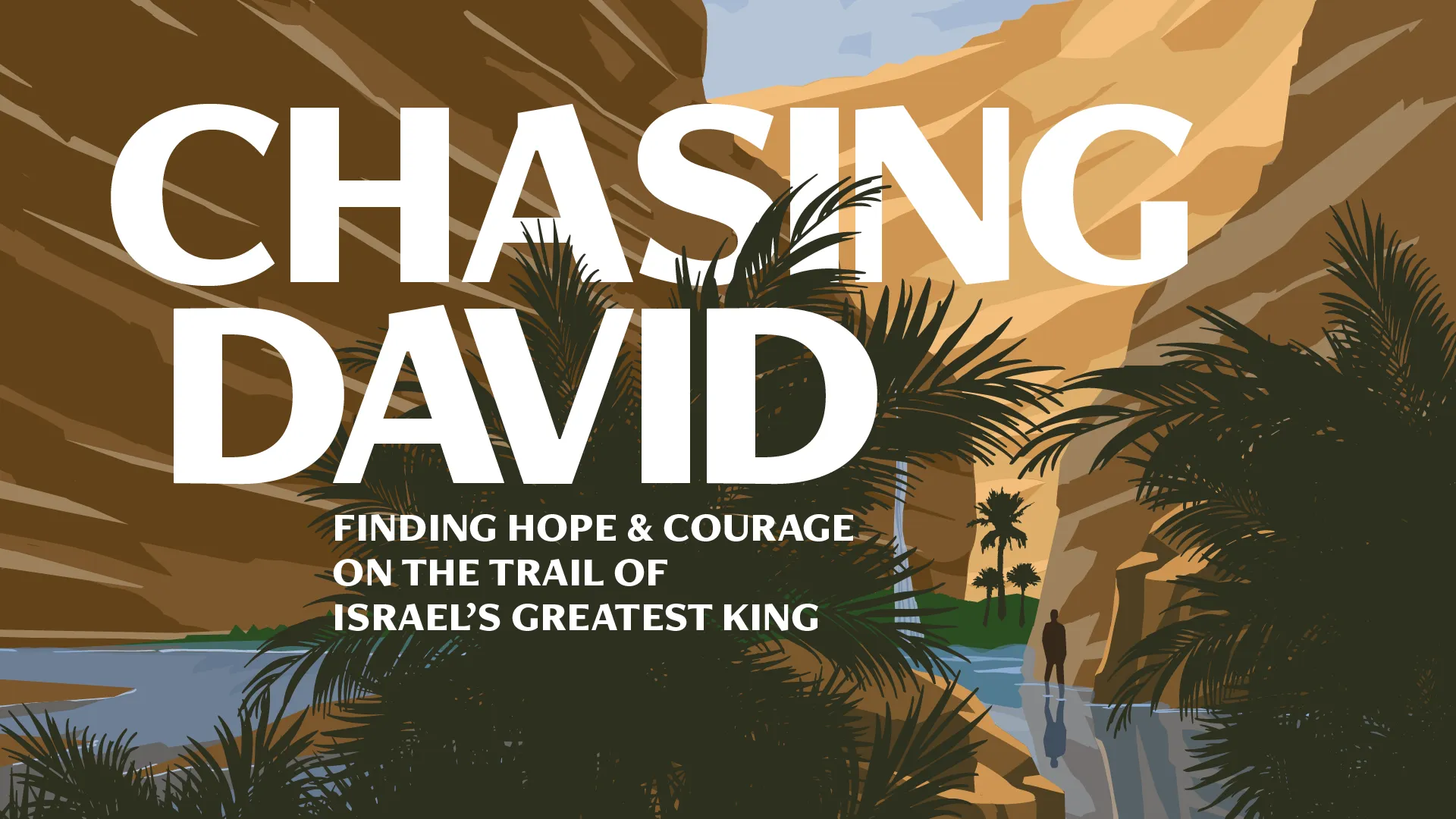
So this year I traveled to Israel to learn more about him. People wonder if King David was just a legend like King Arthur. Well in the last few years archaeologists began unearthing artifacts that not only prove David existed, they also shed new light on his world and help us to understand him better. So I traveled into caves and deserts and archaeological digs. I'll be sharing what I discovered in the next eight weeks in this series, "Chasing David, Finding Hope and Courage on the Trail of Israel's Greatest King." And it's not just some history lesson. As you can see in this card in your bulletins that shows you the topics for each week, David's story shows how to find confidence when rejected, how to find courage to face life's giants, finding power to forgive, and lots more.
Now this is preview weekend. Next weekend is week one. The small groups start then and I just want to add my voice to this. Whether this is your first week or thousandth week here, please sign up for a small group out on the plaza today. Now this morning what I want to look at is the prelude to David's story, the way the Bible tells it. I call it "Finding Hope in a World of Chaos," and it's in the book of 1 Samuel in the Bible. Let me set the historical stage as this play is about to begin because I find that even most Christians do not understand the historical context.
In his book, 1177 BC, the year civilization collapsed, historian Eric Klein describes what scholars call the late Bronze Age collapse. In around 1250 BC, all around the Mediterranean, Northern Africa, the Middle East, even into Asia, there was peace, international trade, large empires, stable economies, beautiful works of art being made, and suddenly it all went up in smoke within one generation. Klein says the thriving cultures of the late second millennium BC which had stretched from Greece to Egypt and Mesopotamia suddenly ceased to exist. Long used trade routes were abandoned, along with writing systems, advanced technology, monumental architecture.
Another historian puts it this way, "It was worse than World War I, worse than the Little Ice Age, worse than the fall of the Roman Empire. This event was the Dark Ages before the Dark Ages. Kingdoms fell like dominoes, empires like the Minoans vanished, the Mycenaeans vanished, the Hittites vanished." And if you don't know who they were, that just proves my point because they'd been dominant, world-dominating cultures for centuries. The few empires that barely survived like Egypt were shells of their former selves, and the bizarre thing is no one knows exactly why it happened.
The current theory is that it was probably some deadly combination of climate change, and they actually know this for sure from soil samples. That generation was the driest generation in a 2,000 year span of human history. Suddenly temperatures spiked, nobody knows why. Well that led to drought made worse by earthquakes, volcanic eruptions, all of this compounding within one generation. But the straw that broke the back of these empires, invasions by vicious seafaring marauders known simply as the Sea Peoples. We know almost nothing about them except that they sailed around the world laying city after city after city after city after city to waste.
And in their wreckage as one historian puts it, "by 1100 BC this whole world and all of its splendors were gone." Reducing people in much of the world to little bands, living in family groups or villages, trying desperately to survive their apocalypse. That is the scene in 1100 BC when the story of David begins to unfold. The Bible describes it this way in the last verse of the book of Judges which comes chronologically right before 1st and 2nd Samuel which tells the story of David. The very last verse of Judges says, "In those days Israel had no king. All the people did whatever seemed right in their own eyes." In other words there was no more rule of law, it was kind of a Conan the Barbarian world, only the strong survived dog-eat-dog.
And understanding this really helps explain the world of the Old Testament doesn't it? Because sometimes we read these old stories and we go, "Oh so violent, so many battles." Well it was literally a post-apocalyptic world, it was Mad Max, it was Hunger Games. And isn't this relevant to us? Because these days we can feel like our world is descending into chaos too. We look at the headlines, so much grief, it's so easy to lose hope or it's not just the headlines, it's your own life. Life isn't turning out like you planned, everything's in ruins. You've made mistakes, others have done you wrong. Where is the hope in a world of chaos?
That is the historical setting when the curtain rises on David's story in 1 Samuel chapters 1 and 2. Now David's story, if you know even a little bit about it, you know it's like a very intense action-adventure drama full of spies and giants and battles and sword fights and slings. But to introduce that kind of stereotypically masculine narrative, the first person to sort of peek around the closed curtain and step onto the stage is a woman who sings a song. And in this beautiful poetic way, she establishes all the themes for the whole epic of David that we're about to hear for the next eight weeks.
So here's her story. Once upon a chaotic time, there was a man named Elkanah and Elkanah had two wives. Now the Bible is not endorsing polygamy, it's just saying hey it happened. And they were named Hannah and Penanah. Penanah had children but Hannah did not. And that little sentence is a big big deal because I just want you to think about it. It's all about context, right? In that post-bronze age collapse of the civilized world, if you have a big family, what does that mean? It means you're more likely to survive. The more kids, the more economically, socially, militarily secure you were, there were no more empires. It was all just family units trying their best to survive in this apocalyptic chaos.
So massive cultural pressure on women to have kids. Next verse, "The priests of the Lord at that time were the two sons of Eli, Hophni and Phineas." And at first you're reading this, you go why are you interrupting the story? Seems like an extraneous detail. Who cares? Well we find out later, Hophni and Phineas were sickeningly corrupt. They treat the holy tabernacle sacrifices as their own personal barbecue. They steal from the Lord's tithes and offerings. They sexually assault the women who serve God there. In fact, Hophni means boxer or pugilist. And Phineas means mouth of brass. In other words, bully and loudmouth. And you gotta wonder if those were the real names or nicknames they got because they were such jerks.
And I think this little detail is there to remind us it was the time of, the era of, the bullies and the loudmouths. Verse 6, "Pennina," this one of Elkanah's wives, "would taunt Hannah and make fun of her because the Lord had kept her from having children." Year after year it was, not just day after day, not just week after week, year after year. "Pennina would taunt Hannah as they went to the tabernacle." They're going to church to worship. "Each time Hannah would be reduced to tears and would not even eat." Look at the pressure put on Hannah because she doesn't live up to her culture's view of what a woman should be like.
And before you go, yes, how primitive, you know, to just judge women based on their childbearing. Oh, we're so far beyond that. It's not just their society. Let me ask you this. Does our culture put pressure on women for failing to live up to our culture's expectations of women? Absolutely. The other day this week I looked at magazines targeted to women today. Women, did you know that you need tight abs, lean legs, and a cute butt? You really need this, otherwise you're gonna be judged. What about your feet? Big feet, wonky toes. Here's the new plastic surgery for perfect feet. Are your feet perfect? You're being judged. Oh, and by the way, you also need to run the world, and while you're running the world, be sure you have one of the 14 looks guys love.
Just a little news flash. No men's magazine has ever said, "Okay, men, run the world." That is what the men's magazines say. Run the world. But they never, ever, ever say, "And while you're at it, have a cute butt." This is insane. A very professionally successful woman here at TLC told me once in tears, "René, it's like women can't win. If we work, we're working too hard ignoring our children. And if we don't work, we're not living up to our true potential." What I'm saying is if you're a woman here, you still hear the voice of Penaena every day. Culture is completely different. Human nature is exactly the same, right? If you don't fit in with our culture's expectation, you're demeaning it.
And just like for Hannah, all this pressure leads women to be reduced to tears and to not even eat. Anxiety, eating disorders, all because of feeling stigmatized by the culture. Next verse. "Why are you crying?" Hannah, Elkin, or her husband would ask, "Why aren't you eating? Why be downhearted just because you have no children?" "You have me? Isn't that better than having ten sons?" "No, that's not in there, but it's implied classic, clueless guy, right?" Classic, classic. Men have not changed at all. And I think this is in there actually for a little comedy in the narrative, but I think he means well, but here's the thing. He doesn't really address the issue of her worth or her hope. It's just, "Hey, don't cry, babe. You got me and I'm pretty awesome. Who could want more, right?"
There's a UC Berkeley professor, Robert Alter, wrote a really interesting book on David, and he's a leading, world-leading expert on Hebrew, and he points out there are two voices addressing Hannah in this story, social approval and male affection. And as he puts it, "It is narratively significant that she doesn't answer either voice." And this is very important because even to this day some women may not be addicted to social approval, but they can be addicted to getting male affection. But one thing this story is telling us, both men and women, is refuse the voices that tempt you to base your self-worth on the expectations of others or even on the affections of others because both of them are not guaranteed, you know, in a world of chaos.
So if that's not where hope in a world of chaos comes from, where is it found? Let's keep reading. Once after a sacrificial meal at Shiloh where the tabernacle was, Hannah got up, and Robert Alter says to say she got up in those days was a Hebrew idiom that means she took charge. She got up, she did something about it, and what does she do? She went to pray. Eli the priest, he was the father of Hophni and Phineas, was sitting at his customary place beside the entrance of the tabernacle, and Hannah was in deep anguish, crying bitterly as she prayed to the Lord.
And the phrase, "they're deep anguish," literally means pain of the soul. And some of you right now know just what that feels like. Bone marrow, deep pain, grief. But pain is a turning point for her, as it often is in our spiritual journeys. As she was praying to the Lord, Eli watched her. Now look at this, seeing her lips moving. She's praying like this, but hearing no sound, he thought she'd been drinking. Look what he does. "Must you come here drunk?" he demanded. "Throw away your wine!" Classic judgmental clergyman. "Oh no sir," she replied. "I haven't been drinking wine or anything stronger, but I am very discouraged."
And I was pouring my heart out to the Lord. "Don't think I'm a wicked woman, for I've been praying out of great anguish and sorrow. Now if somebody said that to you, what would your next sentence be? What would your next sentence be? What's wrong?" Eli never asks that. Eli says, "Well in that case, go in peace." It's like clergy malpractice. He doesn't even want to know. "May the God of Israel grant the requests you've asked him." I'm like, "Very nice, get out." But Hannah takes this seriously. And she prays, "Lord, if you give me a son, then I will dedicate him to you to serve you his whole life." Then they returned home to Rama, and when Elkanah slept with Hannah, the Lord remembered her plea.
And in due time, she gave birth to a son. And she named him Samuel, for she said, "I asked the Lord for him." And Samuel means God heard. Well fade to a few years later. Hannah takes the voice Samuel back to the tabernacle to dedicate him. And unexpectedly, she burst into this prayer which becomes this amazing song. But here's what's so cool when you look at this work of art that is the book of Samuel. Her song becomes the overture to the David symphony, because every theme you see in David's story is foreshadowed here. This is so cool, so beautiful.
Then Hannah prayed, "My heart rejoices in the Lord. The Lord has made me strong. Now I have an answer for my enemies. I rejoice because you rescued me. No one is holy like the Lord. There is no one besides you. There is no rock like our God." I love that in her world of just complete chaos, she calls God her rock. And do you see, this finally is where she finds her hope in a world of complete chaos. Now I want you to picture this scene. Here is this woman who previously, year after year, had just been quiet, probably kind of an introvert, and she's standing before these priests that the Bible describes as completely corrupt.
And she kind of speaks truth to power, because let me read you the next few verses of her song. Think of who's witnessing this. Stop acting so proud. Don't speak with such arrogance for the Lord God knows, and He will judge. The bow of the mighty is now broken, yet those who stumbled are now strong. And that pattern is something she repeats. She goes on to observe this pattern of how God always works. And really what she's doing is encapsulating the theme of the whole Bible. This is how God always works, and this is such good news.
When you feel like you're just surrounded by strong men in a chaotic world and you're losing hope, she says you got to remember this. First she sees that God works through the excluded, not just the included. She says He lifts the poor from the dust and the needy from the garbage dump. He sets them with princes, placing them in seats of honor, and we will see God do exactly that for David, overlooked and ignored by his own father, rejected and mocked by his own brothers, yet anointed King. And Hannah's saying, "Do you see that's how God loves to work?"
And her words here remind me of a documentary I once saw called Land Philharmonic. Have you seen this? It's the true story of the kids who literally lived in this garbage dump in a town in Paraguay. Hope was non-existent for the people who lived in the chaos of the dump. Nobody even knew they existed in absolute hopelessness. But here's what changed that. A man named Fabio Chavez lives there and envisioned a music school for the kids. Problem? No instruments. They were too expensive. And so he verbally described instruments to a man who lived there named Don Gomez who worked at the dump.
And Don Gomez had never seen or heard a violin, for example, in his whole life. But he took a paint can and made a violin and his next instrument was a cello out of an oil barrel. And together they started a music school for kids and they started doing concerts, began with small local concerts, and then gained amazing fame. They have now toured the world several times. They've opened for groups including Stevie Wonder, Metallica, and even Pope Francis. Would you like to hear some of them playing? Well here they are on Recycled Trash Instruments. It's a little chamber group of them at a very recent TEDx talk in Amsterdam.
It's just so amazing. And do you see what Hannah is saying? This is exactly what God does. And in fact the whole Bible is a pattern of God taking people from the garbage dump of their lives and turning them into masterpieces that inspire millions. As Max Lucator writes, "Look at his Philharmonic, that woman on the flute, that's Rahat the prostitute. That religious terrorist who tried to kill Christians mercilessly, first chair trumpet, that's the Apostle Paul. The string section, Hannah, Elizabeth, Sarah, Rachel, Rebecca, all women rejected by their culture because they couldn't have any babies. And hey look closer, there's you and me. The ones who thought at times we were trash but God had other ideas.
And as he writes to get into the orchestra, all you need to do is say God here. Here's my heart, it's kind of crushed because somebody threw it out. Here are my hopes, they've been smashed. Here's my faith, not much left, you want it? And then watch as he creates a masterpiece out of it. See this is a paradigm about how God works that brings in its extinguishable hope in the midst of all the chaos of life. But that's just the first thing. Second theme she sees, God has a plan even though the world seems out of control. She says, "For all the earth is the Lord's and he has set the world in order." Now look at that, he has set the world in order.
This sounds like the words of a woman who's looking out the window and seeing Switzerland, right? Ordered and organized and 700 years of peace moving like clockwork but what she's actually seeing is the smoking wreckage of the late Bronze Age collapse. Hannah's not saying these words as an actual observation of her world physically. She is choosing to see her world through the eyes of faith. How important is this for us? Because we tend to be mastered by our emotions. Watch TV, it's all chaos, we get bummed but faith says, "I will not be mastered by my emotions. I will choose to believe that God has a plan and you will see David doing this when his world seems out of control."
Saul's tried to kill him, he has to run, nothing going right but he keeps affirming God will fulfill his purpose. Man that brings hope in any chaos. And then the final pattern Hannah sees, God works through weakness and not just strength. He will protect his faithful ones but the wicked will disappear in darkness. No one will succeed by strength alone. Now again she wasn't actually seeing this to be true. In her world nobody did succeed except by strength. But she's saying ultimately the victory does not go to the strongman and we're gonna see this over and over in the David story. David and Goliath, David and Saul, David and the Philistines.
It's a lesser known story that's in the narrative. But David keeps affirming, "You may be stronger, you giants, you armies, but I come in the name of the Lord." So these are all themes in David's story so I encourage you to be here every weekend because what all this is gonna give you is week after week it adds up cumulatively is a sense of hope and courage to face the chaos. And then finally Hannah says, "And I believe God is going to raise someone up to lead us out of this chaos and unite the nation and make us strong." She says, "He God gives power to his king." Now in those days they didn't even have a king. This is a prophecy. He increases the strength of his anointed one.
Now watch this. Within 1 Samuel this is a foreshadowing of David but within the broader arc of the Bible of course she's looking forward to somebody else. That phrase anointed one that means Messiah. And about 1100 years after she sings this song, "God enters our world." Now watch this. The difference is that Jesus voluntarily becomes excluded by giving up the throne. Voluntarily chooses to enter our world's chaos. Freely gives up his power to become weak. All for our sake and in Christ's death on the cross God shows the ultimate way that he turns exclusion and chaos and weakness into hope. And we're gonna remember this at communion in just a few minutes.
Now one other thing Hannah's story shows me is this. Your suffering is never meaningless but you may never know exactly how God will bring meaning to it in your lifetime. I mean really Hannah didn't even though she sang all these beautiful words because after this things actually got worse over the whole arc of Israel's history here in the next generation. Eli's sons get more corrupt if that's possible. The Ark of the Covenant is captured by the Philistines and the leadership of Israel's wiped out. Samuel's own sons become absolutely corrupt and out of control.
So finally Israel, the nation of Israel, asks for a king though Samuel warns them this king's gonna tax you and slave you lead you into war. Sure enough their king saw spirals down into egotism and narcissism and their ceaseless war and about 60 years later Samuel, Hannah's son, is an older man and seeing all this is deeply discouraged. I mean he knew his mom's song but he's grieving the chaos. Nothing's going right. And then this transition verse that begins the real story of David and ends the prologue. "Then the Lord said to Samuel, 'How long will you mourn for Saul since I have rejected him as king over Israel? How long will you mourn? Fill your horn with oil.'" That's the hollow ram's horn that they would use to anoint the next king.
"And be on your way." God's saying there is a time to mourn. In fact we're commanded to mourn with those who mourn but God doesn't want you stuck there. He's saying, "I'm sending you to Jesse of Bethlehem. I have chosen one of his sons to be king." Now notice he's not saying to Samuel, "Get over it!" He's not saying, "Forget it!" He's just saying, "Samuel, you've spent enough time being bummed out. Now it's time to put yourself back into the mix. There's stuff to do. Move ahead!" God had a plan. It was not at all what Samuel expected but it would change everything. And we pick up that story next weekend.
But listen, if you've been drifting off wondering how the Niners are doing against Tampa Bay or something, I want you to focus back in on me here because here's my question for you. Where is God saying this sentence to you right now? "How long will you mourn?" Where is he saying, "I know you're broken-hearted. I know it didn't turn out the way you planned. I know it's disappointing. That's fine." But as I heard somebody say, "Be disappointed but don't die in it. Don't die right at an open door." God has something else for you. There's another door. There's another door. It may not be who you expect, when you expect, what you expect, how you expect, it wasn't for Samuel, but God is moving. He's always up to something. So get ready. Don't miss it. Fill your horn with oil and be on your way.
So where is God saying this to you? What is your next step? Maybe it involves making a commitment to God today. But can I be so bold as to suggest that maybe it involves plugging deeper into this faith community through this series this fall? Look in your bulletin in the box. You can see all the components of this. There's a book we made that ties into this. Each chapter connects to each weekend's message starting next weekend. And then in each chapter, by the way, there are Roman numerals 1 through 5. If you're the kind of person who likes to do daily readings, you can choose to do one per weekday for five weekdays. Or you can do the whole chapter at once. It doesn't matter, but that's just there for your convenience.
In the back of the book, there are discussion questions that link to each week's message in the book and in the weekend messages. And those link to discussion starter videos that we filmed on location at eight spots in Israel on the trail of David. Plus, every weekday you can get these daily video devos texted to you. That's all free. Many were filmed in Israel at many spots associated with David. These come out Monday through Friday at 7 a.m. starting in a week. Just text TLC to 41411 to get these if you're not already getting the devos. This is all to make this fully immersive, right?
And then something else very cool I think about this series is we're doing it together with seven other churches. Let me show you a map that shows you where they are. We're doing the same series simultaneously with them. They're also using the same material. But listen, what I love about this, look at their names. Not one of the seven churches are from the same denomination. In fact, we got a Pentecostal, various Baptists, a Presbyterian Church, a Lutheran Church, a covenant. We got everything from the holy rollers to the frozen chosen in that group right there. But we want to focus on what we have in common in Christ, not our differences. That's not good.
Are you glad to be a part of that? We're a part of this broader faith community here in the Bay Area and all the way up to Alaska. So I encourage you to join us. This is gonna be a blessing, man. This is gonna be exciting. How long will you mourn? Pick up your horn, that book out there, and move forward into what God has for you and for our faith community. Let's pray together. Would you bow your head with me?
Thank you so much, Lord, that you are our hope in the chaos. And with all our heads bowed, God, I pray if there's anybody here who heard you say, "How long will you mourn? Move forward." And maybe that means to commit their life to you. I pray that they would even now, during communion, say, "Lord, here's my heart. Here's my life. Help me move forward, God." Lord, in this moment we commit our lives to the anointed one that Hannah foresaw. And we want to dedicate this fall series to you. Please work through it powerfully in our lives. Please unify all these churches around, not just around David, but the Son of David, Jesus, and we pray these things in His name. Amen.
Sermones
Únase a nosotros este domingo en Twin Lakes Church para una comunidad auténtica, un culto poderoso y un lugar al que pertenecer.