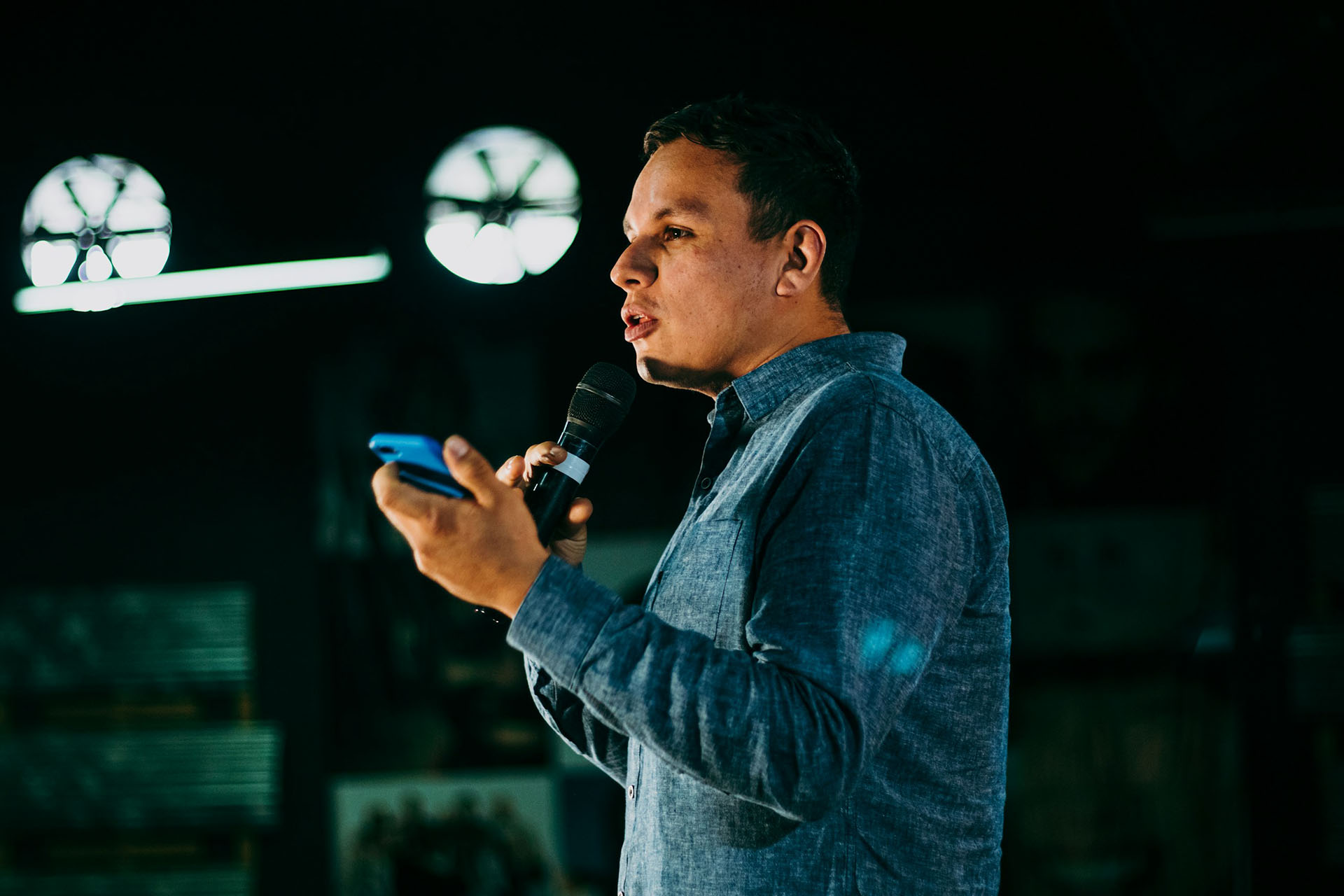
Staying on Mission

René discusses our mission as Christians: reconciliation.
Transcripción
This transcript was generated automatically. There may be errors. Refer to the video and/or audio for accuracy.
Undaunted is our fall series in the biblical book of 2 Corinthians, all about how to stay on track in a chaotic world. Good morning. My name is René, another one of the pastors here at Twin Lakes Church. Want to invite you to go online and download the notes for this message at tlc.org/notes.
If you haven't already, I'm going to start with this. In a very famous Harvard Business Review article called Marketing Myopia, Theodore Levitt wrote about why businesses often fail. His first example was the railroads. Why did the railroads almost all go under? I mean, if you think about it, they were the kings of the world for quite a number of years. And now all of them are just a shell of their former glory. Why? Not because the need for transportation declined. I mean, that grew exponentially as the nation grew. Levitt says their problem was this. The railroads thought they were in the railroad business when really they were in the transportation business. But they didn't see it that way.
And so while they focused just on, you know, building better locomotives and more comfortable carrier cars, they let cars and trucks and vans and ships and airplanes take away the transportation business from them. Another example he talks about in the article, Hollywood, the old movie studios, you know, most of them went out of business or were sold to larger conglomerates. Not because the market for entertainment declined. That, of course, increased exponentially. Also, the problem was this. They thought they were in the movie business. When really they were in the entertainment business. But they didn't see that.
They thought they were in the movie business. And so they saw TV as an enemy instead of an opportunity and just doubled down on making their movies twice as long as before. Really, the only studio that saw things clearly and said, no, we're not in the movie business. We're in the entertainment business was, who do you think? Yeah, I can hear you from here. It was Disney. And so they saw TV shows and theme parks and even cruise ships as part of their business, their entertainment business. And guess what? They are by far the most successful independent legacy studio today.
The point is this. One of the keys to enduring, to lasting, to staying undaunted is to stay on mission, to know your business and then to mind your business. This is true for your own business and also for your life and especially for us as Christians. And here's where I want to apply this this morning. What is our mission? You, me, us, Christians, this church, what business are we in as Christians? Now think about it a second. And I know Christianity is not a business. I'm just using that as a metaphor here.
Some of the answers that I've heard Christians basically come up with in answer to this question are, well, we're in the worship service business or we're in the church building business as in literal buildings or we're in the Bible study business. Now, all of those are good answers. They're all part of what we do, but I would say they're just means to the end. Some people would basically say we're in the morality business, the holiness business. We're trying to get all those people out there to behave or we're in the political power business. We're trying to change the world by getting the right people elected, all tempting answers and fatal errors because these are not biblical.
So what is our business according to the Bible? We really need to know. Well, the Apostle Paul answers this question in 2 Corinthians 5:17–6:2. That's the passage that we're going to look at today in our series in 2 Corinthians. Just to recap where we've been so far in this book of the Bible, the author, the Apostle Paul, has been revealing what keeps him going through imprisonment and illness and all kinds of opposition and what keeps him undaunted really in the midst of all of that.
And in the verses we're going to look at this morning, Paul reveals something else that he hasn't talked about yet, something all undaunted people have, and that's a crisp, clear sense of their business, of their purpose. And I want to start with a challenge for you. Wherever you are watching this, however old you are, I'm going to challenge you to do something. I'm going to read about half of today's verses just right in a row with no commentary. And you tell me what you think Paul's answer to this question is. This isn't a trick question. I think it'll be very clear.
And then what we're going to do is we're going to go back and look at these verses one at a time a little bit more clearly. And I have to tell you before we get into this, the verses we're about to read did more to shape my own identity as a Christian and my ministry as a pastor than almost any other verses. If you want to know what makes René tick, what's the DNA behind Twin Lakes Church and the way we operate, you can't find a more revealing passage than the one that I'm about to read to you.
Starting with the verse we ended with last weekend. "Therefore, if anyone is in Christ, that person is a new creation. The old is gone and the new has come, and all this is a gift from God who reconciled us to himself through Christ and gave us the ministry of reconciliation that God was reconciling the world to himself in Christ, not counting people's sins against them. And he has committed to us the message of reconciliation. We are therefore Christ's ambassadors as though God were making his appeal through us. We implore you on Christ's behalf, be reconciled to God."
All right now, according to those verses, what would you say Paul would answer to the question, what is our business? Really, it's one word he says five times in three verses. That's right. Reconciled, reconciliation, reconciling, reconciliation, reconciled. He says it over and over again so that we won't miss it. That is our purpose. He's saying our purpose as Christians can really be summed up in one word. What is it? Reconciliation, that's right. This is our business.
Our business is not the worship service business. Our business is not, and this may be controversial for some of you, our business is not even the social justice business. Even social justice is a step toward the end that God intends, which is reconciliation together. This is our business. This is our purpose. This is why God doesn't immediately beam us up and rapture us the minute we accept Jesus Christ. We are left on earth to be reconcilers.
Now if this is our business, then what does this word mean? Listen, reconciliation means more than just we are forgiven by God for our sins. I mean, that's great all on its own, but reconciliation carries a deeper narrative to it than that. Reconciliation carries the connotation of making enemies into friends. And this is so powerful. You know, last year there was a movie called Best of Enemies that told this true story. In 1971, the city of Durham, North Carolina convened a committee on racism in the schools, and they asked black civil rights leader Anne Atwater to chair the committee.
But apparently not everyone at the city council was on board with this agenda, because the city, or someone at the city, also appointed, believe it or not, the Ku Klux Klan, the Ku Klux Klan, grand exalted cyclops, and yes, that is an actual title, Claiborne P. Ellis, to be the co-chair, everybody around town called him CP. CP Ellis, the Ku Klux Klan, grand exalted cyclops, was somehow the co-chair of a committee in Durham, North Carolina, on racism. How do you think that went? How do you think the two of them got along? Yeah, not too well.
At the very first meeting, CP actually brought a machine gun and sat there with it during the meeting. And he announced that he was there to, quote, "disrupt everything that everybody was trying to do." And the feeling was mutual. At another meeting, Anne actually pulled a knife on CP and threatened him. I mean, these two hated each other, as you would probably expect. They were enemies.
Here's where it gets interesting. One day, a black gospel choir was asked to come in and sing a gospel song to the committee, and CP started clapping on the wrong beat. On one and three, you could say the white person's rhythm instead of two and four. And so Anne reached over, grabbed CP's hands, and as she put it, "learned him how to clap." And that was their first really civil interaction. And then as the committee kept meeting, guess what? It turned out that hearing firsthand about the black experience was an eye-opener for CP.
Before long, the two of them met privately. They actually cried together. They buried the hatchet, in their case, literally. And CP Ellis left the Klan and teamed up with his new best friend, Anne Atwater, to fight social injustice. Here they are, working side by side in the early '70s, and here they are after decades of close friendship. I love this picture. They became actually the best of friends. In fact, in 2005, at Ellis' funeral, Anne Atwater sat with the family, and she did CP's eulogy. And when she spoke, she wrapped up with these words. You know, I gave them a title much cooler than grand exalted cyclops. I call him "brother."
What an illustration of what Paul is talking about here. God has brought reconciliation, enemies into friends. In our case, we were the enemies. And God reached out and said, "I now call you friends." And you could even say, "He sang us a gospel song." He taught us how to clap. And that gospel song was a love song of His love to us through Jesus Christ. Now, that's the big picture in these verses. If you forget anything else, don't forget that God has come to turn His enemies into friends.
But now let's look at these verses again one at a time, because this is so rich. I think you're going to love this. Verse 18, "All this is a gift from God." We don't earn it. We don't merit it. It's a complete 100% gift. "Who reconciled us to Himself through Christ and gave us the ministry of reconciliation." In other words, reconciliation is our mission. It's our business. Our mission is not, "Okay, now that you're saved, stay in your holy huddle and don't get sullied by that big, bad, dirty world out there, Christians." No, it's go out. It's go out, build bridges of reconciliation, go turn some enemies into friends.
It's our mission and it's our message. You're going to love this. Verse 19, Paul says that God was reconciling the world to Himself, the world to Himself in Christ, not counting people's sins against them. And He has committed to us the, what? Message of reconciliation. Our message is not, "God is mad at you, you dirty, filthy sinners." Our message is, in Christ, God is not counting people's sins against them. God has come to turn enemies into friends. Reconciliation is our mission. It's our message and it's our method.
Listen carefully. We bring this message of reconciliation as our mission with a very particular methodology, and that is a reconciling methodology. We don't go out angry. We don't go out combative. We go out as reconcilers. In verse 20, Paul says, "We are therefore Christ's ambassadors." Now stop there for just a second, because for a couple of minutes I want to talk about this. What is an ambassador? What's an ambassador's job? How does he or she do it?
My family is Swiss. We all have dual citizenship, American and Swiss, so we spent some time at the Swiss Embassy over the years. This is a picture of the brand new Swiss Consulate, which is up there in San Francisco. It's pretty cool when you go inside. It's super clean. It has free Swiss chocolates and little dishes around. They've actually got this Swiss railroad clock out in front. And I kid you not, it always has the precise, accurate time down to the second, because that is a high priority in Swiss culture.
This place on Pier 17 in San Francisco is like a little piece of Zurich or Geneva right down there in the middle of the city. And who leads this place? Who leads all the consulates in America and the embassies of Switzerland? The Swiss ambassador. And bottom line, what is an ambassador's job? To represent his country and its interests well, and to build goodwill toward his country among foreigners. He's a stranger in a strange land, reaching out to Americans and to others to build goodwill toward his country.
And you know, he'd be fired if you only knew Swiss people. He is here in order to literally build bridges, to change the way Americans see his country. Now, do you get this? That's our job. For you it means being a little taste of heaven here on earth and intentionally making friends with people outside of our tribe, with people who may, listen, who may perceive Christians as their enemies. We go out as ambassadors to them.
And I don't know what God has in store for you. Maybe that means God wants you to make friends with that atheist neighbor. Or maybe it means God wants you to make friends with those people you know who are from the LGBTQ+ community who perceive Christians as their enemies. Maybe for you that means Democrats. Maybe for you that means Republicans. Now, this has to be intentional. Going out outside of our country, our nation, to be ambassadors to people outside of our tribe. It is so easy today to just stay within our own social tribe. Do you agree with that?
I love this quote from Eugene Cho. He says, "It is easier than ever to unfollow, unsubscribe, delete those who think or vote or live differently than you with our ability to make social tribes. We curate friends who are just like us and shut others out. But we need a deeper imagination that goes beyond tribalism and cancel culture." I love that phrase, "deeper imagination." Why don't we do this? We forget what business we are in.
The way we act sometimes we think Paul must have said, "We are therefore Christ's commandos. So let's go out and power and smash all our opponents." Or, "We are therefore Christ's police, so let's bust all those sinners out there." Or, "We are therefore Christ's prosecuting attorney." No, it says we're Christ's ambassadors. And so as ambassadors, let's do our job.
Now, part of what ambassadors do is good deeds in the foreign country they live in in order to increase goodwill toward their country. In our case, it means openness to the good news, right? It's what ambassadors do. And let me show you a great, real-life, boots-on-the-ground example of somebody who totally gets this. Each week in this Undaunted series, I've been interviewing another undaunted person on Zoom, and today it's Pastor Artis Smith of New Hope Missionary Baptist Church.
Now, Artis grew up in the heart of Watts. His wife is from Compton. But instead of becoming pastors in a well-heeled, comfortable suburb, they headed straight back into inner-city ministry in East Salinas. Let me show you something. You know what this is? Probably looks like a little white church building to you, right? You know what this really is? This is an embassy of heaven there in East Salinas. This little church is punching way above its weight class.
This is a church of just 150, 200 people, yet they just, listen, they just finished a drive for school supplies for migrant farm workers kids. They supplied nearly 3,000 children. This little church, here's another example. Every single Thanksgiving for the last 10 years, they've had a sit-down Thanksgiving dinner for a thousand people in their neighborhood. They've even gone to the lengths of purchasing cars for people who don't have a car to get to work. I love this church. I love this man.
Here's just five minutes of our conversation this past week. Tell me a little bit about your own background. I was raised in a single family household. There are no men in my household. There are no men in my household by all women. My father left when I was at a very early age. The women who raised us, it was six of us, they had to be strong. They had to be strong because we were raised in South Central Los Angeles. In South Central Los Angeles, it was gang-infested. Either you're in the military or you were going to jail or you were in a gang.
My auntie and my mother, they made sure that we were in church, we were rooted and we were grounded in church six days out of a week. But when I knew God for my own self, when I experienced Him for my own self, it was when actually it was when my mother passed away when I was 18. Then I took Him on as my personal Savior. What brought you back to a neighborhood like that and what's keeping you going? God was in Christ reconciling the world back unto Himself. Because He did that, He has given us the ministry of reconciliation and enabled for us to go out and do the same thing that Christ has done to us.
We think it's imperative that we reach out, we be that arm that we reach out into our community and say, "Look, this is what we have to offer." We do it with no strings attached because that's how Christ did it unto us. You're not just saying go out there and go with words. You go out there with actions, loving actions. I can't minister to those in my community and they're hungry. I have to actually feed them. I have to make sure they're close, I have to make sure that their children have a place to come where we can tutor them on weekends. We tutor kids every weekend right there at our little church.
And so when they see us doing these things, then that opens up another avenue for us to be able to share with them the gospel. So you're a black man in a heavily Latino neighborhood in Salinas. So that's cross-cultural ministry too. Was that a challenge for you? It was. It was a challenge for me. It was a challenge because once again, when I first got there, I think there's one or two families here and they all look like me. And so I said, "This is not going to work." Here we are in the middle of East Salinas and none of our parishioners look like the community in which we serve. I said, "That has got to change." And so we went out, we did door-to-door ministries, we did ministries in the mall, so it paid off because now our church is multicultural. And so we're really happy about that, but it was a challenge at first.
Talk about where our cultural moment is right now, the racial reckoning that we're going through as a culture. What do you think we Christians can do as ambassadors? What do we bring to the table? I think what we bring to the table is the possibility of hope. So many people, pastors, is going through what I say is a hopeless state now, especially African-American parishioners and those who are experiencing racial injustice. They really see that there is no hope, that there is no justice, especially for us. And so our voice has got to be heard and sounded across the nation that there is hope.
I'll ask you something sensitive. There are Christians who look at some of the groups working for the less privileged, groups working for the rights of black people, groups working for the rights of farm workers, and they say, "Well, these groups aren't Christian." And in fact, they may not hold the same values that we hold as Christians. They may be against some of our family values, some of our biblical values. In fact, some of them may be Marxist or communist. So we as Christians can have nothing to do with them. We need to stay away from those groups. Now, you say that that is exactly why Christians should be in the mix. I do believe that.
Imagine this. I had one of my mentors, one of my mentors told me that he would preach the gospel in hell if the devil invited him. And we said, "What?" Of course, if the devil invited me to hell, I would go there armed with the Word of God and preach Jesus and him crucified. And same thing with these groups. We understand that their platform may not be what we believe. We understand that their platforms may be far left. But how will they hear? How will they know if we stay away from them, if it's hands off? We can't allow it to penetrate our belief system, our doctrine. That has to be steadfast. That has to be what we are about. That's our foundation. But we cannot allow it to scare us and keep us away from it either. Because there's overlap, right? If we're seeking reconciliation, then there's overlap. Absolutely. And so we have to be as wise as servants, but as harmless as doves.
That is so good. And it is complicated, right? Being ambassadors of reconciliation. It means you're a stranger in a strange land. So it gets messy. It gets complicated. But that's our business. So let's wrap this up by looking at something I love, the ripple effects of reconciliation that Paul talks about here in 2 Corinthians chapter 5. Man, I just love this. It starts vertical, right? Between you and God. Look at the rest of verse 20. Paul says, "We are therefore Christ's ambassadors as though God were making His appeal through us." Watch this. "We implore you on Christ's behalf, be reconciled to God." Because God has done the work.
It says, "God made him who had no sin," that's Jesus, "to be sin for us." What? Now stop there for just a second. What does that mean? "He made Jesus to be sin for us." What's he talking about there? Check this out. You might have seen the headlines Saturday a week ago. It said, "Holocaust historian offers to serve 10-year sentence of Nigerian boy," and Auschwitz Memorial Chief says, "Let me serve time for boy 13 years old." Turns out that Peter Chawinski, the director of the Auschwitz Memorial Holocaust Museum, offered last week to serve the sentence of a teenage boy in Nigeria who was sentenced to 10 years of prison after reportedly using blasphemous language in a conversation with a friend.
And Peter wrote an open letter to the president of Nigeria. He doesn't threaten. He doesn't scold. His tone is very kind. He simply says this, "I suggest that in place of a child, volunteers from all over the world, myself personally among them, each serve time in a Nigerian prison as his substitute." No word yet from Nigeria about whether they're going to accept the offer, but wow, that is exactly the truth being explained in this verse. Jesus took our place. He served our time, became our substitute, took the penalty for our sin, and it gets better so that in him we might become the righteousness of God.
Now, this is so mind-blowing. Whatever else you're doing right now, just stop and pay attention to this line. Do you get this? Let this just blow your mind. This is going to be life-changing for some of you right now because some of you live with this constant, low-hum background noise of guilt, and you feel like you're always letting God down. I get it because I am a very guilt-oriented person by nature. My default mode is to think, "God must just be sickened by me." And my default prayer is, "God, I am just so sorry. I'm so sorry. I'm so sorry."
Listen, Paul has already said that God is not counting your sins against you, okay? And here he says, "When God sees you," what does he see? The righteousness of God. He sees you as holy as Jesus Christ. Let me make this plain. This means God's not mad at you. God is not upset with you. God is not disgusted with you. He is not counting your sins against you. He doesn't even see it. When God sees you, he sees nothing but the righteousness of Jesus, and he is just filled to infinity with love for you. And so the only thing left for you and me to do is to take one step toward him. He has done all the rest of the reconciling work.
So reconciliation starts vertical. God, to you, this has to come first, and then once you get that, once you relish what God has done, cherish it, you let it capture your imagination, then it can't help but overflow and go horizontal between you and other people. It ripples out. I want you to check this out. Paul loves this word reconciliation. He uses it several times in several epistles that wound up in the Bible. Look at Ephesians 2:15. He says, "He, God, made peace between Jews and Gentiles." And in Paul's first century Roman world, this was the biggest ethnic, racial, cultural rift in the world. And Paul's saying he made peace between Jew and Gentile by creating it himself, one new people. Christ reconciled both groups, Jew and Gentile, to God.
Paul's saying, "Can you believe it in Jesus Christ? Even these two separate groups can be reconciled." That is so beautiful. And then in Colossians 1, he goes even wider. He says, "Through Christ, God reconciled everything to himself." He made peace with, check this out, everything in heaven and on earth by means of Christ's blood on the cross. He means somehow Christ's blood shed on the cross is the center of cosmic history. And what started there is rippling out to everything else. And our role is simply to let it ripple out through us and make enemies into friends all around us to just radiate a spirit, a scent of reconciliation.
Let me ask you this. How is this not perceived by others as our business? How is it that not only do Christians not perceive reconciliation as being our primary business, but people around us, when you ask people, what's one word you used to describe Christians, a lot of times they would think of something that starts with anti. They're anti this, they're anti that, like the opposite of bridge builders. Why do people not perceive Christians as reconcilers? Because we have forgotten what business we are in. If you agree, type amen in the comments section, whatever app you're watching this on right now.
Here's the most basic form of what it means to have horizontal reconciliation waves rippling out from your vertical reconciliation with Jesus Christ. Cross the street and go love your neighbor. That's the most basic form of our ambassadorship. Now, for some of you, horizontal reconciliation means family, friends, you're estranged. There's a coldness reconciled. Paul himself models this in the whole letter to these Corinthians. And for all of us, this means we have a role to play in say racial reconciliation. It means in this divisive election season, we have a role to play in national reconciliation because reconciliation is what we do.
And this is one of the reasons, you know, we take our ambassadorship very seriously here at Twin Lakes. And this is one of the reasons we do our fall food drive starting this weekend because we're ambassadors of heaven. Our goal this year is to provide one million meals, as you heard Adrian say, to second harvest food bank. That sounds outrageous when I say it. But what this really means when you break it down is if every man, woman and children who joins us either in person or on the livestream were to give about $85, we could make that goal.
Now, I know some can give more, others are not in a position to give it all. We're here for you. If you need food, that's why we're doing this. For those who can, let's give because this food drive, this is one of the best things we can do in our community as ambassadors. Now, let me say this. I grew up in a church that emphasized the vertical almost at the expense of the horizontal. And maybe you can relate to that. It was all about our personal relationship with God, but very rarely were social issues talked about.
On the other hand, other churches talk all about the horizontal social justice issues and kind of almost at the expense of the vertical. Biblically, it is both. And so how do we do both? Well, biblically, the time to start either one is now. Let's finish. Paul brings this to a crescendo in the last two verses of our text, the first two verses of 2 Corinthians 6. Don't be fooled by the chapter division there in your Bible, which was added much later. This concludes Paul's thought. He says this, as God's co-workers, we urge you not to receive God's grace in vain.
He's saying, you've been saved by grace. Let it change you. Because the Corinthians were holding grudges against people, including Paul. Paul's basically saying, people, let's not have a five-cent response to a million dollar gift, right? God has graced you, so go out and grace others. For God says, in the time of my favor I heard you. In the day of salvation I helped you. I tell you, now is the time of God's favor. Now is the day of salvation. I heard somebody say there's only one word on God's clock. It is now.
And so let me ask you this. When are you going to reconcile with some of those people in your life? You say, well, I'm going to make that a New Year's resolution in a few months. God says, now's the time. When are you going to reach out to your neighbors so you might have an opportunity to share with them? Now's the time. And listen, maybe you've been considering becoming a follower of Jesus. Now is the only time you've got. Yesterday's gone. You may never get tomorrow. What you have is now. And so I want to urge you, I implore you, as Paul does here, now, today, be reconciled to God and to each other. Because this is our business. And so let's mind our business now.
Would you pray with me? Let's bow our heads together. With our heads bowed, if you long to run into the arms of your Heavenly Father, just pray this in your heart with me. Lord, I want to turn from my sin and to you, Jesus, as my Lord and Savior, thank you so much for forgiving my sin and giving me instead the righteousness of Christ. And now help me to be a reconciler, to be your ambassador in the world. And may this church be a great embassy of heaven here in Santa Cruz County and beyond.
And Lord, we just want to pray for those many who are suffering, for those impacted by the fires, including members of our own staff, for those ill from COVID and other sicknesses, particularly the nursing home residents. I think of the outbreak at Watsonville post-acute care. We pray for strength and for health. And God, help us to help. Give us the will and the means to help generously as your ambassadors of reconciliation, making enemies into friends. And we pray this in Jesus' name. Amen.
Sermones
Únase a nosotros este domingo en Twin Lakes Church para una comunidad auténtica, un culto poderoso y un lugar al que pertenecer.