Don’t Give Up and Don’t Give In!
Daniel's story teaches us to stay pure and trust God's control.
Transcripción
This transcript was generated automatically. There may be errors. Refer to the video and/or audio for accuracy.
This morning, what I want to talk to you about is purity. Purity. And I want to see how relevant this is. So just by a show of hands, how many of you would admit you'd confess if you were honest? And this is church, so, you know, confession is good for the soul, be honest. How many of you would admit, and I'm not asking for specifics here, but in some way, in thought or deed, you at times struggle with staying pure in an impure world? How many of you would admit that that's a struggle at times for you? Look around. Wait, wait, wait. Don't put your hands up. Look around at the hands up. You're not alone. Look at this. Now look at the people whose hands are not being raised. Their struggle is with lying. That's another sermon that comes up later. Because we all struggle with this, right?
Now, the good news is, did you know that there is an entire department of the federal government devoted to your purity? There is. The purity of what you eat. It's called the FDA. And one of my favorite writers, John Orpburg, in his book, The Life You've Always Wanted, talks about the FDA and how some of their purity requirements for food, well, they may not be as stringent as you would like. For example, let's talk about mushrooms. Not the kind of mushrooms for which Santa Cruz is famous. The kind of mushrooms you eat, like with an omelet. The FDA, here's their purity requirement. It says mushrooms cannot be sold if there's an average of 20 or more maggots per 15 grams of mushrooms. I mean, you gotta draw the line somewhere, right? No more than 20 maggots! That is it.
All right, how about coffee beans? Yes, caffeine addicts beware. They cannot be sold if there's an average of 10% or more per container that are insect infested. Or if the inspectors find two live insects per container. Because really, you don't want more than one live insect in your morning brew, right? Do you read that? All right, what about fig paste? Like, you know, for fig newtons, fig paste. If they find more than 13 insect heads per 100 grams, the FDA ruthlessly tosses the entire batch. And what's intriguing to me about this is why specify insect heads? Apparently other body parts are fine. You know, but heads? No, we draw the line.
How about apple butter? How many of you enjoy apple butter on your English muffin in the morning or something like that? Okay, not for long. Because if it averages four rodent hairs per 100 grams or five whole insects per container, it's off the list, but two or three rodent hairs? It's on your English muffin in the morning, my friends. Next, hot dogs. You don't even want to know. Okay, listen. What are your purity standards? And how do you retain your standards of purity in an impure world? How do you stay pure in a world where the average hour of TV has 29 acts of violence? How do you stay pure in a world where the average R-rated movie has an obscene word every two and a half minutes? Average. How do you stay pure in a world that's not?
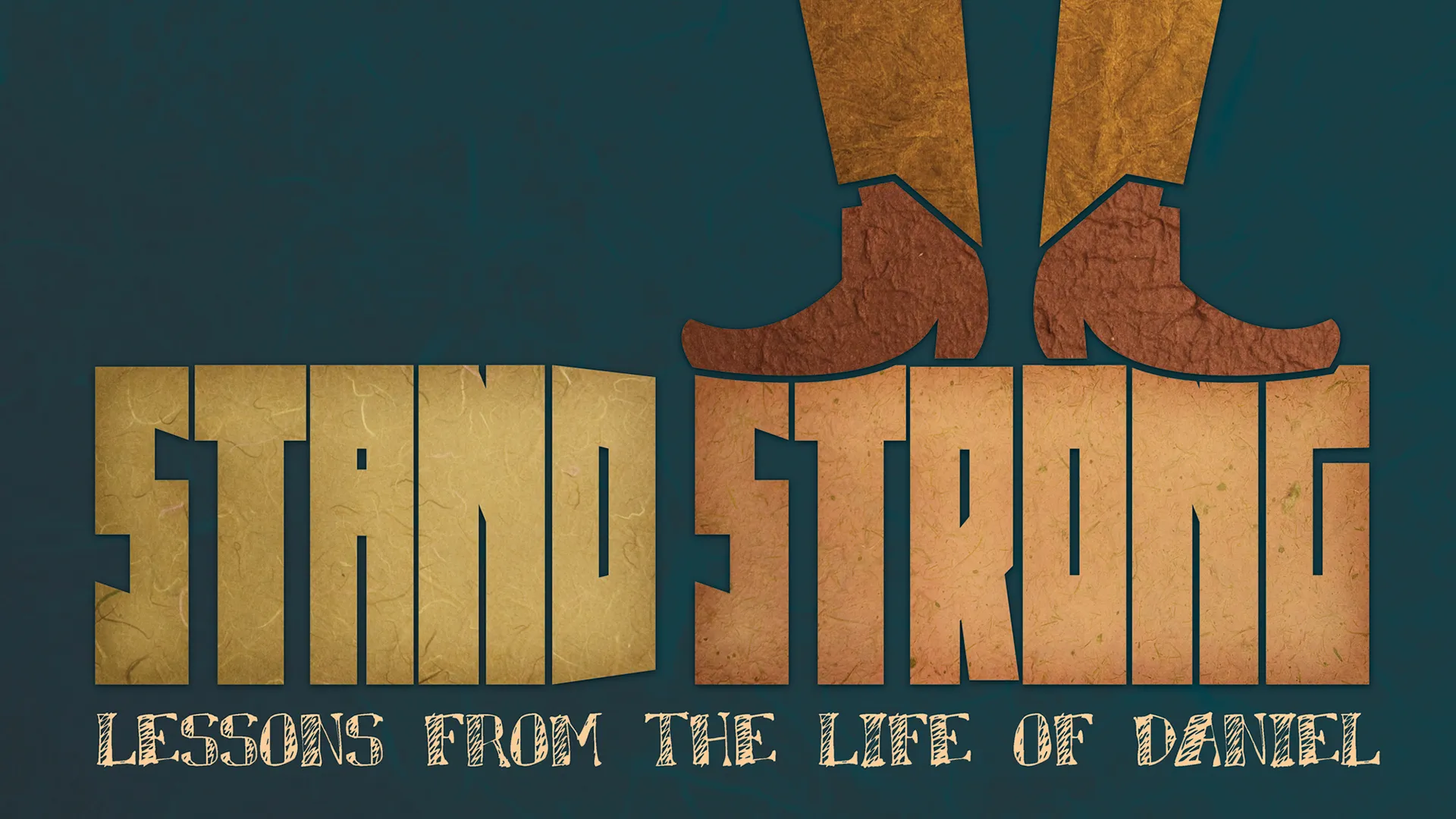
Well, let's look at the guy who gets a gold medal in this, Daniel. Because Daniel stayed pure without becoming a Puritan. Daniel stayed holy without becoming a hermit. Daniel was sanctified without being separated. He stayed pure, and not only did he not become a hermit, Daniel was promoted to the third highest position in the biggest superpower on the entire planet. How did he do it? Well, today we start a brand new series. Grab your message notes. It's called Stand Strong, Life Lessons from the Book of Daniel. I'm really looking forward to this. We're going to spend seven weeks in the Book of Daniel. That's in the Old Testament of the Bible.
And I want to kind of do an introduction for the first half of the message this morning, because most of us, all we really know about Daniel is the flannel graph Daniel and the lion's den story, right? From Sunday school when we were six. But there's a lot more to Daniel than this. There's adventure. There's intrigue. There's spies. There's mystery. There's prophecy. There's stories you probably have never heard before. You're going to be surprised or in the Bible. And you will find yourself motivated and inspired. And I believe changed because the theme of Daniel is the title of the message this morning. Don't give up and don't give in. Anybody need to hear that today? Don't give up and don't give in.
I think a real key to how Daniel was able to not give up, not give in, stay strong, stay pure, you know, is this Daniel's name. Daniel's name has an intriguing meaning. Jot this down on that first blank in your notes. It means God is my judge. And this right here, this is the key to understanding the person of Daniel and the book of Daniel, because this attitude defines the guy. This is a guy who does not care what anybody else thinks, says God's my judge. This is a guy who doesn't care what the king says, doesn't care what his enemies say, doesn't care what his friends say. He says God is my judge, not you, not him, and not her. He's a guy who's living, as we say, for an audience of one.
Now I love this because this is a cure for what a lot of us have a bad case of. And that's approval addiction. You know what I'm talking about? Approval addiction. I'm 50 and I meet people my age who are still addicted to approval from their parents. People still addicted to approval from father figures or mother figures in their lives. And they won't move forward and do a thing unless mom or dad or their mom or dad figure in their lives approve. And it's got them in a prison. Or they're still addicted to approval from their peers. I'm not going to do that because what would my peers say? Or they're addicted to approval from their boss or from their friends at school or whatever age you are, you can have approval addiction. And Daniel's story is a cure for that because he says, uh-uh, God's my judge.
Now you might think, well, easy for Daniel. You know, he lives back in Bible times. Things were easier back then. It wasn't like modern life. Well, after I tell you the story behind the stories in Daniel, you will not think that anymore because here's the setup, the context, the timeline for the book of Daniel. Watch this. To really understand the context of the book of Daniel. First, you've got to go way back to around 2000 BC where God makes a series of promises to Abraham, to Isaac, to Jacob. And he says, from their descendants will arise a kingdom that will never end. Now that was the promise that they clung to a kingdom that will never end. That is so important to understanding the background of this book that I want you to say that phrase with me out loud. Say, a kingdom that will never end. Say it again. A kingdom without end. It'll never end. That is the promise that they are looking forward to.
So does it happen? No. Soon after that, for hundreds of years, the descendants of Abraham, Isaac, and Jacob, the Israelites, they're slaves in Egypt. It's like, well, where's the promised kingdom? But then there's a glimmer of hope. About 1400 BC, the Israelites come out of Egyptian slavery and they wander around for a little bit in the desert, still no kingdom without end. Then they battle giants and kings and they get land. And then finally, around 1000 BC, at last, it's Camelot. There's a united kingdom under David, under Solomon. They're happy. They're living the dream. But then, let me ask you again. What was the promise again? It was a kingdom that will never end. Well, after a couple of hundred years, things change. There's a civil war. The kingdom is divided into north and south. It's severely weakened. They're fighting against each other. And then, disaster part one, 722 BC, the northern kingdom, Israel, falls to the Assyrian army. It is wiped off the map. The dream is unraveling quickly.
Disaster part two, 605 BC, the southern kingdom, Judah falls to Babylon. The people are shipped off as slaves to Babylon. And this is bad precisely because it is Babylon. In the Bible, Babylon is referenced over 300 times. And it's never good. Babylon, the name itself is the icon of evil. It is the symbol of a satanic system. And Babylon here is defeating God's kingdom that should never end. It's an incredible reversal of fortune. It feels like everything is falling apart, like evil has won. This is the moment that the story of Daniel begins. And incidentally, this is also a moment captured for us by Babylonian artists. There are wall sculptures like this one. This shows a Babylonian soldier there at the end. And he's beating with a rod the Jewish captives. The cuneiform writing on the bottom talks about how these were members of the Jewish royal family that at the fall of Jerusalem were being led into captivity back to Babylon.
And I want you to look at these men. These are people, all members of the royal family, they had palaces. They had gold and silver. They had position. They had prestige. And now they're being marched. And the writing says all that they own in the world is in those little satchels on their backs. This is a picture of what the Bible talks about. One thing, though, that I noticed, look at the hats that those guys are wearing. I saw Jeff Neckers, who works for us, who's about 25 years old. He was wearing a knit cap exactly like this this morning. And so these guys would fit into downtown Santa Cruz, I think, without any apparent flaw. But there they go. There's cuneiform tablets that they found in the last several years. These are Babylonian chronicles of the Babylonian kings and armies. And they detail this whole experience down to the year and the month and the date. And so the fall of Jerusalem to Babylon and the shipping off of the captives to Babylon is one of the best attested events in the entire Bible. We know the exact day that it happened.
Then it gets worse. Because in 539 BC, Persians come and take over Babylon. The Persian Empire is on the rise and they wipe out the existing superpower. And think about what this meant for the Jews who were captives in Babylon. For 65 years, they've been learning the ropes in this new culture. Now there's new ropes! For 65 years, they've been learning the language. I got a question. How many of you began life with a language other than English? Can I see a show of hands? I did. Learned Swiss German. That was my first language. Got a lot of you here. It's hard to learn a new language, isn't it? It's hard to learn English. Imagine this. You're learning a new language. You're getting to know the new culture. Now there's a new language. Now there's a new culture. You're getting to know the VIPs, the influencers. Now there's new VIPs. Now there's new influencers. So this book is talking about living in almost total disorientation. Where one thing after another is going wrong. And this promised kingdom that will never end looks like it's gone forever.
I like the way Nancy Orford puts it. The main question of the book of Daniel is this. Is it possible to live with courage and convictions? When my circumstances are completely removed from the dreams I had for my life. Let me ask you. Do you need to hear this today? I talked to a woman after one of the services this weekend. And I know she's just representative of many people here today. And she came up crying and she said thank you for the message. And I said, how was it relevant to your life? She said in the last few months, explaining this to me through tears, I've been through divorce, unemployment, bankruptcy, and the death of a child. She said, I feel like all my prayers are nothing but God, Uncle. I give up. Maybe that's where you're at. Or maybe it's not something specific that's happening in recent months, but it's that sense of cultural disorientation. You look at the paper and the headlines always seem like every day there's new bad news.
So for relief, you turn over to the feature section of that same paper. And our culture just seems like it's getting more and more just crude. And in your own life, you can remember you had dreams. You had hopes. And they haven't come true. How do you not give up and give in when it feels like everything is going wrong? See, it's in times like that that you're tempted to be impure. It's in times like that that you're tempted to say, you know what, serving God has not worked out very well for me. So forget you, God. I'm not going to serve an absent God any longer. And that is precisely what the Jews at this time must have felt like. And what I love about Daniel is you see this question answered, not didactically, in other words, not through lecture or principles or teaching. You see this question answered through stories of the life of a guy who lived through all of this.
The fascinating story of Daniel, because he was a teenager in 605 BC, about 14 or 15 years old. That's all. When he and his friends were carted off to Babylon. And he's an old man in 539 BC when the Persians take over. And the whole time he pulls off this amazing balancing act, he stays pure in this very impure Babylonian culture. Yet he does it without being a freak. Do you know what I'm talking about? He does it without being odd. He is sanctified without being sanctimonious. And talk about a success story. Daniel walks into Babylon with nothing but apparently that little bag over his shoulder. And he goes from worst to first. He's promoted. He's successful. He's respected without compromise. How did he do it? How can you do it? Where you work? Where you go to school? The town you live in? In your life situation?
Let's dive in. Daniel 1. If you have a Bible, crack it open. If you don't, you can grab those brown TLC Bibles. This is on page 625. This is an amazing chapter. It's kind of the introduction to all these adventures that are in the book of Daniel. And it has three acts that happened very fast, like in a movie. Act 1 opens with a bang. Chariots, thundering, smoke rising. The cities and ruins. People are crying. The army's thundering across the screen. Verses 1 and 2. King Nebuchadnezzar of Babylon came to Jerusalem and besieged it. Now stop there at verse 1 for a second. This is almost like the crawl at the beginning of a Star Wars movie, because you come in right in the middle of the action, right? Here's the city that's being besieged. And it gets worse. The Lord gave him victory over King Jehoi, King of Judah, and permitted him to take some of the sacred objects from the temple of God.
Now stop there, because just to highlight how bad this defeat was, it says sacred objects. Well, it's not... You think, well, two or three objects. The Bible says there were 580 items of gold and silver and bronze in the temple, including what? The Ark of the Covenant. Now the Bible doesn't specify the Ark of the Covenant was taken, so we can't be absolutely sure, but certainly the Jews living at the time believed it was gone along with everything else. So this is not just like they're stealing treasure. This is an absolute morale disaster. The kingdom that will never end, that not only doesn't exist anymore. Now the Ark has been melted down to be made into pagan gods. Unbelievable. But check this out. Curious. The author says the Lord gave him victory and permitted him to do this. What's that all about?
If God says I'll give you a kingdom that will never end, why would it say here that God is allowing this pagan king to melt the objects of worship? Let me give you the background. For hundreds of years, God had been warning his people, disaster is coming if you keep living your life of sin. And in Jeremiah 19, which was written just before this happened, Jeremiah says, check this out, it had gotten so bad in Israel that in Israel they were actually practicing child sacrifice. And Jeremiah says the blood of the innocents calls out to heaven. And so basically what's happening here is God is pressing restart. He does a reboot. And 70 years after this happens, the Lord allows the Jews to go back from Babylon to Jerusalem. And they do restart the kingdom. And they do have an amazing revival. But at the time, they don't know it. It doesn't look like it's just going to be 70 years. It looks like it's going to be forever.
And so the author here is revealing something the characters inside the story cannot see. We know about that light at the end of the tunnel. But they don't see it yet. It's pitch dark to them. But in the very first sentence of the story, he's making the point, God has purposes I can't see. Jot that down there in your notes. God always has purposes I can't see. God is in control. And I don't know about you, but you might need to hear that today. You might be in a situation where all your dreams seem dead. Maybe you even feel like a captive in another country. And I want to tell you, God is at work. He'll take disaster and bring amazing good out of it. So don't give up and don't give in.
Act two. You see a hint about some of those plans of God will start to unfold. This is fascinating. Check this out. Verse three. The king ordered his chief of staff to bring to the palace some of the young men of Judah's royal family and other noble families who had been brought to Babylon as captives. Now the next verse says, this is the cream of the crop. It says these were all young men. The king specifies. He says, I want you to bring me the best looking. The ones with the best stature. In other words, like the most athletic, the most intelligent, the ones with the best personalities, the most charisma. Now, why do you think the king is saying, I want you to bring these people to my palace?
First of all, these are young men who are intelligent, charismatic, good looking, kind of athletic young men. In other words, these are the next generation of leaders. These are the kind of young men who would be most likely to lead a revolt. Right? Spartacus. You know? Slave revolt against the Babylonians. And so the king says, all the next generation of potential troublemakers for me, I want you to round them up, bring them to the palace. And what's he going to do there? I'm convinced that these young men thought the king's going to go, you know, behead them. But the Babylonians were so clever, so insidious. He doesn't behead the next generation of leaders because that would have made them what? Martyrs. And they would have been rallying around that cause, right? So what he does instead of making the martyrs is he de-claws them. He defangs them. He kind of takes all the gumption out of them by saying, I'm not going to make you into martyrs. I'm going to make you into Babylonians. I'm going to make you love Babylon so much, you're going to go, why would we even want to go back to Jerusalem? Babylon's awesome!
And part of this group was Daniel and his three best friends. At the time, there were four teenagers. You can call them the Fab Four, right? And here's what it's all about. They're going to be trained, says verse five, for three years. And then they would enter the royal service. For three years, they're going to train them all about Babylonian culture and art and essentially leech out of them their ethnicity. Essentially brainwashing them of any memories that they were Jewish and of the Jewish religion and so on. And don't miss this. Verse seven says, "The chief of staff renamed them." Now, when I was younger, I thought to myself, that would have been awesome to be renamed. Growing up with a name like René Schlupfer, you know, it's like, yes, that's great. Please rename me. You know, Ben Stone or something like that. But that's not the kind of renaming that it's talking about here. This again is trying to squeeze out the one last reminder of their Jewish identity.
Watch this. Daniel, which as we've seen means God is my judge. Literally the name there uses the Hebrew word El for God. It says, "My judge is El, Donny El." Well, they changed this to the Babylonian name Belteshazar, which means may Bell protect him. It's a cruel pun from El to Bell. And they do this to every one of the guys. Identity theft, you could call it. Daniel's three friends, Hananiah. Imagine how funny the time he was little. His mom and dad probably put him on their knee and said, "You know what your name means? It means Jehovah is gracious." Then the Babylonians change it to Shadrach, which means illumined by Shadd, who was a Babylonian son God. Next friend, Mishael, which means who is like God. In other words, it was a cry against idolatry. There's nobody like God. They change it to Mishach, which means who is like Shaq. And Shaq was not a retiring NBA player at the time. Shaq was the name of the love goddess of Babylon.
And in fact, it's from this word that we get our phrase, shacking up. No, that's not true, but I just wanted to see if we're paying attention. One of the other friends, Azariah, which means Jehovah helps me. And at this point, he had to have been thinking, "Does he? Does he?" They changed this name to Abednego, which means servant of Nago, who was a Babylonian fire god. And so everything, everything, everything was taken away from these teenagers. Their home, their royal lineage, their wealth, their position, their family, and now their identity. I mean, they're out there just twisting in the wind. And then they go into this training program for three years. And the Bible says, and this is how I know that it was like behavioral conditioning, because you'd expect the king to treat these captives really bad.
But it says during the training program, the king says, "Give them the best food in the kingdom. Give them the best wine. Treat them as good as anybody's treated." Why? Because he wanted the potential future leaders of Israel to forget them. Forget that they were God's people. To never want to go back. To say, "Why should we want to go back to Israel? This is awesome." Except, verse 8, Daniel was determined not to defile himself by eating the food and wine given to them by the king. And here is where his strong stand starts. It uses the word defile, so apparently the food wasn't kosher. Are you familiar with Jewish kosher rules? That was part of the faith at the time. And Daniel says very respectfully to his supervisor. He doesn't come across and say, "Hey, you better feed us kosher." He says, "You know what? I don't expect you to feed us kosher food. So very respectfully, we'd like to, me and my three friends, would like to be put on a diet of veggies and water, please." He'd totally be a Santa Cruz hero, wouldn't he? "Make us vegetarians, dude." You know, and that's what he does.
And he says, "We want to make this a win-win for you." He says, "Just give us 10 days." That's all. Just 10 days on the veggie diet. And if at the end of the 10 days we're not as fit as the guys who are having the meat and the wine, then we'll do the meat and the wine thing for the rest of the three years. But just let's make this a win-win. That way we'll have kosher food and you guys can do your thing. And that supervisor says, "Okay, I'll agree to that. I appreciate your attitude." Now, the point to the story obviously is be a vegetarian. No, that's not the point. There's nothing wrong with being a vegetarian. But the point is in any place I can live for God. In any place, any place you are, there are ways that you can draw the line and not forget your identity as part of the people of God, even under this kind of brainwashing pressure. Daniel says, "There is a line I will not cross." And you can stay pure too, even when your life is turned upside down.
Are you familiar with the Vietnam War story of James Stockdale? Do you remember him? He became famous when he was held longer than any other prisoner of war, 2,714 days in captivity. That's seven and a half years. And he was a POW in the most brutal prison camp of the Vietnam War, the infamous Hanoi Hilton. He writes in his book about how his captors would shackle him up and leave him in the hot sun for three days at a time. Well, his skin just blistered and then they wouldn't treat his sunburn. He writes about how every time he'd fall asleep, they beat him to keep him awake. And then he writes about how after one beating, Stockdale hears the sound. It's the snapping of towels, which is odd, he thinks. And then he realizes that there's a pattern to the snapping that's repeating. And he starts to recognize that the pattern is Morse code.
And so he listens and he recognizes the letters G-O-D, and there's a pause, B-L-E-S-S, and he realizes that somebody is sending him a message. "God bless you, Jim Stockdale." Somebody knew he was there. Somebody knew his name. And somebody was praying for him. Well, soon other prisoners pick up on that and they start sharing Bible verses in Morse code with towel snaps. And as time went on, they found new ways. If one man walked by another man's cell, they would drag their sandals in code, sending Bible messages and encouraging messages. And then they'd send messages by the noises that they made bodily, like he writes when they would belch. They'd do it in Morse code and send Bible verses and stuff. He said when they blew their nose, they'd do it in Morse code. And I am not making this up. I considered whether to share this, but it is in the book for a few prisoners who had, I'll say, had the rare talent to do this. They sent Morse code messages passing gas. Yes, it's in the book. Some of you, that is the only thing you'll remember from this entire sermon. But I just lost some of you right there.
But I dare you find a better illustration that in any place at any time you can serve God. You can draw the line. You can be an encouragement. You cannot forget your identity as one of the people of God. You might be in a very secular school. You might be the only Christian in your family. You might be in a tough workplace. You can be like Daniel. And notice that Daniel was very respectful to his culture. He never came across like the church later, you know, like, hey, you know, I'm better than you. Very respectful. He said this can be a win-win for you guys. You can be sanctified without isolation. You can be in the world, but not of the world. You can treat people who disagree with you with respect like Daniel did.
Great example of this. Let me tell you about the San Francisco mission outpost. These people are in a place a lot of people call Babylon by the Bay, right? San Francisco. But they've done a great job at getting people in the city, which is very suspicious of Christians, to trust them and respect them. Yet they have not compromised their convictions. One, Iota, one of our TLC outreach teams did a short mission project with the San Francisco mission outpost just this last weekend. They did a Memorial Day barbecue for the community, a carnival where all kinds of people showed up and it was free. And the thing is these people live with the people. They don't just come in and tell them how to live their lives. And if you talk to these people, they love San Francisco. They love the people of San Francisco. They don't get all mad and hate San Francisco.
In fact, they distribute what they call bags of love with essentials like socks, hats, toothbrush, toothpaste. And the city, the city now knows what that means, that term bags of love. Our team said that they distributed these door to door last weekend. And they discovered when you say bag of love for you, bag of love, people in San Francisco know where those bags come from. Oh, that's that church, the San Francisco mission outpost. And they love it. These guys built play structures for kids in San Francisco where there were no play structures. They work with the food bank there and they have church services and other events where they really preach the gospel. To me, they're a great example of being pure without being puritans of sanctification, without separation, and that is the spirit of Daniel.
So back to the plot. What happens on that veggie diet? Act three, they blossom. It says God gave these four young men an unusual aptitude for understanding every aspect of literature and wisdom. Now you have to understand, he's giving them aptitude for understanding literature and wisdom that is not necessarily true. They're being trained in Babylonian mystery religion. This includes a lot of magic and astrology, but God allows them to become excellent students in this odd environment. What that tells me at least is that God desires excellence, no matter where we are. That excellence honors God. That when you're working at the boardwalk or Whiting's Foods or Plantronics or the county or UCSC or Cabrillo College, when you're in that environment, excellence bolsters your testimony and when you don't have that spirit of excellence, it can actually undermine your testimony.
But God gifts these guys. He gives them the gift of this kind of intelligence and fascinating insight even into the Babylonian knowledge. And in fact, it says Daniel remained in the royal service until the first year of the reign of King Cyrus. That is 80 years later. God blessed him with intelligence. God blessed him with influence. And God blessed him with longevity. The point, God can bless me right where I am. I went out to dinner, as I said earlier, with some friends of mine who were visiting from out of town. And this friend of mine is in just a dead end job. He had an amazing position a few years ago as the national program director for a very influential broadcast network. And he lost that job. And now he's working in a windowless cubicle doing collections on home loans for a bank. And he just hates it. He's miserable and just kept saying, "I don't know why God has me here. And maybe you can relate. Maybe you're wringing your hands wondering why is my life wasted in this captivity I'm in? My health is keeping me captive. Or my marriage or my lack of marriage or my job is a dead end. Or my dreams are dead or dying. I'm in a rut." But God can bless you right there. Right in that job you hate. Right in that house that's in the neighborhood you dislike. Right where you are.
In fact, Dallas Willard has this great quote, "God has yet to bless anyone except where they actually are. If we faithlessly discard situation after situation, moment after moment, as not being right, we will simply have no place to receive his kingdom into our life." It's a good quote, isn't it? Think about that for a second. God has yet to bless anybody except where they actually are. If you keep saying, "This situation's too hard or I can't see God working here," you will never be in a place God can bless. He can bless you right now. So don't give up and don't give in. God has purposes you can't see right now. You can live for him right now. He can bless you right now.
See, the overarching message of the book of Daniel is this. God is in control. So don't give up and don't give in. Stand strong. Stay pure. Let me wrap up by skipping to the end of the book. There's a lot of fascinating stories we're going to cover in this series, but I'm going to skip to the end, which is a great example of this message. Daniel eventually becomes head of the royal advisors under the Persians. Now, I got a trivia question for those of you who might have some Bible knowledge here. What was the name for the royal advisors under the Persians? Anybody? The Magi. Now, where do you see Magi elsewhere in the Bible? Hundreds of years later, at Christmas. The Magi, right? We sing the song, "We Three Kings." They were the Magi who came from way away, way some kingdom in the east, to come and see this Messiah who was foretold.
You ever stop to think at Christmas time, where in the world did the Persian Magi ever hear prophecies about a Jewish Messiah? Well, where do you think? From Daniel. In Daniel 7, as chief of the Magi, Daniel has a vision, and he says, "I saw one like a son of man," which is, by the way, the term that Jesus uses more than any other to refer to himself. "I saw the son of man coming with the clouds of heaven. He was given authority, glory, and sovereign power. All nations and people of every language worshiped him, watch this, his kingdom is one that will never be destroyed." He's saying, "Guys, you're in captivity now, but hang on. God's given me a vision of the future, and the Messiah's coming, and he's going to renew heaven and earth, and that kingdom is the one that's been promised us. That kingdom is the one that will never be destroyed." He's saying to the people, "The dream is alive. So don't give up, and don't give in."
In fact, in Daniel 9, Daniel even predicts the time the Messiah would come to Jerusalem and announce himself as the Christ. He says it'll be exactly 490 years from the time that Jerusalem is rebuilt. And guess what? 490 years later, Magi show up in Jerusalem looking for the promised Christ. Daniel's prophecies, made in the seemingly disastrous era of Jewish history, become a key part of the tapestry of the greatest story ever told. You see, this is just one example of how God is always setting his pieces into place like a chess master. In the book of Daniel, in spite of appearances, God's in control. And in your life, in spite of appearances, God's in control.
Best way to remember that? It's communion today. And churches all over the world are remembering how God was in control even at the cross. I mean, I want you to think about it. That right there, that was another time in the Bible when it seemed like it was pure disaster, right? That was another time when it seemed like the dream is dead. Because evil has conquered, you know, the icon of good. And he's dead and he's in a tomb. But once again, God showed, no, I am in control. And I am building a kingdom that will never end. And he worked it out so that at just the right time in history, Jesus came and bore our sins so that whoever believes in him will have everlasting life in that everlasting kingdom. And that Jesus is here, I believe, right now. And he's telling you, don't give up and don't give in because God's in control.
Let's bow our heads together for a word of prayer as we prepare our hearts for communion. Heavenly Father, I know this room is full of people right now. Who have a tough life. Some of us, the life we once had, we don't see anymore. It has vanished. Like the Jews in the book of Daniel. God, I pray that you give us the courage to hold on and believe that you're at work to trust that even when our lives don't turn out the way we hope, your goodness hasn't changed to believe that you are working in our lives and in this world. And then there's other of us, things are going great. We love our lives. It's going fantastic. But we're feeling the pressure to compromise. Help us to hold the line, to be like Daniel, to be in the world but not of it. And God, help us to find our purity, ultimately, not in what we say no to, but in who we say yes to, the Jesus who died for us on that cross we remember now. It's in his name we pray. Amen.
Sermones
Únase a nosotros este domingo en Twin Lakes Church para una comunidad auténtica, un culto poderoso y un lugar al que pertenecer.