Walking in the Way of Peace

René discusses how to find peace through the gospel in challenging times.
Transcripción
This transcript was generated automatically. There may be errors. Refer to the video and/or audio for accuracy.
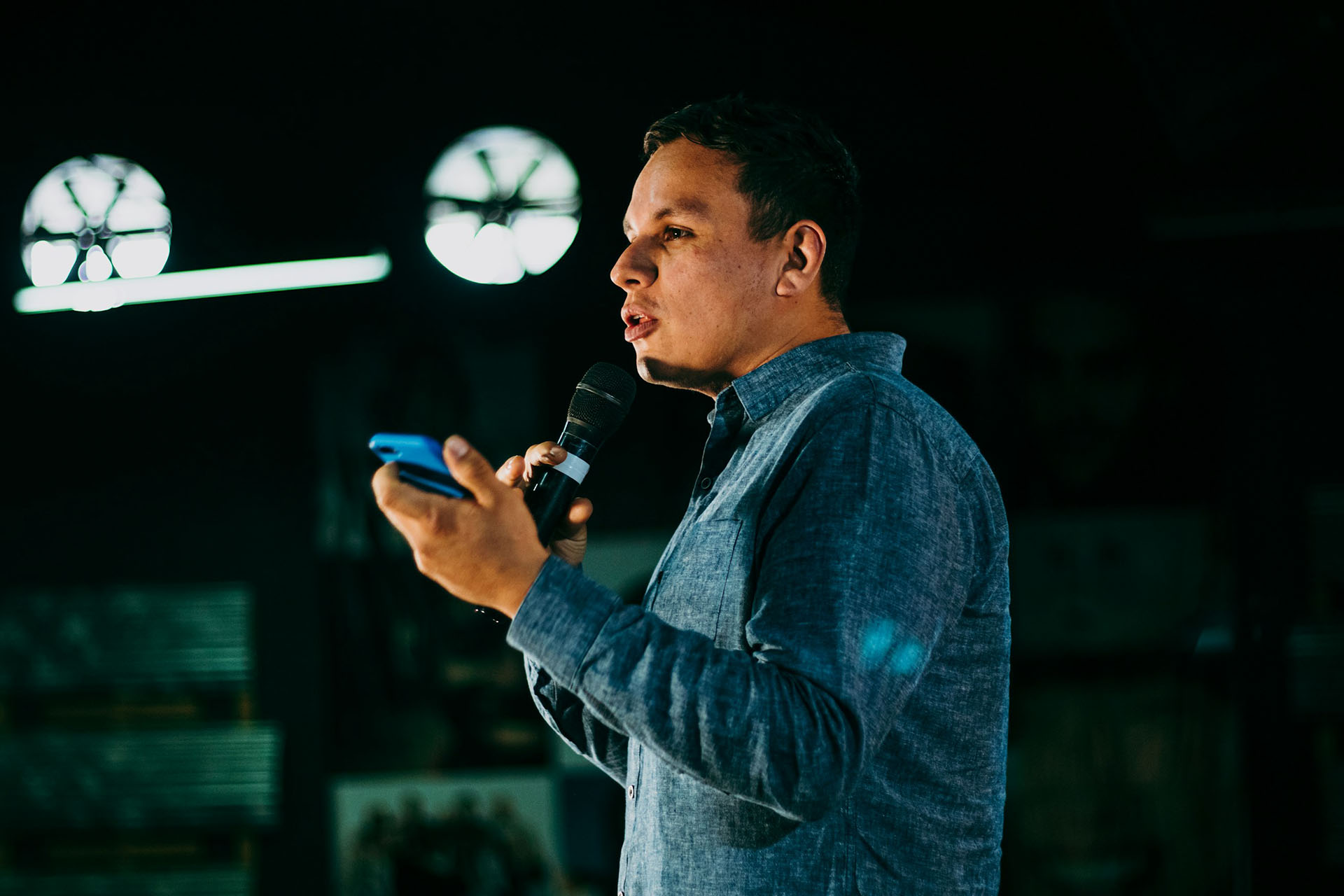
Well, good morning everybody. Who's happy to be in church today? Wasn't that a beautiful worship set? Baptism's coming up after church. What a great day. Chicken and waffles. Doesn't get better than this. To me this is exactly like the early church in the book of Acts. They ate together, they got baptized, they studied the apostles' teaching, they worshiped. This is Acts 2. This is why the church grew so much. They ate all the time together. So it's awesome.
My name's René, another one of the pastors here at TLC. Hey, I gotta show you something right before I get into my sermon. So once in a while there's something cool on social media, right? Once in a while. But I saw this and I had to pass it on for a couple of reasons. Look at this. This is a baby mockingbird. I mean, how cute is that, first of all, right? But here's why this baby mockingbird was on social media, because some accident happened and his little feet got mangled. And so the good people at the California Wildlife Fund put together some little shoes for him. So he can get around and do bird stuff. How cool is that?
Now I wanted to show you that because it's just adorable, but also because we're going to be talking about shoes today here at church. I'm stoked about this. And I was thinking about it. I actually have sort of a strange relationship with shoes myself. And I'll tell you why. Because I grew up, we were very poor growing up. And so it seemed to me like I never got cool shoes because we couldn't afford them. And in fact, I rarely even got new shoes. Our family shoe store was The Good Will down in the neighborhood. And sometimes we really couldn't even afford a lot of shoes from The Good Will. You didn't find shoes that fit you right.
And so I remember very clearly a shoe incident that happened when I was a young teenager. I was in high school and my one pair of shoes, it wasn't even sneakers. It was a brown like dress shoes. And I just had to wear them everywhere. That's the only shoes I had. And the soles were just flopping off the bottom of the shoes. And my mom saw this and was horrified. But at the time we didn't have enough money for new shoes. And so she said in her Swiss German accent, "René, we must pray for new shoes." And I'm like, "Pray for new shoes?" I'm a teenager. And I'm like, "That's not going to work." But she says, "No, hold my hand. We must pray for shoes."
And so she prayed, "Lord Jesus, give René new shoes that are just his size." And I'm thinking, I feel sorry for her. Faith is going to be destroyed because that's never going to happen. And the very next day, brand new, never worn shoes, exactly my size, were left in a paper bag right on our front porch. One of our neighbors must have seen us in need or something. And they put those shoes in the bag exactly my size. And they were the ugliest shoes I've ever seen in my life. Puke green color. They had the already outdated ecology logo and peace symbol on them.
And I realized at that moment when I looked at the bag, what had happened was some kid on our street said, "I am never wearing those. Give those to the poor kid." Right? I actually found a photo online. These are very similar to these shoes right there. That is, those were the shoes. So I told my mom, "There is not a chance I am wearing these to high school. These are clown shoes." She listened to my complaints and explained to me in her patient, logical way, "God has given them to us and you will bear them." So I put them on.
Oh man, I approached high school that day with such trepidation. I was already kind of a nerd. And of course, everybody at school when I walked in looked at these shoes because you can't not see these coming from a mile away. And they loved them. They all went, "Cool. Like retro shoes. Where did you get those? I am a paper bag." I didn't know what to do. It was the first time in my life I had ever been like a footwear trendsetter. Now the shoes that I actually wanted as a kid were PF flyers. Anybody remember PF flyers? Do you remember their logo? They had this for decades. "Run faster, jump higher." I'm like, "If I can only get my hands on a pair of PF flyers, I'll be like Superman."
They were just vans. This was not... This was a lie. They did not make you run faster or jump higher. But I was thinking about this. There are some specialty shoes made these days just so that you can do a certain task. So let me give you a quick shoe quiz. I'll show you some pictures. You tell me what these shoes are for. Like what will these shoes help you do? Hike, that's right. What will these shoes help you do? Golf. What will these shoes help you do? What will these shoes help you do? Never date. No, just kidding. Aya. Joking, Crocs are cool. I should talk, right?
Hey, let's look at some other shoes that are specially designed for you to do some very, very cool stuff to keep and bring peace. Grab your message notes. And we actually have so many people this morning. We ran out of notes. So you can download the notes at tlc.org/notes or on our Twin Lakes Church app. Same goes for you if you're watching the live stream. Your true battle is our series in what the Bible calls the armor of God. So what this is... Excuse me, this is a metaphor that the Apostle Paul develops at the end of the Book of Ephesians.
He's saying, you know, the Roman soldiers, Caesar's soldiers, they wear armor, spear, sword and stuff. We got armor too as Christians. But it's a totally different kind of armor. Their armor is used to kill and destroy and rob. And our armor is used to bring peace and to bring God's grace because it's actually not physical armor. It's spiritual. It's a beautiful metaphor. And I love the fact that Paul is actually writing this from prison in Rome. Nero is the Caesar already. He's imprisoned the Apostle Paul. And we know from history that he later goes on to be executed by Caesar.
But I imagine him there in the prison cell and he's like writing this down and he's looking at the Roman soldier. Like, can you turn around for me a little bit? Because he's looking at the Roman soldier's armor to develop this beautiful metaphor. So what I'm going to read is Ephesians 6. I'm going to go back to verse 10, the beginning of this section. And I'm going to read the whole text and then we're going to go back and examine it. Finally, be strong in the Lord and in his mighty power put on the full armor of God. So you can take your stand against the devil's schemes.
For our struggle is not against flesh and blood, but against the rulers, against the authorities, against the powers of this dark world and against the spiritual forces of evil in the heavenly realms. Therefore, put on the full armor of God so that when the day of evil comes, and that just means the day of testing, the day of trial, tough times that come into all of our lives. When the day of evil comes, you may be able to stand your ground. And after you've done everything to stand, that's three times he said, "Man, stand, stand firm then." Here it is again. "With the belt of truth buckled around your waist," that's the first part of the armor of God, Herman talked about this two weeks ago.
"With the breastplate of righteousness in place," Mark did a great job with that last week. And here's this week's piece of armor, verse 15. "And with your feet fitted with the preparation that comes from the gospel of peace." So what are Paul's original hearers and readers thinking of when they're hearing this, right? They're thinking of a Roman soldier and what he wore. Well, here's what they looked like. They called these Caligae. There were a bunch of different kinds of shoes in ancient Rome, but the Roman soldiers had a very specific design. And in fact, I'm going to magically reach into the television and I am going to pull out these very shoes. It's magic. Look at that.
So these are cool. This is actually a historically accurate reproduction of a Roman soldier's shoes. It's one of the blessings of this job is I'm able to travel all over the world and to a lot of the biblical lands. Several times now, often leading tours from this church, I've been able to go to Rome and Greece and Turkey, where Ephesus was and Israel, of course, and I got these on Amazon, but they're still... They're still historically accurate Roman shoes. So here's what they... Here's the way they made these. So they... First of all, they have these iron hobnails that are nailed into the bottom of these shoes. And these have a couple of different functions for the Roman soldiers.
First of all, they allowed the soldiers to tap dance. No, just kidding. They wasn't about tap dancing. What these were for was so they could stand firm in battle. They were like spikes on an athletic field, right? The second thing they were for was actually as a weapon, because if you got your enemy on the ground, you could stomp on your enemy with these hobnailed boot sandals. And then the third way that they distinctly made these shoes is you may not be able to tell there's three thick pieces of leather that are put together at the bottom of the shoe. So it's a very stiff shoe, which a podiatrist will tell you. That's what you want in a shoe, not a slipper. You want a stiff shoe like this for support.
And so those enabled the Roman soldiers to go on these long, long hikes that they would have to go on. So they were designed to be weapons, specifically for three things. First, stability. You know, those spikes would grab into the ground and you could stand. Second, endurance, the thick soles for those long marches. And third, you gained an advantage over their enemy because once you got them on the ground, bam, you could stomp on them with your waffle makers here, right? So I want you to remember these three things because we're going to go back to them. So say these out loud with me for memory purposes. Ready? Stability, endurance, advantage. One more time. Stability, endurance, advantage.
Wouldn't you love to have stability, endurance, and advantage in your life? How do you get that? Well, let's dive back into the text and look at some clues here and look at a little bit of detail. Remember how Paul sets this whole thing up. He says, "For our struggle is not against flesh and blood." Wait, not against flesh and blood? Where did I just tell you Paul was writing this from? From prison, from a Roman prison. Back in the day, it sure looked like their struggle was against flesh and blood. Flesh and blood Romans wearing iron and steel Roman armor, right? And in fact, those kinds of Romans and those kinds of soldiers have just been stomping against Christians.
Think of what these Christians, when this was written, this was written in the early 60s AD, okay? Like 61 or 62. So think of what these Christians had seen just in the 28 years or so leading up to this. 28 years before this, Jesus Christ himself is killed by Roman soldiers. Stephen is then killed by the temple authorities. Jesus' brother James is killed. Paul himself has been arrested and is about to be killed. And there were a lot of other deaths between Jesus and Paul. I think it's safe to say this is a traumatized community of Jesus followers. It's a lot to go through in just 28 years, you know? Arguably, your three top leaders, James and Jesus and Paul, all killed, or about to be.
And I think the natural human tendency to this kind of hostility would be fear, for one thing, you know, go away and hide somewhere, anger at what's happening to you, and in fact, aggression, some kind of revolt against the Romans. Like you get punched in the face after a while, you want to punch back. Yeah, you want to try that again? Because I got to tell you something. You caught me off guard the first couple of times, but I'm ready for you now. And yet, the very earliest Christians showed absolutely none of these responses, particularly after they saw the resurrected Christ.
I mean, think of it. Jesus, as the Roman soldiers are crucifying him, says, "Father, forgive them." Stephen, as the temple mob is stoning him to death, says, "Father, do not hold this against them." And that permeated the whole culture. In fact, according to historian George Kalansis, there is not one single recorded instance. He's gone through all of the literary records. In 300 years of on-again, off-again Roman persecution of any Christian ever striking back in violence, like not only not an organized revolt or a mob, but not even one person, how is that possible? Because they knew this. They did not see the Romans as their enemies. They saw them as people that God loves.
And so even as they're being killed, they keep telling him, "But God loves you so much." And some of those people, like the Apostle Paul himself, turned from persecutors into followers. Ironically, there was no Christian violence until Christians gained political power 300 years later and forgot this. So question, have we forgotten this? Have you forgotten this? Have you forgotten that your enemy is not people who vote different than you, think different than you, act different than you, look different than you? Your enemy isn't even the people mistreating you. They're not your enemy. Your enemy is not flesh and blood. They're deceived, but they're fighting the same exact battle that you're fighting. They may not know it, but you have a common enemy. A spiritual battle is what you're all fighting together.
Now, there's a reason why this is so important in this cultural moment. All the research shows that a growing number of Christians in America are feeling marginalized and beleaguered and that society is intolerant and more and more hostile to us as believers. And if you feel this way sometimes, maybe when you look at the news or maybe even at your job or at your school or among your friends, how do you respond? Let me put it this way. When you get attacked, how do you attack back? When you get punched, what's your counter-punch? It's interesting because Paul is saying not just be a doormat. He says, "Put on the armor of God." So there is a counter-strategy. There is a counter-punch. There is a counter-attack. But what is it?
A lot of Christians right now are embracing a super aggressive, us against them posture. I was reading an article from the New York Times this morning, this morning, where a pastor quotes a congregant saying, "We have turned the other cheek long enough." It's amazing. Let's fight. But is that move even in our playbook? Let me tell you a true story. Andrew and Noreen Brunson were relaxing at a beautiful retreat on the Aegean coast of Turkey when Andrew's phone rang. And a voice on the other end said, "Andrew, the police were just here looking for you." That call from his church was the beginning of a nightmare that lasted 735 days.
Andrew is an American Presbyterian pastor who for 24 years led a church in the city of Izmir in Turkey. He was thrown into prison, accused of terrorism, even though there was zero evidence. And for over two years, the world neither saw nor heard from Andrew Brunson after his arrest. It was like he went into a black box and just vanished. And finally, after years of diplomatic pressure, he and Noreen fled for the United States after their release. It later turned out it had been one single disgruntled former member of his own Christian congregation that had set him up, just had to add a grudge against him, and told all of these false things to the Turkish authorities about him cooperating with rebels and so on. Not an ounce of truth was behind it.
And of course, the Turkish government leveraged the accusations to make it into a big political tool. Two years of his life just gone absolutely false accusations. Question, how would you have responded? Anger, fear, aggression? So I was riveted by an interview I read with him two days ago. Here's what Andrew said. "We have a love for Turkey in our hearts." And when we say this, it's just love for the culture and the food, the love God has for Turkey. He has placed in our hearts. We continue to love the Turks in spite of what we went through. In fact, we forgive those who harmed us. I love Jesus. I love Turkey.
I mean, how could Andrew have said that? He knows the Turks are not his enemy. Our enemy is not flesh and blood. The Turks are people God loves. But he also has a warning for Americans. Raise your hand if you're an American. Can I see you if you're an American here today? Okay, this is for you. Listen up. He says, "I believe the pressures that we're seeing in our country now are going to increase." And one of those pressures is going to be hostility toward people who embrace Jesus Christ. He says, "My concern is we're not ready for this pressure. And not being prepared is very, very dangerous." He should know.
Not being prepared, not being ready, he says, is very, very dangerous. Why? When you're not ready for the attack, what happens? You attack back with aggression. You attack back with the first weapon you can find, which is usually your anger, because you're not wearing the shoes of the gospel of peace. So if we need to get ready, if we need to get prepared, how do we get prepared? Well, you know, I mentioned that he pastored a church in Izmir on the coast of Turkey. What's fascinating to me? Check this out. Just 40 miles away is Ephesus. And in the letter to the Ephesian Christians written almost 2,000 years before Pastor Brunson's arrest, Paul says, "That's right. You gotta be prepared. You gotta be ready."
Did you catch that emphasis in this verse? With your feet fitted with the preparation that comes from the gospel of peace. Preparation for what? Some other Bible verses say readiness. Readiness for what? Well, I think, I mean, Paul's writing from prison, and those early Christians, as I just recounted to you, they had seen persecution before, and they can smell it in the air. You know, anybody who was here for the CCU fires, have you noticed how anytime anybody's burning any wood, like, you know, your alert goes on, they're like, "Smells like persecution." And they were right.
We know that less than two years after this letter was written, Nero would launch his bloody campaign against Roman believers, blaming the Roman fire on them, executing probably thousands. Mob attacks would follow across the Roman Empire, killing beloved leaders of churches. And I think Paul is saying, "Yep, you are exactly right. It's coming again." So, be prepared with what? The shoes of the gospel of peace. Make sure you got these on, because they'll give you stability, they'll also give you endurance for however long it's going to take, and they're actually going to give you an advantage over the enemy. Because they're not going to expect you to fight with this weapon.
They're going to expect you to fight back or just roll over, but you're not going to do either one of those things. You're fighting with very unusual weapons. So that begs the question, what is the gospel of peace? Well, the word gospel means good news, so what's the good news? Well, this is at the end of Ephesians. What's Paul been teaching for the previous five chapters of this letter? If you've been with us, you know it boils down to three things. Number one, I have peace with God. Remember what he said in Ephesians 1:7, in him, Jesus, we have redemption through his blood, the forgiveness of sins in accordance with the riches of God's grace that he lavished upon us.
I'll tell you what the number one worst attack against Christians is, and Christian churches, and it's not persecution. Do you know what it is? A false gospel. A false gospel of works that somehow, you know, you kind of maybe you can get in the door through Christ's grace, but then really to assure your salvation to be a good Christian or get God's blessings, you've got to do this and this and this and this and this. You've got to behave this way. You've got to cut your hair this way. You've got to vote this way. Who knows? And so you have to keep trying, trying, trying, trying, trying, trying, and it never seems like it's enough. So against that attack, you have to keep circling back to this man. You're redeemed, you're forgiven, you're lavished with blessing of God's grace, not by your works. That gives you stability to stand in those withering attacks. Why? Because this gospel is unchanging.
And then number two, I have peace within myself. Peace within myself. You know, Laurie used to tell me, "René, you are the single most guilt-oriented person that I know because I constantly felt like I'm not good enough as a pastor, as a husband, as a dad, as a worker, as a follower of Jesus. I could do more. I should do more. I can do more." I was never at rest. And I can tell you as a pastor, I've lost count of how many Christians have told me that they're plagued with those feelings. But you see, that is an attack. You know what the Bible calls Satan? The accuser of the brethren. That accusing voice, that's not coming from God. It's coming from the other place. The Holy Spirit convicts. The Holy Spirit doesn't condemn because the Bible says in Christ there is no condemnation for us in Christ Jesus.
So I need to be prepared for those attacks. How? Paul says, "May you have power to understand." How wide, how long, how high, how deep is the love of Jesus for you? He says, "Man, I just pray that you could experience the love of Jesus. It's infinite. It's divine. It's unconditional." You know, as we say around here a lot, you need to keep preaching the gospel to yourself. One of those accusing voices come into your head. You just, you say back to them, "I know I'm not perfect and I never will be in this life, but I also know God loves me perfectly and unconditionally, not because of anything I do or leave undone, but because of Jesus Christ's sacrifice on the cross for me." Do you know what it means when you soak yourself in the gospel of peace? It gives you endurance, right? That hard soul of those shoes. Endurance for the hike.
I think of my mother-in-law June who's sitting right here in the second row. June, is it okay if I tell this story? She said no, but I'm going to tell it anyway. I, um... So her husband, my father-in-law Paul, was shot by a gunman in Phoenix several years ago in a mass murder. A couple of people were killed. Many, many others were shot. Paul survived, but it was touch and go for a number of days as the bullet was lodged in his back. And June would say that she can tend to be a warrior sometimes, but in that moment, probably the greatest crisis of her life, June said, "René, it's like the peace of Jesus is just surrounding me like a blanket." Do you remember that? You said, "I can't explain it. It's supernatural." Why was she feeling that? She was prepared.
She'd been preaching the gospel of peace to herself and to others for decades. So she knew Jesus loves me and Jesus loves Paul and Jesus is with me and Paul now. And no matter what happens, even if Paul dies now, Jesus will still be with Paul and will still be with me. And soaking herself in the gospel of Jesus' love for her gave her what the Bible calls a peace that passes all understanding. Listen, life is going to happen. Are you prepared? It's not just like when the chaos happens, it's like, "Oh yeah, whatever René say." Are you prepared with your feet firmly planted in the gospel when the day of evil comes?
But the third aspect of the gospel of peace is the one that Paul by far has spent the most time in the book of Ephesians. It's this, "I have peace with others." This is what really blows his mind that the gospel brings, you know, natural enemies together. Look at what he says in Ephesians 2:14, "Jesus himself is our peace who has made the two groups, one, that's what Jesus does, and has destroyed the barrier, the dividing wall of hostility." Now Paul here is talking specifically about Jew and Gentile, but he applies this principle to any groups. He says in Galatians, Colossians, Jew, Greek, slave, free, rich, poor, male, female, we are a one in Jesus Christ, amen?
Jesus breaks down all barriers, cultural, linguistic, you know, ethnic, skin color, any language barrier. And by the way, this is one reason we think it's so important for us to have TLC and Espanyol. Our slogan is "One Church, Two Languages." And I want to show you, if you don't know, every Sunday at 11 a.m. our Spanish language service meets, it's growing. We already have 50 women signed up, 50 for our Spanish women's breakfast in August. We have three home Spanish Bible studies every Wednesday. I am so grateful for Pastor Julian and his wife Jessica and their team. But the point is this, with a third of our county being Latino, we want to make something very clear. The gospel is not just for one language or one ethnic group or one skin color. We are one in Christ Jesus, amen? One.
And this is what is tripping the Apostle Paul out. In fact, he says this is my specific mission. He says I became a servant of this gospel, what gospel? That gospel of bringing the two together. By the gift of God's grace, this grace was given me. What grace? To preach to the Gentiles, the boundless riches of Christ. He's saying I'm a Jewish guy preaching to my natural enemies, the Romans, about peace. That's what it means to wear the shoes of the gospel of peace. I no longer see them as enemies, but as people God loves. That is our mission, amen?
Paul says in 2 Corinthians, listen, God reconciled us to himself through Christ, and he also gave us the ministry of reconciliation. First of all, it's the message that God is reconciling the world to himself in Christ, but also it's a method. He says we're therefore Christ's ambassadors, and I love that metaphor of ambassadors because ambassadors are bridge builders, right? Ambassadors are diplomats. What this means is peace is not only my message, the gospel of peace, peace is also my method. It's how I walk. It's how I move through life.
What's this look like? InterVarsity Christian Fellowship is an amazing college ministry. They're all over the country. They were recently kicked out of Tufts University. The reason, listen to this, the doctrinal and behavioral standards for InterVarsity leaders were distinctly Christian, not just that anybody could attend, but for the leadership, it was distinctly you had to be a Christian, and so because they wouldn't allow, say, an atheist to be president of InterVarsity Bible Studies, they couldn't be allowed officially on campus. So how did InterVarsity respond? Well, they were kicked off campus, so they found another home to meet in.
They were followed by hecklers who, every time they would come to Bible study, would accuse them of being hateful bigots and so on. So they brought water and donuts to the groups protesting them. Every week they looked for ways to bless the college with cleanup days and so on, and when they appeared before the administration, they were always peaceful. New York Times columnist David French wrote about it. Listen to this. This is in the New York Times and the National Review. "With my own eyes, I've seen young college students braving physical intimidation in deliberately darkened hallways to respectfully defend religious freedom. I've seen young women endure death threats, yet double down on their faith commitments and commitment to free speech for all. Young students have been subjected to star chamber-like proceedings in which furious campus administrators tried to hector them into doubting and denying their faith, and these students have turned out by the hundreds, crowding campus buildings to pray for their university and protest their unjust punishments.
How could they respond with such peace and love? Because they were prepared. You know, they were laced up with the shoes of the gospel of peace. So what happened to InterVarsity? Well, Treven Wax says, "In the last four years, InterVarsity has grown at a double digit rate. They're nationally not only back on Tufts campus, they're in a hundred new campuses around the country since that happened. They're serving 40,000 students up from 31,000, and most importantly, their conversions are up 172 percent." So let me ask you this. You feel like Christians are being marginalized and all this stuff, I can't believe what the crazy thing's happening. Does that mean defeat? Does that even mean decline? Apparently not! Not when you don't fight back with their weapons. You fight with our weapons, like the gospel of peace.
Here's an idea for you. The next time you hear about some cultural challenge, don't view that as an obstacle. View that as an avenue for you to walk with the shoes of the gospel of peace. Not an obstacle, but an avenue. I mean, remember what Jesus said. Look at Luke 6:26. Let's read this verse out loud together, all right? Let me hear you. "Love your enemies. Do good to those who hate you. Bless those who curse you. Pray for those who mistreat you." Here's the way I've been trying to remember that when I see somebody on the news or I see whatever somebody who is mad at me or says some bad thing or shoots me with an angry email or something, I try to remember PBS. Pray? I gotta pray for them. Bless? I'm going to thank, encourage, compliment them, serve. I'm going to look for a way to serve them. PBS. Pray. Bless. Serve.
You know what this does? We've talked about stability and endurance. This gives you actually an advantage over your enemy when you have your feet fitted with the preparation that comes from the gospel of peace. Now you might say, "But René, this is so naive. Wear the shoes of the gospel of peace." I can see why somebody wore peace signs and ecology symbols on their shoes would say something like that. That's such a '60s... Maybe it's something about the '60s, right? '60s AD. People said that. Our own 1960s. People are like talking about that. But René, it doesn't work. It didn't work for the Ephesians. You know who the pastor of the Ephesian church was when Paul wrote this letter? You know him. Timothy, Paul's disciple. You know what happened to Timothy? A mob surrounded him on the streets of Ephesus, beat him up with sticks because he was a Christian and he died of his injuries two days later.
So you might say, "Well, you know, great. They tried it. It didn't work." Yeah, in the short run, in the long run, Ephesus is a rubble-filled tourist attraction today. But the little movement Jesus started in places like that as of this weekend, more than two billion people globally and counting. Eventually, after 300 years of Roman combat boots trying to stomp out Christians, who outlasted who? The majority of the Roman Empire said, "No, our Lord is actually Jesus, not Caesar, without one sword ever raised against the Roman Empire, not one time." And that can happen again if we refuse to fight with the armor of this world and we choose instead the way of Jesus. Don't choose the way of Caesar. Choose the way of Jesus.
And this is not just academic. Today is your opportunity to go out into your world and bring peace. Every room you walk into should become more peaceful because you just walked into it. The internet should be a kinder place because you're on social media because you're choosing the way of Jesus, not the way of Caesar, the way of peace and not the way of aggression. I'll close with this. Here's what this looks like. Helen Berhany is a Christian in Eritrea. Eritrea is a country in Africa where Christians are experiencing tremendous persecution. She was arrested for her faith and placed in a metal storage container as her jail cell. No ventilation, no sanitation, no legal representation. In sweltering heat, her imprisonment lasted two and a half years.
During the time she was only taken out to be beaten, yet the Lord literally gave her a song to sing that even changed the hearts of her captors. Listen to this two-minute clip from a speech she recently gave at a Voice of the Martyrs' Conference in England. I have one song. God gave me this song when I was in that metal shipping container. It says kind of, doesn't matter if I'm freezing, but I will follow my forefather's foot, so I will sing that song.
Isn't that remarkable? Remarkable. How was she able to do that? She was prepared, soaked in the gospel of peace. Wouldn't you love to just radiate peace like her? Me too. Here's the thing. To radiate peace, I must first receive peace, the peace of Jesus. And the good news is he's here right now to give you that peace. Let's pray together. Would you bow your heads and your hearts with me? Heavenly Father, thank You so much for the peace You bring through Your Son Jesus and Your Holy Spirit. First, I want to pray for those in the midst of chaos right now. Let them walk out of church with assurance.
And I pray for those being attacked right now somehow. Empower them to respond not with aggression but with peace. And finally, I pray for all of us here at TLC, may we be peacemakers in Santa Cruz County. May we bring peace to our communities, peace to our families, peace to our workplaces, peace to our neighborhoods, peace to those struggling around us. And we pray this, God help us to choose the way of Jesus and not the way of Caesar and to be very discerning when those two ways are presented to us. And I pray this in the name of the Prince of Peace, Jesus Christ. Amen.
Sermones
Únase a nosotros este domingo en Twin Lakes Church para una comunidad auténtica, un culto poderoso y un lugar al que pertenecer.