Solitude and Slowing

René discusses the importance of solitude and slowing down in life.
Transcript
This transcript was generated automatically. There may be errors. Refer to the video and/or audio for accuracy.
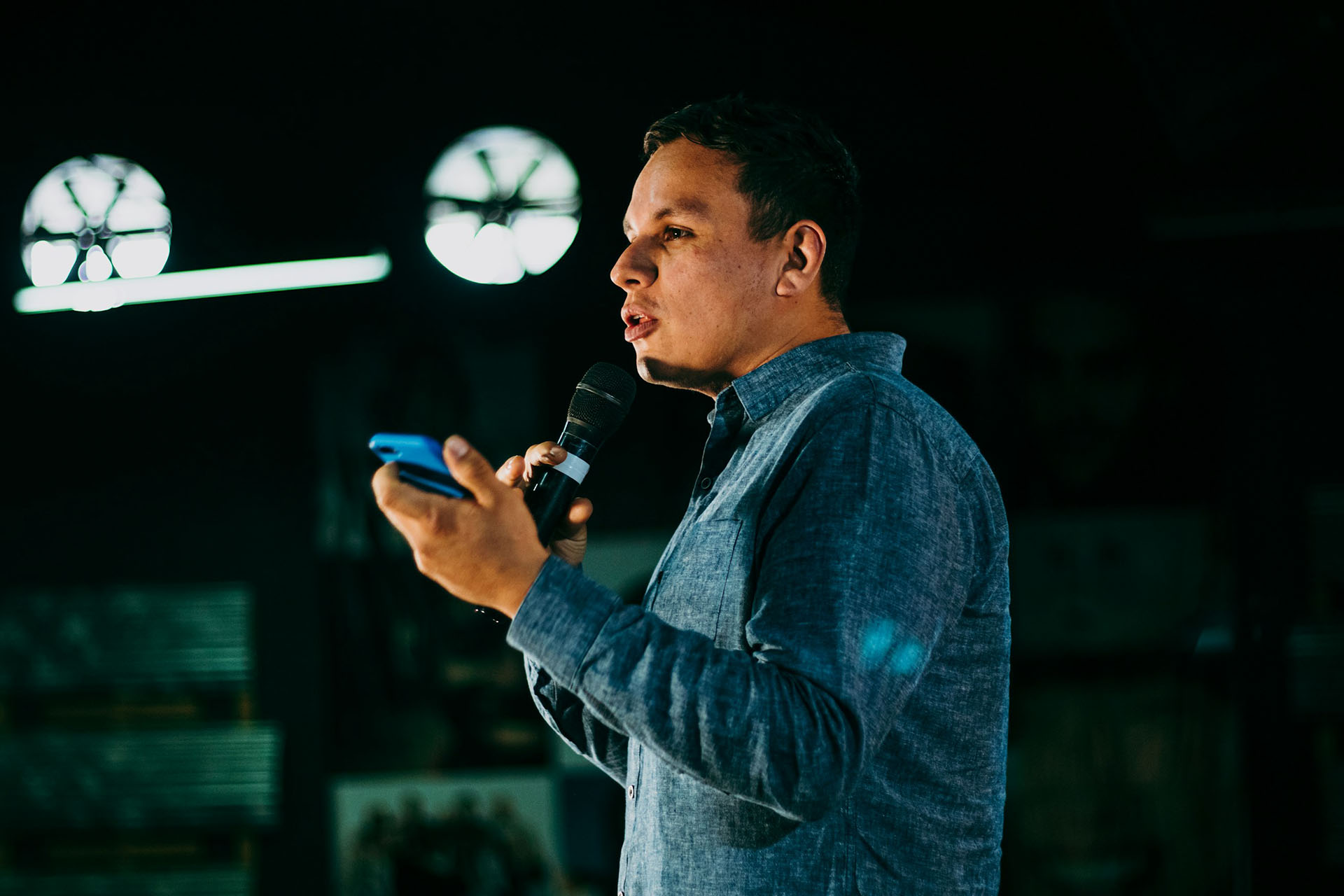
Well, hi everybody, my name is René. I'm another one of the pastors here at Twin Lakes Church, and I am super glad that you guys are joining us today via YouTube or Facebook Live or Vimeo, our website, wherever you are joining us. We're super stoked that you are with us. And I just want to add my comments to Adrian's. I want to invite you to reach out to us, send us messages through social media, or you can email us your messages as well. We would love to hear from you.
And we've already heard from several of you. I mean, literally hundreds of you. I love some of these notes. Somebody sent me this. So since you don't have to do the sermon at church, will you be broadcasting from your living room in your pajamas? I know we will be watching from our living room in our pajamas. And pajamas seems to be kind of a theme with the text that you're sending me. Somebody said, "Stay at home, stay in bed, have coffee, and still attend church." Could this be a small definition of heaven? People actually are loving this.
Somebody sent us a picture of them making pancakes while watching our service on streaming in the last hour. So we love that. We want to hear from you again, #twinlakeslive, or you can email us info@tlc.org. I would love to hear your answers to two questions. Is there an upside to this for you? Are you in any way seeing any kind of benefit in your life? And how have you been helping? Have you found that there are some ways that you can help your neighbors? We would love to know because we'd love to share it with other people.
You know what? I really, truly think that we can all be brought spiritually closer, even though this is pulling us spatially apart. And I think that can happen in our look at scripture as well. We're in a teaching series here at Twin Lakes Church right now called Rhythm, Walking Daily in the Spiritual Practices of Jesus. And guess what we were already scheduled to talk about today? Time out the spiritual practice of slowing down. Can you believe that? I had no idea when we scheduled this months ago that it would be this relevant this weekend.
I saw a graphic on a website this week. Time out, breaking news, coronavirus stops, sports world in its tracks. And it's true. NBA, hockey, golf, suspended, baseball, postponing their opening day. March Madness canceled, not to mention Broadway, the Disneyland resorts, all the big concerts. Everything is stopping. But here's what I think. This is a disruption, yes, but it's also an opportunity.
This is a huge opportunity for you to deal in black market toilet paper. No wait, that's not right. It's an opportunity for you to be the church through your house, through our homes as Twin Lakes Church now has been disseminated into thousands of homes all across Santa Cruz County and beyond. You know, we've always said the church is not four walls and a roof. It's us, it's people. And now here we are meeting in our individual homes just like the ancient Christians in the Bible. Only of course they didn't have YouTube and they were being tortured by Nero. But other than that, it's exactly the same.
And God used those ancient house gatherings of Christians in amazing ways. And I know God is going to do it again. As you worship in your homes, as you keep your eye out for your neighbors and how you can help your neighbors. In fact, I wanna encourage you, if you know any of your neighbors' contact info today, text them or call them up and say, "Hey, is there anything we can do to help? How are you doing?" Because that's a way to truly love your neighbor and be the church.
And of course we can actually take advantage of social media for once and truly connect with one another on a deep level. I was walking in the forest on Friday and I came across this scene. The water had eroded away the hillside. So there was about a 30 foot cliff and these redwoods were right on the edge of the cliff, leaning over and I thought, "Why are they not falling down?" And then I remembered. Redwood root systems don't go very deep, but they do spread wide.
In fact, redwood trees interlace their roots with other redwoods. They tell me as far back as a hundred feet in the forest. So these redwoods that are right on the edge of a precipice are fine because they're cantilevered out, interlaced with the roots from their redwood community. And I thought, what a great example of what it's like to be the church in our day. We can stay interconnected, interlacing our roots, connecting to one another and supporting one another. We truly have an opportunity to be the church.
And this is also an opportunity in another way. This kind of national timeout is also an opportunity to discover the blessing of slowing down, to slow the pace of life and recenter our lives around what's truly important. You know, now that you can't watch live sports, now that you can't go to most theaters, what are you gonna do to use all that extra time with, right? What are you gonna, how are you gonna fill that extra time? I would suggest don't just binge watch Netflix. Fill that time in another spiritual way, begin a new habit.
I just finished reading a great new book by John Mark Comer called "The Ruthless Elimination of Hurry." And the intro to my message really is gonna be a reader's digest of much of that book. He says, here's how he got this interesting title. A pastor he knows named John Ortberg here in the Bay Area phoned up a spiritual mentor of his named Dallas Willard. Dallas Willard was a USC professor of philosophy. And John asked Dallas, "What do I need to do to become the man I want to be?"
And there was a pause. And then Dallas Willard answered, "You must ruthlessly eliminate hurry from your life." Then there was another pause, still pausing. And then John says, "Okay, okay, what else?" And Dallas Willard says, "There is nothing else. Hurry is the great enemy of spiritual life in our day. You must ruthlessly eliminate hurry from your life." I don't know about you, but I definitely need to hear this.
There was a famous woman named Corey Tenboom who survived Nazi concentration camps and became a well-known speaker. And she said something I'll never forget. If the devil can't make you sin, he'll make you busy. And there's real truth in that because both sin and busyness take us out of relationships, relationships with one another, relationships with God, and even a relationship with ourself, our own soul. But busyness is a real problem in our culture today.
A philosopher named Roland Rolheiser says, "Our society has pathological busyness." Everyone right now feels overloaded. In fact, here's a telling stat. The average American works nearly four more weeks per year than we did in 1979. Can you believe that? How did we get so busy? Well, in his book, John Mark Comer has a brief history of hurry because it hasn't always been this way. But four major inventions changed our relationship to time.
And I wanna share this with you because I found this very thought provoking. First, around 200 BC, the sundial was invented and almost instantly, everybody was complaining about what this new technology was doing to the pace of life. And I'm not kidding. A Roman writer named Plautus wrote this, "The gods confound the man who first found out how to distinguish hours, confound him too who in this wretched place set up a sundial to cut and hack my days so wretchedly into small portions." What a great quote.
Next time you find yourself too busy in the day, quote Plautus, right? Gods confound the man. I love this. And then around 1300 AD, the clock tower was invented that was the year that the first fully mechanical public clock tower was erected in Cologne, Germany. Now before that time, time was natural. You went to bed with the moon and you got up with the sun but the mechanical clock changed all that. It created artificial time and it changed society.
One historian says, "Here was man's declaration of independence from the sun. Only later would it be revealed that he accomplished this mastery by putting himself under the dominion of a machine with imperious demands of its own." And then in 1870, Edison invented the light bulb which of course made it easier than ever to stay up after dark. And what has that capability done to us? Well, brace yourself for this stat. In 1870, the average American slept 11 hours a night. Right now, it's down to seven. Wow, like thanks light bulb, right?
And then in 2007, the iPhone was released into the wild by Steve Jobs and how radically has our world changed since then? A new study found that average iPhone users, get this, touch their phones, an average of 2,617 times a day. And that adds up to about two and a half hours a day that people are staring at their phone screens. Now that's all iPhone users. A recent study of millennials put this number at about twice that. And one effect of all this is our attention span is dropping drastically.
Some of you, I already lost you. You're on your iPhones right now playing Candy Crush because I got boring about five minutes ago. But those of you who are still with me, check this out. In the year 2000, before the digital revolution, average American attention span, 12 seconds. So it's not like we had a lot of wiggle room. In 2020, it's down to eight seconds. And to put that in perspective, a goldfish has an attention span of about nine seconds. That's right, people, we are losing to goldfish. And I think that's a huge problem.
My point is all these devices conspired to kind of unhitch us from the natural rhythm of life. And so the pace of life got faster and faster and faster and faster and faster. And right now it's at a fever pitch. And it's gotten to the idea that we're deeply ingrained in our society is the idea that slow is bad and fast is good. Think about it. In our culture right now, slow is a pejorative. When the service is bad at a restaurant, we say it's slow.
When a movie's boring, we complain that it's slow. When somebody doesn't get a joke, we say, "Hey, a little slow on the uptake there." But is slow bad? As somebody pointed out, all the spiritual masters from both inside and outside the Christian tradition agree on something as do secular psychologists. If there is a secret to happiness, it's this, presence in the moment. The more present we are to the now, the more joy we tap into and hurry by its nature is antithetical to being present in the moment.
And so this national time out, as hard as it is economically and emotionally and physically could actually in some ways be good for our souls if we let it. And that brings us to Jesus. Are there practices from the life of Jesus that can help us stay present? I mean, think about it. Jesus Christ's schedule was full. He was in constant demand under constant criticism, near constant threat, yet somehow he never comes off hurried or frazzled, right? You read the gospel, he always, no matter how hectic his schedule got, somehow stays grounded and centered.
How did he do that? I think there are two simplifying spiritual practices in his life, part of his life's rhythm. And you and I need to learn how to incorporate these into our lives now. And I think this time right now, this time in history, could be an amazing opportunity for us to begin to develop these two habits. And the first is solitude. Solitude. No matter how busy his life got, Jesus Christ made time for solitude.
Mark 1:35 is basically one long chapter about Jesus's very first day on the job as Messiah. And it was a marathon day. He's up early, he's teaching in the synagogue, then healing Peter's mother-in-law over lunch, and then out healing people until dark, and then he goes to bed, and then this. Very early in the morning, while it was still dark, Jesus got up, left the house, and went off to a solitary place where he prayed.
I mean, you'd think that he'd sleep in after such a busy day, you know, or have a late brunch with the disciples. Instead, he's out the door seeking solitude. And the story's not over. Next verse. "Simon and his companions went to look for him, and when they had found him, they exclaimed, 'Everyone is looking for you.'" You know, a modern translation might be something like this. "Jesus, where have you been? TMZ, paparazzi are all around. Jimmy Fallon wants you. Hashtag Jesus is trending. Get on this publicity ride." And what does Jesus say?
Jesus replied, "Let us go somewhere else to the nearby villages so I can preach there also. That is why I have come." As John Mark Comer puts it, "That's Jesus for no." And as the gospels go on, you realize that finding time for solitude was a huge priority for Jesus. There's a story in Mark 6:31 where the disciples are just dead tired. And it says, "Then, because so many people were coming and going," watch this, "that they did not even have a chance to eat." Have you ever had a day like that, where it's so busy you don't even have a chance to eat? I know right now all you parents of toddlers are going every single day. Right, we've all been there.
So what does Jesus say to the disciples in this circumstance? He says, "Come with me by yourselves to a quiet place and get some rest." And I think Jesus is saying this to you and me as well. Right now, come with me by yourself to a quiet place and you will find rest. Now you might be thinking, "Man, René, I would love to do that, but how do I do that with my life the way it is right now?" We will get to that with some how-to suggestions. But right now I wanna look at the second spiritual practice that's related to the first, silence.
In Luke's gospel, it says, "The news about him, about Jesus spread all the more so that crowds of people came to hear him and to be healed of their sickness." So you have crowds just banging on the door and then look at the next line. "But Jesus often withdrew to lonely places and prayed." Now that phrase there, lonely places, can also be translated from the Greek word eremos as deserted place, wilderness, or my favorite, a quiet place. I love that. Because don't you long for that just to go someplace quiet.
Yeah, I don't know about you, but I grew up in a church tradition where people used to talk about the need for a, what they called daily quiet time. Do you remember that? I think that a lot of people in my generation kind of shrugged that off as some sort of holdover from legalism, but it's not a legalistic requirement. God won't love you more if you have a daily quiet time. He already loves you unconditionally and infinitely. But you know what? You might sense his love for you more because you're paying attention.
Quiet time, lonely places, they're a gift for you to receive. And it says he did this often. In fact, in Luke's gospel, it says, "Jesus went to a quiet place no less than nine times." So listen, if Jesus needed to make sure this was in his schedule for his health, then for sure you and I need this too, right? So this week, if you can, all of our schedules are completely different than normal. So if you can, get out to nature like Jesus did. Lots of amazing places here in Santa Cruz County and the surrounding areas to do that, like Nicene Marks, Henry Cowell, De La Viega Forest, or Eastcliff, Westcliff, Seacliff, the Harbor, Wilder Ranch, and just try being quiet.
That's a discipline all by itself, right? Not listening to a podcast, not listening to your favorite jogging mix, just the waves and the wind and the leaves and the birds. And I know you're gonna find it rejuvenating. The spiritual discipline of slowing found in daily solitude and silence. And I just think that right now, when we're being asked to have solitude, they're using the word self-quarantine, turn that word around and call it solitude and take advantage of the spiritual benefits of that.
Now listen, I know this is gonna be easier for some of you than for others. Right now, parents with little kids at home are going, are you kidding me, René? This is impossible, especially right now. No school, right? The kids are at home running wild? Well, just some suggestions for you. How about after you put the kids to bed, prioritizing this before catching up on the chores, before dropping on the couch for a Netflix binge for 30 minutes or 10 minutes or two. Anything is better than nothing. Just sit down, stare into space, pray, read some scripture, prioritize it.
Another idea, see if you can partner with a neighbor or a friend where you can give each other time for solitude. Maybe a neighbor has kids, you watch their kids, they watch your kids, so you can both have some solitude time. If you're married, spouses, please give your spouse some time so they can do this. If you're in an extended family, in-laws, aunts, uncles, grandparents, you can help. It is that important. And then of course, the biblical pattern, which we don't have time to get into today, is to do this a little bit every day, but also to practice Sabbath, take a weekly day of rest to get into this rhythm.
Now listen, I wanna make something clear. No guilt trip here. I am preaching this to myself as much as to anybody. No guilt, just an opportunity. You know, I just finished a book about the building of Disneyland, and there was a great little story in it. It seems when they opened the Autopia, Disney Mechanics put speed governors in these Autopia cars to keep them just putting along at five or six miles an hour along the track, right? Well, almost immediately, some enterprising Orange County teenagers figured out how to remove the speed governors.
So there were Autopia cars careening around the track at 50 miles an hour. Well, thankfully, there were only a few broken bones and some chipped teeth before the managers figured out how to keep that from happening. But I read that and I thought, I feel like what's happened in our society is we have taken off our speed governors. It used to be that people talked about taking a daily quiet time and a weekly Sabbath. And that kind of put us into a sustainable rhythm, kind of slowed us down.
But now that we're no longer doing those habits, we're all rocketing around the Autopia track, breaking our bones. So take a stand against our hurried culture and put the speed governor back on and go at a slower pace. Now I wanna wrap up by looking at the opportunity before us right now in this crisis. The Bible says, be careful then of how you live, not as unwise, but as wise, making the most of every opportunity because the days are evil. We have an opportunity before us right now. Let's make the most of it.
Now there's another way you could translate this phrase and it's as redeeming the time. Literally redeem the time. That means see time as a limited asset like money. How are you spending your time? What are you getting in exchange for it? You know, if the results you've been getting are lousy, if you've been feeling constant anxiety, high levels of stress, burnout, little to no sense of the presence of God, an inability to focus your mind, odds are the way you've been using, spending your time is off kilter. Something's out of whack.
So make the most of this opportunity where we've all had to press pause on normalcy to kind of reinvent your schedule and put that speed governor back on and start a new habit of slowing through solitude and silence. Now one more verse I wanna leave you with and this is an important change that you can make right now. In Philippians 4:8, the apostle Paul is writing during a crisis. He is in a Roman prison under a death sentence. Christians are being persecuted by the emperor Nero. And so what is the apostle Paul's advice on how to deal with all this life-threatening stress? He says you need to be very intentional about how you direct your thoughts.
He says, finally, brothers and sisters, whatever is true, whatever is noble, whatever is right, whatever is lovely, whatever is admirable, if anything is excellent or praiseworthy, think about such things. Really, that's his advice? In times of life-threatening stress, I'm supposed to focus on beauty, on the good news, on heaven? Yes, that's exactly what Paul did. Now this doesn't mean that you won't have tough times. I mean, Paul actually died in prison, but whatever you choose to fill your mind with changes your emotional trajectory, no matter what happens.
No matter what happens in life, no matter what happens during this crisis, you can either be miserable and worried or confident and peaceful. It all depends on what you set your mind on. As John Mark Comer puts it, "We become what we give our attention to for better or for worse." You know, one thing that that verse in Philippians definitely means for us right now, listen, stop constantly checking for news updates on the coronavirus.
You know, I read that they say ironically, constantly checking for news about the virus makes you more vulnerable to the virus. Now, how does that work? Well, there's a man named Rolf de Belli. He's a PhD in Switzerland who's actually done research on this and he says, here's the way it works. Constant alarming news is toxic to your body because alarm triggers the limbic system. This releases cascades of cortisol. This deregulates your immune system which causes nervousness and susceptibility to infection.
So don't check that feed all the time. Don't live in this constant state of alarm. That's bad for you. Somebody said, don't go for updates on the outbreak. Go for upgrades on your intake, right? Don't just intake alarming news all the time. Intake Bible verses. Intake beauty. Intake joy. Dr. Helena Kekmanovich is a professor of psychology at Georgetown University and she said in an article this past Friday about how to fight stress about the coronavirus, to reduce anxiety. I recommend limiting your exposure to coronavirus news to no more than 30 minutes per day.
Instead, practice mindfulness, spend time in nature and employ relaxation techniques. Exactly what we've been talking about here. Only she left out the best part, which is Jesus. You know, I wanna suggest that you and I make a rule. We're only gonna check for coronavirus news updates like twice a day, say at 10 a.m. and 6 p.m. That is going to be more than enough for you to know what you need to know.
You know, we get this illusion that if I listen to the news, I'm gonna be more in control, but that's an illusion. Give up trying to control what you can't control anyway and be in the moment and deliberately fill those moments with love and with beauty. Now here's what I wanna do here at TLC to make this easier for this to become a habit. As Adrian mentioned, every weekday morning at 7 a.m. you can get a free text from us with a link to a video, just a simple two or three minute meditation on scripture and you can text TLC to 41411 to sign up.
I wanna invite you when you get that text at seven or some other time during a day, take a deep breath, watch that devotional and then ponder the scripture in it. And maybe you're saying, I don't wanna go near my phone because I'm giving it up for Lent or something. Well, then at least for this week, I put those same daily scriptures in your sermon notes. You can download the notes, you can print them out at TLC.org/notes. It has daily directed meditations for you.
So just to summarize, during this time of an enforced timeout from our regular routine, let's all take advantage of it and start a new rhythm of slowing through solitude and silence. In fact, let's start that habit right now. In a moment, I'm going to show you an example of the kind of video devotionals that we send out. First, I'm going to pray. We're gonna be joining churches all over the country during this national day of prayer. But then after my prayer, stay tuned and just relax and soak in these verses for a minute or two. And then we're gonna close our time together with a song and show you some of the pictures that have come in during this broadcast.
So would you pray with me? Lord, thank you so much that you love us. Help us to be your church in our neighborhoods, to look out for our neighbors and help us to make the most of this opportunity to develop these new habits of solitude and silence. Lord, I pray for all of our leaders and our county, our state, our nation in countries around the world. May they have wisdom and courage and insight. And Lord, I just wanna pray for anybody who's frightened of death today, that they would have the peace that comes from knowing that their eternal destiny is secure.
In fact, I pray that if anybody's insecure now, they would pray, Lord Jesus, I trust in you for my eternal life and my daily life because of what you did for me by conquering death and sin on the cross and by rising again, I don't understand it all, but help me to understand it better as I put my life in your hands. In Jesus name, amen.
Join us this Sunday at Twin Lakes Church for authentic community, powerful worship, and a place to belong.