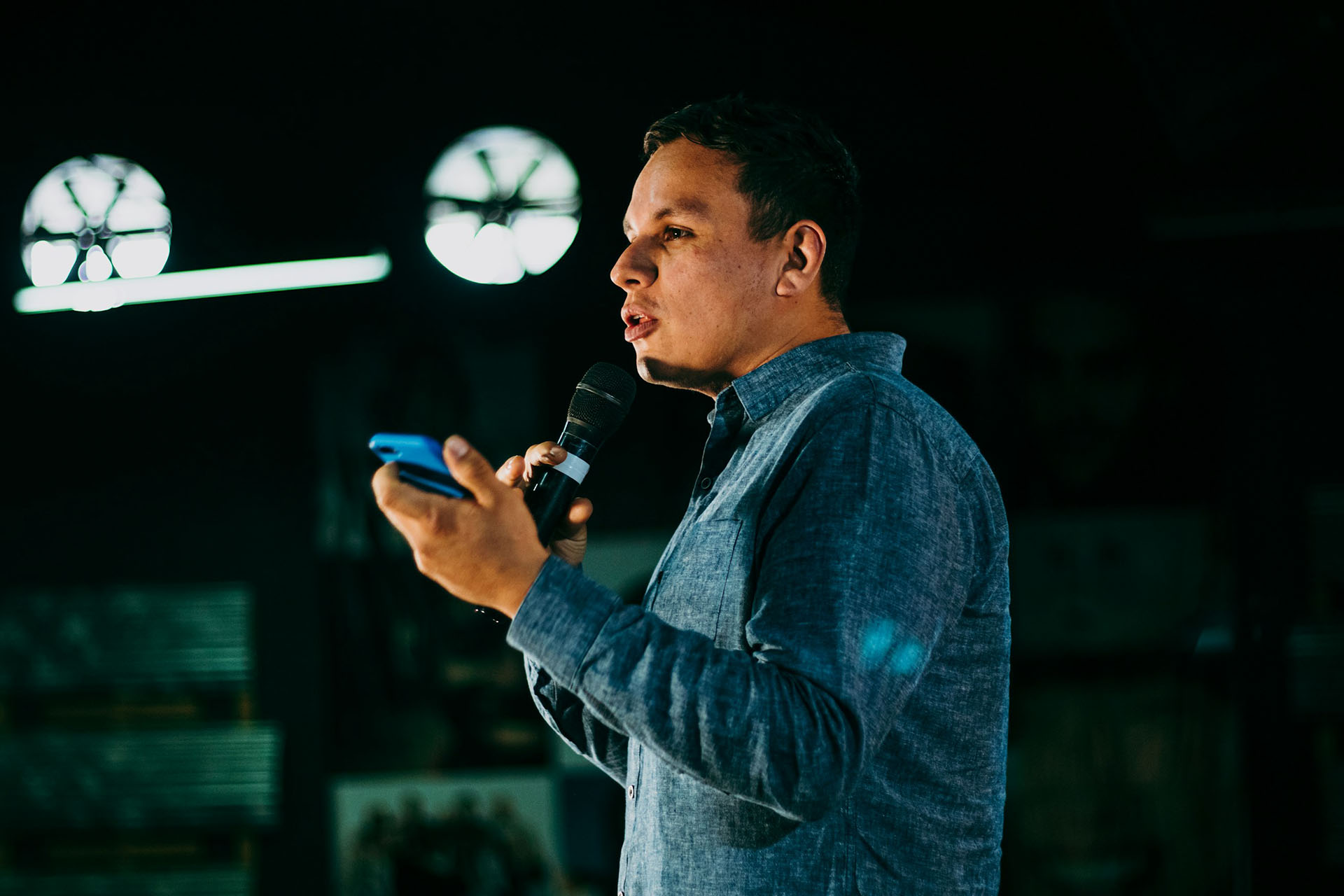
Unity in a Divisive World

René discusses the importance of unity in a divided world.
Transcript
This transcript was generated automatically. There may be errors. Refer to the video and/or audio for accuracy.
The Way Forward is the name of our series that we're in right now because we're talking about how to navigate all of the cultural landmines that just seem to surround us. How do we move forward with unity as Christ's ambassadors in our world? I gotta be honest with you, as a pastor, this concerns me far more than the fires. This concerns me far more than even the coronavirus tensions and frustrations because the virus, the fires, these are huge challenges, but they're challenges that I'm confident we can get through. Tension, disunity, that can bring down a church and that can bring down a nation.
And if you don't think it's a big problem, I want you to listen to a couple of passages from some messages I got in the last couple of weeks on Facebook via email. One young woman wrote me, "René, there is such a big divide right now in our world." She says, "It seems political party lines are defining faith in today's world." Don't you see that? I see that all over the place. She goes on, "Pretty much all my Christian friends are on the opposite side of the political party lines from where I am." I, she says, "Honestly, I'm not even really a party line type of person." But they take such strong stances that I feel like I can't have an authentic relationship with these friends anymore. Everything is an argument and I'm feeling I don't belong in this crowd.
Any conversation leads to heated discussions and I'm left to think that maybe, maybe, I am no longer a Christian at all. She says, "René, I'm falling away and I'm starting to question the reality of the Christian message altogether. I wish that these people that stand hard with their politics knew how they're actually driving people away from God. And I'm pretty sure I'm not the only one." You know, I am a hundred percent sure that she's not the only one who feels this way because about two days after I got that Facebook message, I got this one from another young woman. I am struggling with my faith in God, but why? Why is she struggling? Here's why. Because of what I've seen from those who call themselves Christians who are cruel to immigrants, people of color.
Now, growing up in Twin Lakes Church, I was never taught to think that way. Thank God. I'm glad to hear that. But now I have a difficult time wanting to associate myself with any Christians due to this, if that is what they really believe in. Now, every time somebody says, "Pray." I find myself wanting to roll my eyes. I've never felt that way before. I hope you can help me find my way back to God. So are you seeing what is happening in both of those Facebook messages to me? Political discussions that really may not have anything to do with the central tenets of our Christian faith are driving these two young women away from the faith. Or at least that's the way they're feeling. That is their experience.
And it's not just young people. I got this email from a retired couple in our church. It says, "We find ourselves navigating the minefields of this time, even with some friends and family, arguments over COVID concerns, mask wearing, racially charged observations. It is so exhausting." Do you relate to that? I know I do. There is division and suspicion and tension seemingly tearing apart our world right now. But you know something fascinating? Jesus saw this coming. Two thousand years ago at the Last Supper, and here's that famous Leonardo da Vinci painting of that moment, Jesus Christ is initiating holy communion at this event.
He prays what's been referred to as the high priestly prayer, his final prayer for the disciples before he knows he's about to be betrayed and put on trial and executed through crucifixion. He has something on his heart that he wants to pray. And in John 17, the author of the Gospel of John reveals to us what was on Jesus' heart. He has a prayer request before God. You know, when I think of prayer requests, I think of the end of Bible studies, like a home Bible study. You're sitting around in a circle, maybe on couches and stuff in your house, or maybe now because of COVID. You're sitting outside on your driveway. And at the end of it, what's traditional is the host says, "Hey, does anybody have any prayer requests you'd like to share, right?"
Well, imagine Jesus is in your prayer circle, and he lifts up his hand. He goes, "Yeah, I got a prayer request. Something's really, really got me real concerned." What do you think Jesus Christ's final prayer request was? What was on his heart that he wanted to be sure that we knew? Well, in this passage that John records for us, we discover what Jesus Christ's biggest prayer request was. Today, I want to look at three things. What did Jesus pray? Why did Jesus pray it? And most importantly, how can we do it? What did he pray? Why did he pray it? How can we do it? How can you and I be the answer to the most heartfelt, final prayer request of Jesus Christ before his crucifixion?
Well, let's look at this in the Gospel of John chapter 17, starting in verse 11. He prays for his disciples in that room. He prays, "Holy Father, protect them by the power of your name, the name you gave me so that..." Now stop for a second. "Protect them so that..." What? What does he want the Holy Father to protect his disciples from? What needs to be safeguarded? What is he so concerned that they be protected? Earlier he says protect them from the devil's schemes. And here he's praying that they would be protected from the devil's schemes. What is the devil's strategy that Jesus Christ says that you and I need to be protected from? He says protect them so that they may be one as we are one.
That is the final prayer request before his crucifixion of Jesus Christ. He's praying for oneness, for unity because he knew if those 11 guys that were left there among his followers in that little upper room, if they stayed unified, he knew the world would be changed. But he knew if they splintered, if the unity disintegrated, his movement would fall apart. Now watch this, "And then he prays for you and he prays for me." This is so amazing. Skip to verse 20. "My prayer," he says, "is not for them alone. I pray also for those who will believe in me because of their message." He's talking about the next generation, the next generation, and the next generation. All the way leading up to you and me.
And so what do you think Jesus Christ prays for us? Hint, not what we usually pray for us. In fact, I would say that there's a lot of us, maybe the majority of us, who have never prayed for what Jesus Christ prayed for. We haven't prayed with passion and fervency for Jesus Christ's all-time, number one biggest prayer request for us. And I think maybe that may be part of the problem. He says, "My prayer is not for them alone. I pray also for those who will believe in me because of their message." Watch this, "That all of them, all of them." Now think about this. In the first century, what did this mean? All of them meant Jew and Gentile. It meant Romans, it meant soldiers, it meant Samaritans, it meant women, it meant slaves, it meant free people, it meant tax collectors, and those from whom taxes were collected.
It meant the educated, the uneducated, the wealthy, and the poor. In the 21st century it means Republicans and Democrats and the independent and the indecisive and the privileged and the not-so privileged and the black and the brown and the white and the married and the single, and on and on, Jesus prays that all of them, all of us in all of our amazing, fantastic human diversity may be one. As Andy Stanley says, and I'm quoting him extensively in this message, he did a three-part series on this passage that's phenomenal. He says, "This sounds impossible, but Jesus Christ was convinced this was imperative. This is not some add-on, this is all, and Heavenly Father, wouldn't it be nice if they also kind of got along? This was not a PS to his prayer. This was his prayer. This was mission critical to Jesus Christ.
So we should be intentional about making this a reality in our church. But it doesn't come naturally, does it? I mean, a disaster like the fires that we've been going through, they tend to bring us out, we unify for a while, and then we tend to run to our little corners politically and racially and every other way. That's just human. That is why Jesus Christ prayed for it. He said, "My church is going to be different. My gathering is going to be the place where black and brown and white and liberal and conservative and socialist and libertarian and on and on can actually be one. Love each other in unity." And I know some of you are going right now because you've been on a steady diet of all the rancor and division in our culture. You're going, "Hey, that's just not... In the 21st century, this vision is just not possible."
Well, Jesus goes on, "Father, just as you are in me and I am in you, may they also be in us so that..." Now stop there again for a second. "So that..." What? Listen carefully, man. If you haven't really been paying fully attention to this, let's just draw a bead on this truth from Jesus. Why does Jesus Christ ask for oneness among us? Just so that we wouldn't have friction in our little small groups? No. It actually doesn't have anything to do with us. He says, "So that the world..." As in the world of people outside our faith. The world of people outside our church. The world of people who would drive by Twin Lakes Church and kind of roll their eyes, those Christians. "So that they may believe, may be convinced of what? That you have sent me." What? Yeah, Jesus Christ is saying the absolute best argument for our faith.
When they see here what they do not see anywhere else, unity beyond the normal social divisions, that more than anything else, is what will draw people to believe in Jesus Christ. That's how important this is. And that's why reading those emails that I just read to you a few minutes ago, man, they just broke my heart. And Jesus doubles down on this in the next verse. He says, "I have given them the glory that you gave me, that they may be..." What? One. "As we are..." What? One. "I and them and you and me, so that they may be brought to complete..." What? Unity. Now, unity here does not mean political unity.
Because if you just look back at those disciples sitting around that table in the upper room of the Last Supper when he was praying this, those disciples were incredibly varied politically and socially. I mean, just two of them. You had Matthew sitting at that table and he was an institutional guy, a status quo guy. He was a tax collector. That meant he was in support of the Roman system that they were all under. And then you also had Simon, who was a zealot, and that was the political party that was dedicated to overthrowing the system that Matthew represented. And both of them were in this little group of 12 people, both specifically picked by Jesus to demonstrate this point. There can be political diversity, but missional and spiritual unity.
And then Jesus keeps going on this theme. Here it is again. It's not about us. Then the world will know that you have sent me and have loved them as you have loved me. It's all about showing the love with which we have been loved. Earlier in the night, Jesus said, "This is my command. Love each other." When we do that, when we love in unity, people are drawn. God is not a Jesus. Let me put it this way. The best argument for our faith is the church being the church as described by Jesus. Listen, do you have some loved ones or neighbors that you really hope will get to know Jesus Christ personally? And maybe you've been searching for just the right book that might convince them or just the right sermon that you can send them a link to that might draw them closer to Jesus Christ.
The best argument for our faith actually is just the church being the church as described by Jesus Christ. Loving others in unity. And let me just say, we've seen evidence of this right here on our campus for the last 10 days or so in our fire evacuation center. People literally in unity putting political differences aside, loving one another. The other day I walked around and just asked people, "Hey, how are you doing?" "What's it like here at the evacuation center?" Listen carefully to what they said. It's just wonderful because where I came from, you know, it was just terrorized by I thought my house was going to blow up. And this is like a little slice of heaven. It's so nice. People are so generous and kind and loving. It's just, it's great.
We came in Friday night and we were evacuated from home and very few things we brought with us. We were able to get electricity and water and people were dropping things off for donations and food is just so overwhelming. The generosity of the community and the church members has just been wonderful. Has really given us peace and just feeling the love. And it's such a scary time for everyone. Twin Lakes has just been awesome. This is the best campsite we've ever been to in our life. Meals three times a day. I helped in the donation area today. I helped a homeless woman find the right place for her to be where she felt safe. And it was just, everything is awesome.
When I sent a text message to Val asking if there might be a place in the parking lot for us to park our trailer for a few days, I never in my wildest dreams expected. The sheer expression of love when I was greeted by Barry with water and electricity and Val who came around a few minutes later to say, is there anything else you need? It just melted my heart. I couldn't imagine a more loving place to be in a time when you just felt broken. What are those people experiencing? They're just experiencing the church being the church.
You know, I saw it all throughout the week. There was a group of men who were among our evacuees and they said a few days ago, you know what? Let's go serve someone else. We've got some skills. And so they went to the home of a Twin Lakes church member, a young widow of a Cal Fire firefighter. And they worked on housing projects, home improvement projects at her house all day long. People who were evacuees who didn't even know if their own homes were safe doing home improvement projects for somebody else. That's the church being the church.
I was also so touched by all the churches around the Bay Area, New Beginnings Community Church, where Herman Hamilton is the pastor, Westgate Church, Bayside Church over near Sacramento, Peninsula Covenant Church up on the Peninsula. So many other churches. These are churches of all kinds of different denominations. And yet it's the church being the church being unified in love. Now, let's get back to the text because think of what happened after Jesus said these upper room words three days later. The resurrection and the church is launched with one purpose, right? To make disciples of all nations. One message that Jesus Christ is the king who is going to make all things new. And he died and rose again, creating an on ramp to a relationship with the father based on grace. And with one command. What? To love one another. That is where they found their unity.
And guess what? They changed the world with no real political power at all. But this unity changed the culture of that brutal Roman society. Now, I know this is challenging. I know because all through the New Testament, there's all these calls to unity and not dissension. So it's very, very clear that this was a challenge to those very first Christians, too. So how do we do this? Well, as we get ready to kind of bring this in for a landing, let me just read you a few verses from one of the places in the New Testament where it talks about how to do this. Romans 14. I'll walk you through a few verses, then we'll close in a word of prayer, starting in verse one, except the one whose faith is weak without quarreling over disputable matters.
Did you know that that probably like 90 percent of what we argue about is just what the Bible calls a disputable matter? In other words, there's some things the Bible is crystal clear on, but there is a ton of just disputable matters, gray areas that Christians of goodwill who love one another, love God, love Jesus can disagree about and can disagree agreeably about. In fact, you know what? I'm going to demonstrate this right now. I want you to respond with which side of the following disputable matters you fall on. If you're joining us on the livestream right now, you can just type in your comments in the comments section. If you're watching with a group of people, just raise your hand. Take a public stand on these. Are you ready for that? Let's just get it out there. We all know what is causing division right now in our nation, in our church.
So I'm just curious to know where you line up on these divisive issues. Are you ready for this? The first one obviously is how many of you are dog people and how many of you are cat people? Very divisive but disputable matter. All right. Second, how many prefer Oreos? How many chips? Ahoy. That is very controversial. All right. Now I'm going to move into the serious ones. Okay. Started out funny. Here's some serious ones. How many are A's fans and how many are Giants fans? Very divisive here in the Bay Area. How many Paul Spurlock and how many Mark Spurlock? Write your preference in the comments section. Now, back in the day when Romans 14 was written, two of the biggest, most giant disagreements among Christians were, can Christians eat meat? Some said yes, some said no. And should Christians worship on Saturday or Sunday? Those were the hot button issues. Those were the issues that people got into knock down drag out arguments about.
So watch this, verse three. The one who eats everything must not treat with contempt the one who does not. And the one who does not eat everything must not judge the one who does. For God has accepted them. Does it sometimes bug you that God is more merciful to other people than you are? God accepted them. Why? By grace, not based on their stand on some disputable matter. So Paul goes on, who are you to judge someone else's servant? Let's talk about judging for just a minute. Aren't we in kind of a new era of judging? Seems to me like six months ago, it was all about tolerance and diversity. And now it's all about jumping on judgment. And if somebody slips up, says one thing, maybe even innocently, it's all about what some call cancel culture and there is no mercy shown.
Everybody's enjoying being judged, jury and executioner on everybody else's career, everybody else's reputation. But the Bible says your role is not judge and jury. That's God's job. Watch this to their own master. They stand or fall. You're not the boss of them. God is the boss. God is the Lord. God is their master. Not you to their own master. They, you know what I found really helpful when I see somebody doing something that I don't agree with or I think is like, oh, that's a little sketchy. If it's a disputable matter, I literally say this phrase to myself in my mind, to their own master, they stand or fall. I've said that to myself many times to their own master. They say, you think they shouldn't vote that way. You think they shouldn't, you know, have those kinds of tattoos or something. You're not the boss of them. To their own master, they stand or fall and they will stand. Paul says, for the Lord is able to make them stand.
In other words, God's working in their hearts and you're not the Holy Spirit. One person considers one day more sacred than another. Another considers every day alike. Each of them should be fully convinced in their own mind. Now that's an important phrase. Be fully convinced. In other words, what Paul is saying with that phrase is not so don't have opinions on controversial subjects. In fact, he's saying have opinions, have strong opinions, be passionate, be fully convinced in your own mind, get informed and get involved, be political and be passionate, go vote, make a difference. Having your own strong, fully convinced opinions is not the problem. The problem is how you express those opinions and if you judge someone else for theirs.
Now watch this, this is huge. Whoever regards one day as special does so to the Lord. Whoever eats meat does so to the Lord. Whoever abstains does so to the Lord and gives thanks to God. What does he mean by this repetition of this phrase, does so to the Lord? What he's saying is what you see as off base probably comes from honest conviction. Let me just give you one real life example that I used to see all the time on the stage here at Twin Lakes Church. I think of Rob Patterson. Rob's a great guy. He's now the pastor of one of our neighboring churches. It's Redeemer Anglican Church here in Aptos. And by the way, it's Rob's birthday. So happy birthday, Rob. But back in the day, Rob used to occasionally lead worship right here where I am standing and he would lead it barefoot.
And I had several people email me or talk to me over the years and say, well, I just think it's so disrespectful how he always leads worship barefoot. He's a disrespectful hippie. They had no idea what I saw backstage before worship services. As Rob got ready to worship, he thought of Moses before the burning bush and he would pray like Moses did. Lord, I am taking off my sandals as a symbol that this is holy ground and we are in your presence. People who thought he was being disrespectful had no idea it was coming from a place of huge respect for the holiness of God. That's exactly what Paul is saying here. You know, you're worshiping a certain way under the Lord out of respect. How do you know that that person's not doing what you are criticizing them for? Also unto the Lord.
Or think of judging somebody else for their politics. As someone said, where you stand depends a lot on where you sit. Where you stand on issues depends a lot on your seat at the table. And it just might be that if you had had their life experiences, if you had grown up the way they grew up, you would feel the exact same way with deep conviction as unto the Lord that the way they are voting is the right way, the biblical way, the Christian way to see things. What Paul's really saying is why not assume the best motives? Well, I assume the worst motives all the time. Verse 13. Therefore, let us stop passing judgment on one another. Instead, make up your mind not to put a stumbling block in anyone's way.
If your brother or sister is distressed because of what you eat, you're no longer acting in love. Do not by your eating destroy someone for whom Christ died. Let's paraphrase this principle. If your brother or sister is distressed because of what you post, you are no longer acting in love. Do not by your social media posts destroy someone for whom Christ died. Or I could say if your brother or sister is distressed because of your political arguments, you are no longer acting in love. Do not by your political rants destroy someone for whom Christ died. Do you get it? Paul's argument here is, listen, you can eat whatever you want. You can worship on whatever day you choose. You can vote however you want. That is not the issue. The issue is, does your expression of that freedom put a barrier to faith that's unnecessary in front of people like those emails and Facebook posts that I read earlier?
Just a couple more verses. Verse 19. Let us therefore make every effort, not just a token effort, to do what leads to peace and mutual edification. Do not destroy the sake of God for the sake of food or politics. Here's the way I think of it in my mind. In the Bible, there are clear principles on a number of issues, like a huge hot button issue, as it should be. In our country right now is racism. What is the biblical principle? Well, racism is condemned all over the Bible. Genesis 9:6. All human life is considered sacred because it's in the image of God. James 2. The whole first half of it is all about do not show prejudice. Isaiah 58 is all about how we have a sacred responsibility before God to lift up oppressed people. So the Bible's principle on this is clear. We can be totally unified on this. And then in our world, we see problems. We see.
We see it in the news every day. There's racial bigotry. There are still issues and we are united that this is wrong. And there's a straight line you see between principles in the Bible and problems that we see in the news. And so we come up with policies to try to solve those problems that are violating biblical principles. But I put a dotted line to policies because here is the point where Christians of goodwill can disagree. This is where there is nuance and discussion and change and disagreement at times. For example, you may be absolutely persuaded of one particular way that the criminal justice system must be reformed to help solve these problems. Or you may be equally passionate about education. Education is the key. We've got to get in there and provide good education for people in neighborhoods where there's a lot of people of color and poor people. Or you may be convinced that it's all about business and economics. We've got to find a way to get small business loans to these people so that they can get get more economic power.
In Romans 14, Paul is basically saying here, can you choose to assume the best motives of people who are passionate about a different policy than you are passionate about? Listen, here's all I'm saying. You and I are by our actions and posts and conversations, either contributing to the environment Jesus prayed for or subtracting from it. So which are you doing? Do you jump all over everybody who thinks differently than you or votes differently than you or has any opinions different than you? Does every disagreement with you turn into a raging argument? Do you repost every incendiary news story designed to make people angry at each other? Then you are literally doing the work of the devil that Jesus is praying against in this prayer in John 17. I don't want to be like that. I don't think you do either.
So take two action steps as we wrap this up. First, pray for oneness. Would you please join me in praying daily for Twin Lakes Church, for our churches in Santa Cruz, for Christians in our nation, for real oneness, that politics doesn't drive us apart. Pray something like Holy Spirit make us one so that we can influence many. And then second action step, look for an opportunity to love unconditionally someone with whom you disagree politically. Can you choose to do that? If you do, then we can really dwell together in unity. Oreo people and Chippsahoy people, Mark Spurlock people and Paul Spurlock people.
Now, some of you might still say, but René, that's so naive. Remember, the greatest social movement ever happened when once upon a time there was a handful of very politically diverse Jesus followers who actually did this. They followed Jesus Christ's original plan in that prayer and they changed the world. And guess what? His original plan is still the best way forward. Let's close on a word of prayer right now. Heavenly Father, we pray for unity in our church. God, I specifically pray that this exhilarating sense of unity that we've sensed at the evacuation center here at the church may continue to permeate us. May we learn to disagree agreeably. May we be bridge builders and not barrier builders.
And God, I specifically think of all those impacted by these fires, those who've lost their homes. And I want to pray specifically for those on staff here. The Swanson-Dexil family, the Reed family, Matthew and Ocean, Jenna and Ryan, Sean, Samara, Cody, Hunter, and others I may not be aware of who've lost their homes. God, may they know they are loved by you through us. God, I pray for those women who emailed me that political arguments would not be an unnecessary obstacle to growing in faith for them. I pray that you would help us shine with the love of Jesus in a darkened, divisive world. We pray this in His name. Amen.
Join us this Sunday at Twin Lakes Church for authentic community, powerful worship, and a place to belong.