Ephesus: To Busy People
Busy lives can distract us from our first love for God.
Transcript
This transcript was generated automatically. There may be errors. Refer to the video and/or audio for accuracy.
We are busy. Would you agree with that? We admire people who are busy. We boast about being busy. We think we're more important if busy, so we have created a culture of busy. Ask most people how they're doing and they'll say busy, so busy, crazy busy. They'll even brag about how their kids are crazy busy. We feel guilty if not busy to the point where it's hard not to be busy, but we forget there are things we miss when busy. We end up having goals without joy, activity without productivity, a full schedule but empty relationships.
Well the good news is this, today's scripture is written to busy people. Would you grab your message notes that look like this as we continue our series, "The Seven." That is what we call this brand new message series. We're really starting with week one this week after a preview week last week. It is based on the last book of the Bible, the book of Revelation. We're looking at chapters two and three and just to get you up to date if you're joining us for the first time this morning, we are diving deep into the book of Revelation.
We're going through the first two chapters, three chapters, verse by verse, and I wrote a book called "The Seven" and it was written specifically for this series for our church and it is designed to help you get more out of your Bible reading. It's divided into 49 little mini chapters and so if you read one of these chapters a day for the next seven weeks you are going to be right in sync with what we're talking about in our worship services, with what we're talking about in our small groups.
We also have home groups, over a hundred and twenty-five of them, meeting all over the county and outside the county and what the home groups do is they watch a video every week that we actually filmed last fall in the archaeological sites relating to each of the seven cities that this book talks about, that the book of Revelation talks about, because in Revelation there are seven letters dictated to the Apostle John by a vision he has of Jesus Christ.
Each letter is addressed to the Christians in a different ancient city and the first letter starts like this. Write this letter to the angel or messenger of the church in Ephesus. Now we're gonna start by studying the church at Ephesus this morning but I just want to tell you right now if you want to get into a small group you can sign up for one outside if you want to buy a book you can sign up for it if you want to get an audiobook. None of the proceeds from these books goes to me. It all goes back to the general fund of the church and we really encourage you to get into that.
Well since the first letter is addressed to the church in Ephesus let's go to Ephesus today and let's look at a city profile of Ephesus. The Ephesians had what we would call a brand or a logo and it was this, the honey bee. It was on their money, it was on their signs, it was kind of their mascot and it's because the Ephesians were as industrious as bees. They were a religious center, the temple of Diana or Artemis there. These are its ruins today but in its day it was one of the seven wonders of the ancient world and that made Ephesus also a tourist center.
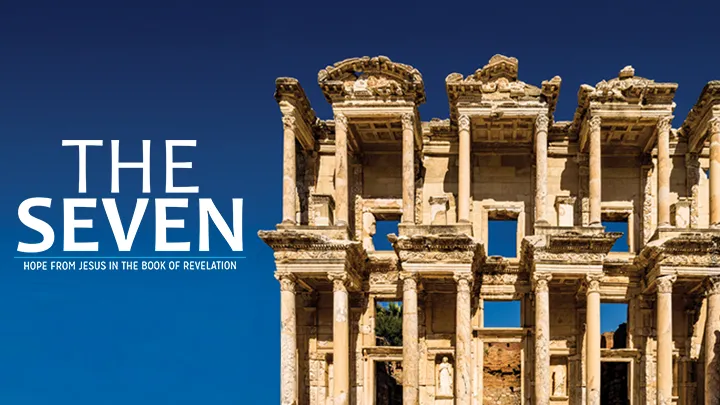
Throngs of people came to see the center or to visit the Pan Ionian games which were kind of like the Olympics and Ephesus was also a learning center. Probably the most famous ruin is their library, the Celsus library. It is still impressive today. This was built in the years following the book of Revelation but its plans were underway then. It's remarkable it was the second largest library in the world after the library of Alexandria at that time and the way they built it, the attention to detail, it's still a marvel today.
Ephesus was also a transportation center. Their engineering was incredible, their streets are still perfectly paved. This is a 2,000 year old street. By contrast, think of Santa Cruz County streets today. I think I'm gonna cry. Ephesus was also an entertainment center. The massive theater there still seats thousands today plus they were a business center. Archaeologists recently uncovered private homes. They're multi-level hot and cold running water stages for entertainers. They didn't have TV but they still had live home entertainment every single night.
The floors had intricate mosaics and these are not the homes of nobility. These are the homes of merchants so that tells us they had a very successful business class and Ephesus was a power center and here's where it got dicey for Christians. We saw last week the Emperor Domitian, the Roman Caesar at the time the book of Revelation was written, was the first Emperor who demanded that he be worshipped as "Lord and God" during his lifetime.
Sometimes the Emperor's would be deified after they were dead but he was the first one to say "why wait until I'm dead? I want you to worship me right now as Lord and God." Kind of the classic megalomaniac CEO you know just like I am going to be worshipped right now and so Ephesus bid for the right to build the first and largest temple to the Emperor Domitian and the base of this massive temple is the only thing that is left standing today but even that is impressive.
It's the size of a football field in its day a massive three-story temple complex stood here and everything about it was designed to be intimidating. Archaeologists have found pieces of the massive statue of Domitian that once stood there at the temple and they actually found the altar itself. This is the very spot where at the time the book of Revelation was written people were expected to go at least once a year to this altar and kneel before it and sacrifice something to Caesar as God.
That was the place where the possibility for compromise to Christians happened right there. It's decorated with shields and swords and helmets. These all represented the spoils of war from different conquered armies and on the altar the conquered peoples are straining under the weight of these weapons. Apparently even the tribe of the garden gnomes was conquered by Caesar. I don't know what to make of that but think of how intimidating all of this must have been to the local Christians right and yet the Christians at Ephesus flourished.
Partly I think because they took on the best aspects the busy bee aspects of their culture. In fact the church at Ephesus they were sort of the poster child for a successful church plant. They were probably the largest of the churches in Asia Minor. They had the most famous pastors. They were very successful but highly stressed. Maybe like you and me. Now I go through all that background to say it's remarkable to me how much the Ephesian churches situation reminds me of a church here in the Silicon Valley/Silicon Beach area.
We too live in a beautiful city near the ocean. It's a strategic location. The world's economies look to the Silicon Valley for queues just like they did at the church at Ephesus and just like them we often reflect the busy bee highly industrious part of our culture and there's positives to that but there's also some negatives and so we need to hear what Jesus said to the church at Ephesus and he starts "these are the words of the one who holds the seven stars in his right hand and walks among the seven golden lampstands" and then he talks about three things and you'll see this pattern again and again in these seven letters.
He talks about what the church gets right, what they need to improve and then how to do it. So first what busy people get right. Verse 2 "I know all the things that you..." What? "do. I have seen your..." What? "hard work and your patient endurance. I know that you don't tolerate evil people. You have examined the claims of those who say they are apostles but are not. You've discovered they are liars. You have patiently suffered for me without" What? "without quitting." Three things the Ephesian Christians got right.
First, they did right and this is what busy people are very good at. He says "I know all the things you do. I have seen your hard work." Now in the original language the word for work here is very intense. It means you work and work and work and when you get home you are just exhausted but even though you want to just just take a nap your child needs some help with their homework or the baby needs to be changed or the grandchildren that you're taking of need or your elderly relative needs some assistance and so even though you're exhausted you get up and you keep working. Does this sound familiar to anybody here? That kind of a lifestyle? That is what they did.
They did right but then when it kind of took a little bit of extra effort they also gave that extra effort. They stayed right. He says "I know your patient endurance without quitting." When it got painful, when they were threatened with death if they did not worship Caesar they did not worship Caesar. They didn't go up to that altar. They didn't care how intimidating it got. They stayed right. They did right. They stayed right and then they thought right. He says "I love how you have examined the claims of these false teachers and rejected them." They had discernment.
You know it is so important as Christians to be willing to step out in faith, to be willing to take risks but I've noticed that some of the Christians, especially younger Christians who are the most eager to take risks in faith can also be the most gullible sometimes right. They just want to do anything for God and some teacher comes along and says "Well here's what you got to do to really be a top Christian." Or somebody comes along and says "Well I've got the gift of prophecy and here's what I prophesy about you." And they're so eager to step out of faith that they go "Really?" and they just eat it all up with no discernment.
But Jesus says to the Ephesians "You know what? I'm actually really glad that you're not like that. You examine everybody's claims even if they claim to be an apostle. They did right. They stayed right. They thought right. And in fact there's something you get out of this later he says you reject the practices of the Nicolaitans. We'll see them again later in the book of Revelation but for now the Nicolaitans were basically a sex cult and the Ephesians rejected that immorality and so they not only did right, stayed right, thought right, they lived right.
Now if you got a letter like this from Jesus, you know if I stood in front of you today and said like somebody at one point did to the church at Ephesus, "Hey guys great news. A guy had a vision of Jesus Christ. It's apparently legit and we have a letter from Jesus Christ addressed to the church in Aptos. We know what's from Jesus because it's in red ink. It's awesome and so let me read it to you." And the letter from Jesus was "You guys are doing the right thing. You are enduring. You're staying right. You're thinking right. You're living right. Man what would you think when I was done with that part of the letter? You'd go man we got it down right. I mean what else is there to being a Christian? We got this thing nailed.
Here's the problem. You could do all of these things and still look like this, the church lady right. She did right. She stayed right. She thought right. She lived right. But what was missing? Only the most important ingredient. Love. Love. Because Jesus said they'll know you are Christians by what? Your great building projects and your website and your service. No, by your love. And that's why you and I need to hear what Jesus says to busy people because this is what busy people often miss.
In the book I talk about an article in Harvard Business Review about what the authors of the article call Silicon Valley CEO Syndrome. And there's more in the seven book but here's the way they put it. They get so busy that they remember goals but forget relationships. Does that ring a bell for you? They remember their goals. They're all goal oriented. That they forget their relationships at work. They forget relationships with their family. And the Ephesians even forgot about their relationship with Jesus.
And so Jesus says to the Ephesians, "But I have this against you that you have left your first love." Now the tone of voice here is not harsh, but I have this against you. It's the tone of the voice of a lover. Longing. Saying, "Please come back to me. Remember what we used to have together." You know the Bible uses a lot of metaphors for your relationship with God. It talks about God as king and you and I are royalty. It talks about God as father and we are his beloved children. It talks about God as friend and it says we are friends with God and it also uses the metaphor of marriage.
God as husband and we are the bride. And this is woven all throughout Scripture. God is our husband and we all of us the church are the bride. And if it maybe weirds you out a little bit as a guy to be called a bride, the Bible also calls women his sons, his firstborn sons. So just kind of get comfortable with this. This is a beautiful metaphor and it's all through the Bible. Check out these verses Isaiah 54:5, "For your maker is your what? Husband. The Lord Almighty is his name." Jeremiah 2:2, this is so beautiful. "Thus says the Lord, 'I remember the devotion of your youth. Your love as what? A bride.'" You know he's like, "I remember the honeymoon phase. How you followed me." And then back in Isaiah 43, "I have called you by name." Says the Lord, "You're mine." Like those little Valentine's hearts that say, "You are mine." God says that to you, "You are mine. You are precious in my sight and you are honored and I love you." And this is what God says about you. This is the metaphor of marriage.
So let's explore that for just a minute or two here. You know I've done a lot of weddings as a pastor and I've seen a lot of crazy things. I've seen a bride throw up, a best man pass out, the ring fall between the cracks of the platform and the flowers explode. Not all in one wedding but I've seen all those things happen in weddings and much, much more. But one of the most memorable weddings I was ever a part of was one that happened when I was a pastor down in San Diego and a French couple came up to me and said, "We would like you to do our ceremony." They were related to some people in the church. They really loved each other. I thought it was very cute so I said, "Yeah, absolutely I'd love to."
But as our counseling went along it became very obvious to me that they really did not speak English very well. In fact, I suspected that they really did not know anything I was talking about. But they really wanted me to do the ceremony and kind of I was already all in so we continued. And then when I stood up in front of the crowd it was in San Diego's Balboa Park about 200 people were there and I led them through the vows, the repeat after me vows. Every time they repeated after me they got it wrong in front of everybody. Like I said, "To love and to cherish." And they said, "To love in the church." True story. "In sickness and in health, in sickness or else," they said. "To have and to hold, to have until old." They got it wrong but they were all good things, right? So I kind of figured they got the gist.
But the problem was that they just kept getting it wrong and so I got so flustered that I lost my place. And at the end instead of saying, "You may kiss the bride," I just went, "Uh, okay, go into your new lives, Farajaka." You know, I didn't know what else to say. And they're halfway down the aisle when all of a sudden a little kid, maybe eight or nine years old, leaps to his feet and he points to me and he goes, "Hey, you forgot to say you may kiss the bride!" And everybody turns to me and then turns to them and I said, "Oh, oh, right, right, right." And I looked at them and I said, "Stop, stop. Halt, halt, halt. You may kiss each other."
They look at me and I said, "You know, kiss, kiss, kiss." And so they stopped and they kissed and kissed. And kissed, you know, the French until finally I had to say, "Halt, halt, you know, sacre bleu." Fini, fini, vit, vit, you know. And everybody applauded but I thought about it later and it occurred to me that that ceremony is really an analogy for a lot of marriages, right? In this way. They remember the to-do part of the marriage vows, "Till death do us part." But they forget the kiss. And that's what Jesus is saying here to you and me. You've got the to-do part of the vows down. I have no doubt you're gonna be faithful till death. But you forgot the kiss.
You're paying the bills, you're doing the grocery shopping, but let's rekindle the romance. So how does that look like for you and for me spiritually? Well, think about it this way. My wife and I were brainstorming about this and she said, "Well, René, here's the way I picture it. When you first fall in love with a human being, there is wonder, right? You're just sort of entranced by them." And that happens spiritually too. There's the wonder of God's love leading to a sense of just gratitude and joy. And then there's also what you could call a desire to know. You just want to know this person that you're in love with. You want to hang out with them. You want to be with them all the time.
And then there's an eagerness to please, right? You just, your conversations go like this, "What do you want to do? I don't know what do you want to do?" And this is true spiritually as well. But we can drift from this. And I've been there many times in my faith where I do the right things, but I forget why. My motivation slowly creeps away from, "I'm doing these things because of God's amazing love and grace toward me." And it creeps toward, "I am doing these things so that people will think well of me." Or people will think I'm a good pastor. Or just out of dry duty. And of course that's exactly what Jesus criticized the Pharisees about so much, isn't it? "Their hearts are far from me, even though their lips honor me."
So how do I get my first love back? Because you know what? All those things that the Ephesians were good at, they did right, they stayed right, they fought right, they lived right. All those, listen, all those things are unsustainable in the long run unless you have the right motivation. Unless you have that first love. That's what sustains all the things that they were doing right. They needed to still do those things, but they needed the right core motivation for those things to last.
So here's what busy people need to hear. And this is also how to restore any lost love. If you need to restore a marriage or a relationship with a with a child or a friend, the exact same advice applies. And Jesus says three simple words. First, remember. He says, "Remember from where you have fallen." Remember the early days. The greatest marriage expert in the United States today, Dr. John Gottman, he says, "Most couples find that recalling their past together recharges their relationship in the here and now." And in fact, he has little questions that he gives to couples to do together.
And if you're married, you might want to try this. Things like, "Remember your first date together." Talk about it. Talk about what first attracted you to the other person. Remember what your early days in marriage were like. Remember how nobody wanted to end a phone call anytime that you were apart from each other. You know, "Bye. Bye-bye." Are you still there? Yes, you know, right? You just all you just wanted to hear each other just breathe, right? He says, "Remember your first year of marriage together." Remember how you'd put little post-it love notes everywhere in the house. They opened the bread box and there was one, "I love you, smiley face." You know, they opened the underwear drawer, "I love you, XOXO."
And Gottman says, "When couples remember these things, it rekindles something." Well, it works the same with your relationship with Jesus. I put some questions there in your notes and I'd encourage you to think about these this week and if you have a chance today. Talk about them with some friends. Like, what first attracted you to Jesus Christ? What was it that captured your imagination about the Lord? How about this one? How did you first get the idea that God loves you? When did that first hit you? What were some moments where God's love became particularly real to you?
For example, let me just tell you some of mine. Now, these are my personal answers to these questions and I'm not making them normative for everybody. Everybody has different experiences, but this is what it was for me. I remember the very first time I ever lifted my hands while singing in church. I was a teenager and I was just so overcome with God's love for me that I lifted my hands and surrendered and I remember this because I'd forgotten to put on deodorant that day and I was sweating and I was just like, "I don't care!" And people were being slain in the spirit to my right and left and I noticed that later, but I remember going on a stroll and everything I saw seemed like it had God's little post-it note of love on it.
"I love you." Every tree, the sunshine, the grass said, "I created you. You're alive because I gave you the spark of life to enjoy all these things. I love you!" And I remember just looking at everything going, "God, thank you, thank you, thank you, thank you!" I remember one time as a teenager, again, looking out my bedroom window and suddenly being a hit by a sense of God's, not only God's love for me, but God's love for the whole world and I remember this because it was the first time in my life I had ever laughed and cried at the same time. Just crying with joy and laughing with joy simultaneously.
And when I remember those days, it does something for my heart, it de-thaws it a little bit and that's why Jesus says, "Remember." And then he says, "Repent." Now the word "repent" has been a little bit spoiled, right? When I hear "repent," "Repent!" I think of angry street preachers with signs screaming, but really, "repent" is a great word. Literally, it means just change your thinking and go in a different direction. When Jesus says, "Repent," you know what it means? Listen, "Repent" means there is hope for you because otherwise why would he ask you to repent? Repent means you have a future.
Look up here for a second. Repent means you can stop believing the lie, "It's too late for me." It's not too late for you. Not if Jesus is asking you to repent. And he says, "If you have years to hear, this is for you." Repent means stop focusing on the past and start focusing on what God can do in your future, on what God can do in your family, and what God can do in your spiritual life, on what God can do in all your relationships. Repent is such a word of hope, such a word of possibility.
But some of you are thinking, "But René, you have no idea I'm so far gone, I've crossed the line too many times, I crossed the line this week even, I don't know what I'm doing in church because God must hate me." You know what? Listen, every saint has a past and every sinner has a future. That's what you learn from the Bible for sure. Every saint has a past and every sinner has a future. So stop believing the lie that it is too late for you because it's not. Repent, remember, and then third, redo.
Jesus says, "And do the deeds you did at first." The little things that people do when they're in love. Over on page three, you'll see that marriage expert John Gottman, he says the same thing. He says, "Many people think the secret to reconnecting in a marriage is a candlelight dinner or a seaside vacation, but the real secret is to turn toward each other in little ways every day." Some ideas at the end of the day talk about how it went. Cook together, do chores together, read together, exercise together, play cards together, call or text loving messages, thank each other.
He says it doesn't really matter what the thing is. In fact, he says just 15 minutes a day will restore and revive most relationships if it's consistent, if it's daily. And so here's the question for you spiritually. What little daily things did you do at the times in your life that you sensed a closeness to God? Again, just for me, I remember going on walks and just looking for things to thank God for. To thank God for, you know, by the way, one of the ways that you can tell if your first love is slipping away, one of the little tests is if your prayer becomes largely petition.
God, do this, God, do that. God, please fulfill this prayer request. Nothing wrong with petition, but when you have first love, you tend to say thank you a lot more. So do the things you did at first and say thank you again. I urge you to try this this week. And then Jesus wraps up this letter to the Ephesians by saying, "He who has an ear, let him hear what the Spirit says to the churches." You know what, raise your hand right now if you have at least one ear. Can I just see a show of hands? Go ahead. You see what Jesus is getting at?
Like we talked about last week, what he's trying to get around is the tendency of human beings to go, "Man, I'm sure glad that this church in Ephesians, in Ephesus, heard this message because they needed to hear this." Or, "Oh man, that dead church down the street really needs to hear this." Or, "That unsmiling person I saw when I came into church today, I hope they're hearing this." You see this line is saying, "No, if you've got ears, this is for you." You know, don't think about those other people. Just think about how this applies to you.
And then Jesus says, "There's a great reward to him who overcomes. I will grant to eat of the tree of life which is in the paradise of God." Now there's so much more about the symbolism in this pregnant sentence in your book, especially the symbolism that the phrase "tree of life" would have meant to the Ephesian church living there in Ephesus. But for now, let me just say this. The promise of a meal in paradise foreshadows something. The marriage supper of the lamb. And that's something that the book of Revelation talks about later.
It says that one day it'll be like the church is wearing a beautiful white wedding dress. And it'll be like Jesus is the bride. And it'll be a feast like the best wedding reception you've ever been to in your life. What it means to say by that is, that's how beautiful you look to Jesus. We as a church look to Jesus like a bride on her wedding day. That's awesome. John Orper tells a story about a friend of his who was putting his five-year-old daughter to bed.
And an hour after he tucks her in, he goes back to check on her, and she's still awake to his surprise. So he says, "Honey, what are you doing?" And she says, "Just thinking, Daddy." And he says, "Well, what are you thinking about?" "Oh, I was thinking about how someday I'm gonna be a bride." And he starts to get kind of choked up already. And she says, "You know, Daddy, I'm gonna have a wedding and I'm gonna wear a special dress. And, Daddy, you will be my prince." Somehow the idea of brides and princes and princess has got all, you know, mixed up together in her brain.
And so he says to her, "Well, that is awesome, honey, but I can't be your prince. I'm already mommy's prince." And so she says, "Well, then who will be my prince?" And he says, "Well, maybe it's gonna be Brandon, or maybe it's gonna be somebody else you know, probably somebody you don't know at all." And he says, "In fact, the wisest thing to do when it comes to choosing the prince is let Daddy decide." Just in all things prince-related. But here's why I bring that up. She is just expressing as a little child the inextinctible desire in all of our hearts to be somebody's prince or princess.
All of us long to be somebody's beloved. And do you understand what is implied in Christ's plea for us to return to our first love? What's implied here is that you are the beloved of God. He already loves you so much. This is the deepest truth of your identity. You are the beloved of God. You know, I love how in 12-step groups, there's a lot of things I love about 12-step groups. But one of the things I love is that at the beginning when everybody introduces themselves, they say, "Hi, my name is so-and-so." They say their name. And I'm an alcoholic.
And I love that because it's like, "Let's just get all the pretense out of the way in the introductions." And sometimes I wish that in church we did that, that at greeting time maybe, we turned to one another and said, "Hi, I'm René and I'm a sinner-holic." You know, "I'm René and I'm a sinner." Because sometimes all the time, I just need to just make that clear. I need to just admit that. No pretense, right? That would be embarrassing. That would be hard. But you know, I think there's something that would be even harder to say and for many of us more embarrassing to say, and that would be to turn to one another and say, "Hi, my name is your name. I am the beloved of God."
In fact, why don't you try that with me for just a second? Looking up at me for just a second, just say, "Hi, my name is, say your name, I am the beloved of God." Let's try that out. "Hi, my name is René and I am the beloved of God." Now here's what I want you to do. I want you to turn to people on your right and your left, look at them, introduce yourself, and say, "And I am the beloved of God." Would you do that for me? Ready? You got five seconds. Go. Even in venue, do this to each other.
Now look back up here for just a second. Some of you, as I was watching you, some of you could not do that without smirking. Some of you could not do that without laughing, and some of you couldn't do it without crying. But to you and to me, to busy people, Jesus is saying, "You are my beloved." Why would that be a cure for people too busy for their own good? Because if you know you are the beloved of God, what more do you need to prove? What more do you need to acquire? Who more do you need to impress? What ladder do you really need to climb? What prestige do you need to gain if you know you are God's beloved?
See, this is a key thought here. This isn't just Jesus calling me to love him more. It's Jesus telling me he loves me most. It's Jesus telling me, "Let's go out again." It's Jesus telling me, "You know, you still take my breath away." And the ultimate way Jesus showed his love for you and me is the ultimate way anybody can do that. He gave his life to set you free. And that's what we remember during communion. Let's prepare our hearts for that right now.
Would you bow your heads with me? With your heads bowed, I would just encourage you to meditate on the idea that I love him because he first loved me. And he showed it. He left paradise so that I could spend my eternity in paradise. He died on a tree, the cross, so I could have access to the tree of life. And some of you may be for the first time, this is the moment when you accept Christ, when you run into his arms knowing that, "Oh, it's all about his love for me." And as we take communion now, maybe this can be your first communion as a believer. Just saying, "Jesus, I don't understand it all, but as much as I understand, I love what I hear. Jesus, I receive you. I receive your love expressed on the cross where you made away from me by your death, your burial, your resurrection. I receive your sacrifice as my own, your substitution as my own now, and help me to grow in love for you for the rest of my life. In Jesus' name, Amen.
Join us this Sunday at Twin Lakes Church for authentic community, powerful worship, and a place to belong.