Overcoming My Fear of Commitment
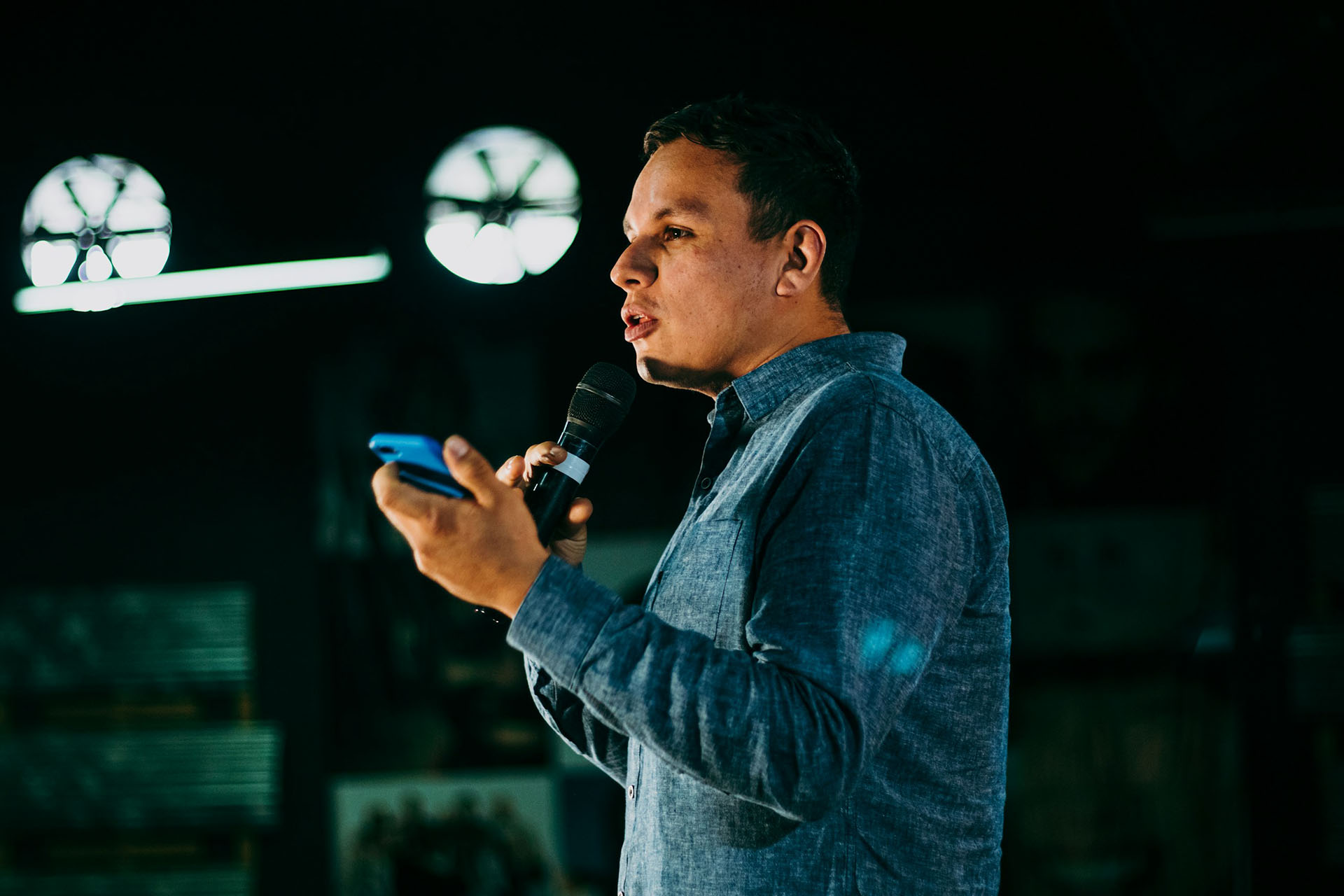
René shares insights on overcoming fear of commitment in life.
Transcript
This transcript was generated automatically. There may be errors. Refer to the video and/or audio for accuracy.
My name is René and I'm one of the pastors here, and I'm so glad that you guys are here with us in church today. Let me ask you another question, kind of a raise your hand poll here. How many of you are on Facebook? Can I see that show of hands? I mean not right now, but if you are, stop. How many of you do Twitter? Any other kind of social media? Okay, like practically everybody here raised their hand at Facebook, right?
Well, on all these social media platforms, I've noticed that they use all kinds of three and four letter abbreviations, right? Acronyms for phrases and for words just to come make it quicker to text with your thumbs if you're using your smartphone. So what I'm gonna do is kind of give you a little quiz to see how many of these you know, and then maybe I'll even teach you some new ones, okay?
Alright, so I'm gonna start with some easy ones. Like L-O-L, what's that stand for? Shout it out. Laughing out loud, obviously. Alright, what about B-T-W? By the way. What about T-T-Y-L? Talk to you later. How about F-Y-I? For your information. Alright, those were softballs. Don't be proud of yourself yet because here's some that are a little bit harder. What about S-M-H? Shaking my head, that's right. A lot of you knew that one. Now you know, those of you who didn't, it's shaking my head. That could come in handy, right?
Alright, how about this one: R-O-F-L? Rolling on the floor laughing. That's good. Alright, those are a little bit harder. Now we're gonna go to the master class. Alright, let's see how many of you know these. How about this one: C4N? Anybody know it? I've got some laughter. Junior hires are making up unprintable answers to these questions. But C4N, that means ciao for now. Very good. We had one person raise your hand. That's awesome. Very good. Now we all know your secret code.
Alright, how about this one? These are even more difficult: B-M-G-W-L. Wow, what's that stand for? Busting my gut with laughter. That's very useful. Right? Here is one that could really come in handy: C-R-T-L-A. That stands for can't remember the three letter acronym. I would use this all the time. All the time.
Well, there's just one more I want to teach you. The New York Times recently had an entire article about another one that's really kind of starting to take over, and it's this: F-O-M-O. And what does this mean? Shout it out if you know. Somebody knew it over here. Raise your hand. Who was the first person? I heard a guy say it. Who was it? Fear of missing out. Really? You got it. That's awesome. You win a free dessert in a home during our 2020 campaign, so sign up tomorrow. That's fantastic. And don't miss out.
Alright, fear of missing out. What is this all about? Well, this is when you won't commit to actually doing anything because you think a better offer might come along, right? And so you don't do anything. Some night, a friend texts you, "Why didn't you go to the movies with us?" or "Why didn't you go to the beach with us?" and you text back, "Well, F-O-M-O, fear of missing out." This has become such a big deal that not only did the New York Times just do an article all about this, there's even a new book just out with this as the title because this is becoming such a societal phenomenon: the fear of missing out.
There's a quote from the book: "Constantly weighing options in every aspect of our lives, we end up with decision fatigue and the dreaded F-O-M-O." This book then goes on to say a lot of people these days won't commit to anything: buying a house, getting married, any long-term relationship, joining a church. Why not? F-O-M-O, fear of missing out.
If you still don't get this, somebody told me recently, "René, it's like this: life is like a buffet, kind of like the salad bar at the Crow's Nest or Carpo's or something, right? You go up to the buffet with an empty plate, and then you have all kinds of options there." Well, this person told me, "René, I don't want to get to the end of the buffet line and see all the best stuff was down here at the end, like all the meat and everything is down here, and I've already filled up my plate with all the wrong stuff." And so he said, "In life, I don't want to experience that, and so I'm keeping all my options open. My plate is clear, waiting for the good stuff that might come up later on."
Now, what's the flaw to that kind of thinking? Well, what if you get to the end of the line and there's nothing on your plate and your life is empty because you were keeping all your options open and you ended up with nothing? Grab your message notes. Let's talk about it.
Last week, we started a new series called "All In." It's about rediscovering the power of commitment. Why? Because fear of commitment, I think, is really behind so many relational problems. A fear of commitment is behind so many spiritual problems. A fear of commitment is behind so many emotional problems. This morning, what I want to talk about is overcoming your fear of commitment.
Let's start by reading out loud together our theme verse for this series. This comes from the Old Testament, from Second Chronicles 16:9, and this is a great verse. So let's all say this out loud together. Let me hear you: "The eyes of the Lord range throughout the earth to strengthen those whose hearts are fully committed to him."
Now, last week we talked about all the benefits of commitment. We said last week my commitments focus my energy. Without commitment, I'm just a flashlight, sort of beaming my energy everywhere. But with commitment, I'm like a laser beam. I'm focused, and I can have some impact in life. My commitments inspire my own personal growth because commitments are hard, and so they're challenging. They're like an exercise program. My commitments stabilize my relationships because they make them secure. I'm committed to them, and my relationships determine my impact. I mean, really, nothing great ever really happens in life without commitment.
So if there's all these benefits to commitment, why do so many people fear commitment? Why do so many people go, "You know, I don't want to do anything because I want to keep all my options open all the time?" Now, you may know that this is very, very personal for me. There's a new chapter to this story, but just as the background, for many years, this was one of my own biggest obstacles in life. Just one example is that Laurie and I dated for four years. Four years! And I still couldn't commit to marrying her or to breaking off the relationship. I was just so indecisive. Not anything to do with Laurie. I thought and still think she is awesome, but I had a crippling fear of commitment.
I mean, in all my decisions, I was the guy who was spending 15 minutes looking at every restaurant menu until I finally decided. And then as soon as I decided, I'd call back the server, "Wait! I just changed my mind!" You know, just waffling constantly. And in the case of deciding whether or not to commit to getting married, some of you know I proposed to Laurie and then took it back twice. I know, and it gets worse. The afternoon that Laurie had all of our wedding invitations printed in the envelopes, yeah, don't get ahead of me here, the stamp on them, she's going down to put them in the mailbox. I said, "Can you just wait like another day and just let me pray about this some more, would you?"
Not have just slugged me if you were her? I mean seriously, I was so, so commitment phobic. Really. Well, two weeks ago, another chapter in the story was written because now we've been married happily for a quarter of a century. We were on vacation up in Portland, Oregon. I was visiting my sister, and then I was to speak at a conference for a week. And so we decided, you know what? Let's take our old beloved seminary professor, Dr. Gary Breshears. He's a prolific author. He's influenced so many pastors. He's influenced Laurie and me. We both got our masters in theology under Dr. Breshears, and he performed our wedding ceremony. So we said, you know what? Let's go up there. We were on kind of a 25th anniversary getaway also up there to Portland. We said, let's go up there and take Gary out to lunch.
It was great. We picked him up and took him out to lunch, and we're having a good time. Gary, at one point during the lunch, looks at the two of us and he just kind of starts chuckling. Laurie looks at him and says, "Gary, why are you laughing?" He says, "Well, just look at you two, so happily married now for like a quarter of a century." Ah, and when I think back on that phone call from René the night before the wedding, it just makes me laugh. Oh boy. And Laurie, sitting next to me, she looks at me and says, "What phone call?" And I said, "Who's hungry for some appetizers?" She goes, "What phone call?" And before he could see me going, Gary goes, "Oh, that phone call. The night before the wedding, René calls me up at the hotel and says, 'I'm still not sure if I should go through with this.'" He says, "Laurie, you must just laugh when you think about that now." And I said, "Gary, she hasn't heard about it until now." And then I looked at Laurie and said, "Isn't it wonderful how after 25 years you could still be learning new things about your spouse? Isn't life good?"
Make you laugh. Several drinks later, Laurie was also laughing. No, just kidding. No drinks, no drinks at this lunch. But what was wrong with me back then? You know, yes, I did call Gary, and I still was so commitment phobic. Well, I thought a lot about this. In fact, at Laurie's urging, we even went to a marriage counselor, a Christian psychologist, even before our marriage because she said, "René, you've got some real issues." Actually, she didn't say, "You've got some real issues." She said, "I think we have some issues that we need to deal with." She was much wiser than that. She didn't point her finger at me. She said, "Let's go together to this marriage counselor." Because you're crazy? No, she didn't say that. But we went, and the counselor really helped me work through a lot of these fear of commitment issues and gave me tools to deal with it when it comes up again.
Because it has come up again in my life. It came up again in my life this year, and I'll tell you the rest of the story a little bit later. But I got so many great resources, so many good books, some good tools from the counselor. I heard way back in the 90s, I heard a message from an unknown pastor who had just planted a church in Orange County named Rick Warren. He was doing a series called "Freedom from Your Fears," and the eighth part was "Freedom from Your Fear of Commitment." I really internalized a lot of what he said. So from that message and a lot of these are the books in my counselor, I just kind of want to share some tools that I have used that I pray will help you as well.
Let's start with four common reasons that we fear commitment, and you might want to jot these down. First is perfectionism, right? Perfectionism always insisting that everything be perfect before you make a commitment. I get a wait for perfect conditions to have a baby, perfect conditions for I commit to God. I'm gonna wait for perfect conditions before I get married or before I decide what my job is going to be. And this was definitely a part of my problem. But you know what the trap here with perfectionism is? Your definition of perfect conditions will keep changing and keep getting unreachable, unattainable.
My best friend and best man at our wedding, Rich Henderson, took me out for breakfast one day, and he asked me when I was being so indecisive about marriage, "René, what are you waiting for? Well, the perfect conditions are what are the perfect conditions?" Honestly, and I said, "Oh, I said it's crazy, but I guess..." He said, "You need to verbalize really what you're waiting for." And I said, "I guess I'm waiting for something like the clouds to form into letters with a message from God that says she is the one you can commit to her." I said, "I guess that'd be enough." And Rich goes, "No, it would not be enough." He said, "Because you know what would happen if you actually saw that? When we walked out of this restaurant, you would explain it away. You would say, 'Yep, look at that skywriter who just happens to be riding that. Rich probably hired him to do that,' or 'Yeah, you know, God's putting those clouds into those letters for somebody else, but not me.'" He said, "You just explain it away." And I said, "You know what, Rich? You're absolutely right.
You see, nothing is ever perfect enough for perfectionists. And can I say that some of you might be wavering about committing your life to God? I could have a similar conversation with you. What are you waiting for? I just want to see God right in the sky. I exist, or I want to hear an audible voice from God. I am real. I just want to see God or something. But you know what? You'd explain that away too. You'd go, "Wow, that was a weird hallucination," or "Wow, how do I really know that was God?" You see, at some point, every decision is a leap of faith. At some point, every decision in life is a leap of faith. And don't let perfectionism be a trap that keeps you from doing anything because of your fear of missing out.
Then there's a second reason: past hurts. Past hurts. We're often afraid of making commitments because we've been hurt in the past. Maybe a bad experience in a marriage, and you think you'll never love again. Or maybe a bad experience in a former church, and you're afraid of making a commitment here. Or maybe a bad experience with a partner in business or a former friend. Now, in my case, I realized with the help of a counselor that my father's death at four and subsequently my stepfather's death at 24, these sorts of things in my life were really contributing to my sense of past hurt. I thought to myself, I was hurt so bad by my stepdad and my dad dying. I don't want to cause hurt like that to somebody else, and so I don't know if I want to be married and have kids and set themself up for that kind of potential hurt. I don't want to be hurt like that again either and love somebody that much.
So my past hurts were restricting me from really making that kind of a commitment. But the fact is we all have past hurts. They might be different, but we all have past hurts. The problem is when you allow ways that you have been hurt in the past to continue to determine your future. See, your past is past. It can't hurt you anymore unless you allow it to. Your past is not your future. Just because you made a commitment in the past and got burned does not mean you're gonna get burned the next time you make a commitment. Just because you made a commitment in the past and you failed does not mean you're gonna fail the next time you make a commitment. Don't allow your past hurts or your past failures to manipulate your future.
And then there's a third reason: self-doubt. We just doubt our ability to actually make a wise commitment, and so we don't make any commitments at all. Like how can I possibly know if this is the right choice? How can I know if this is the right one to marry? How do I know for sure? How do I know this is the right major? How do I know this is the right career? But what happens is you start to second guess yourself all the time, and when you do that, you set yourself up for failure. As the Bible says in the book of James, a double-minded man is unstable in all his ways. Great verse, great warning. Because when you're double-minded, you spend all your brain time and all your energy on your doubts rather than spending your brain time and your energy on making your decision work.
You know, you get a bad case of what I call the what-ifs. But what if this is the wrong choice? What if I don't like it? What if I'm not competent? You know, what if we decide to have children and I'm a bad parent? What if we decide to have children and I don't like them? You know, we doubt our ability to make good decisions, and then we doubt our ability to keep the decisions we make. What if I promise something and then I can't do it? So let me just say this to all the self-doubters: there is a time for everything. There is a time to consider all of the options, but once you're committed, that time is over.
As Jesus himself said, "No one who puts a hand to the plow and then looks back is fit for service in the kingdom of God." And here's what this verse means. When you're going to plow like a furrow in the ground, like you see down here in Watsonville, now they use tractors. In those days, they used horses or oxen. But you need to plant a furrow still to this day to plant strawberries or artichokes or whatever, right? Well, if you go to do a furrow with a plow but you keep looking backwards, what's going to happen? The furrow is going to go all crooked on you, and it's not going to be usable at all. And so he's saying once you decide to do something, especially something for the Lord in this context, do it. Look forward. If you're always second-guessing, "What about that field over there? What about if I should have gone that direction over there?" you are guaranteeing failure with the furrow that you're plowing at that moment.
Once you've decided to do something, you've got to make sure you focus on plowing that furrow straight. You know, one saying that really helped me in my self-doubt during my indecision about marriage was this: the grass isn't greener on the other side of the fence, and the grass isn't greener on this side of the fence. The grass is greener where you water it. Instead of second-guessing that I do the right thing, make it the right thing and put your energy and focus into that instead of doubting yourself all the time.
So these are all reasons that we fear commitment. But then finally, there's a huge one here in America, and it's this: a desire for independence. A desire for independence. This is a huge major issue really for any humans, but especially, I think, culturally in America. In America, we built our country on the Declaration of Independence, right? And so we love to be independent. That's great. But now we almost idolize independence. It's like the top value. We even make hit songs that glamorize the independent life, and every generation has them. Every generation. We were thinking about this this week in the office. In the 30s and the 40s, it was "Don't fence me in." Right? In the 50s and the 60s, it was "I did it my way." Right? In the 70s and the 80s, it was "I don't care what you say anymore. This is my life." And so many songs in this generation. In fact, this last week, I heard Miley Cyrus's new song, and it was "We can't stop," and it's all about, you know, what we can do whatever we want. It is our life. It is our rules. We are totally independent. We don't care what anybody else says.
But you know what? It's no coincidence that the more highly our society prizes complete and total independence, the more pathologically lonely our society is too. Because you weren't made to be completely independent of anybody. The dark side of total independence is deep loneliness. God didn't make us to be islands, to be completely independent. God didn't make you to be dependent or codependent, but he made us to be interdependent. The Bible says it is not good for man to be alone.
I read you part of an article in a very detailed way. The man who wrote this article, very transparent, talks about how for years he didn't want to be trapped, didn't want to be committed to any particular person in marriage, and he lost two people he really loved because of that. The last one, he actually lived with for seven years, and she left him because he wouldn't commit. And then he wrote this column. I'll just read you a paragraph. He says, "Until a month ago, I was what some women call a Peter Pan, one of those men who contemplate but never decide, who float around instead of committing." In his case, it was seven years until this woman finally left. He says, "I've spent the last month in hell. Suddenly I see how stunted a place I've spent my years in so-called independence. I am being shown with the searing force of a revelation that commitment is the point of life." Now listen to this: "I've spent all my life trying to avoid the messy mistakes, only to become one myself. And now I sit suspended in the amber of afternoon, my heart under glass." That's the empty plate at the end of the buffet line. He realized, not too late, I hope, that commitment is part of the point of life.
So look at these. Which one of these do you struggle with? I can tell you honestly I have personally struggled with every single one of these at some point in my life, at many different points in my life. So if these are the main obstacles, how do I overcome my commitment phobia? How do I get past all those obstacles and become a more decisive person? Well, there's four ways that really, really helped me, and these are four things that address those four obstacles.
The first one is probably the most obvious for a pastor to say in church, but it's very important: number one is ask God for wisdom. You have self-doubt? You ask God for wisdom so that you can avoid making dumb commitments. James 1:5 says, "If any of you lacks wisdom, he should ask God, who gives generously to all without finding fault, and it will be given to him." Now, before you turn your notes over, because I know you don't want to miss any riveting moment of this sermon, but stay there on the bottom of page one for just a second because I want to look at that verse for just like two minutes.
Do you spend just five minutes a day doing this? Say five minutes, two minutes at the beginning of the day before you blunder into your day, saying, "God, I just want to be receptive to your leading. If there's somebody you want me to talk to, some direction you want me to go, please guide me because I want to be in tune with God's direction today." Man, it'll center you, it'll calm you down, help you get focused. Because look at this verse closely: those phrases, "God will give generously" and "it will be given." God is a God of grace. He is a giver. My problem for so many years was I thought of God as stingy. I thought of God as a reluctant giver. I thought of God as somebody who didn't really want to give me guidance, who only reluctantly would give me guidance. And when he did give me guidance, it would be as inscrutable and difficult to decipher as a hard-to-understand Chinese fortune cookie saying, right? But where did I get that idea that that's what God is like? From the Bible? It's not in the Bible.
My personal theory is that I got that idea from the pagan gods. I think this is the way human beings tend to think of God, tend to imagine God. Because think of the Greek gods, the Roman gods, the Viking Norse gods. You know, Zeus and Jupiter and Loki and Poseidon. Those gods were always messing with humans, always tricking them, always misleading them, messing with their lives, throwing lightning bolts down at them. You don't see that in the Bible. Well, I think really part of my problem was idolatry. I'd been making the true God in the image of these pagan gods of the human imagination. In the Bible, it says God gives generously. And notice this phrase: "without finding fault." God doesn't ever say to you when you ask him for wisdom, "You don't deserve to have wisdom. You have messed up one too many times." It says God gives generously to all without finding fault. That means God is willing and waiting and ready to help you make wise commitments.
Now, some of you are thinking, "But René, I do ask for God's direction all the time, and he never seems to lead me." Here's a little tip I learned: start by asking not what is God's will for me in this specific thing. Just ask what is God's will generally. Does that make sense? Don't just ask, "What is God's will for me? Should I get this car, that car? What's God's will for me? Should I go to that place on vacation or this place?" Just go, "What's God's will just generally?" Because when you think about it, you already know what God's will is. As James says later on in the book of James, "Be peace-loving, be considerate, be full of mercy, be full of good fruit." That's God's will for your life. God doesn't really need to tell you what to do at every single fork in the road. He's already revealed his plan for your life and for mine. As Jesus put it, "Love God with all your heart and love your neighbor as you love yourself." And when you remember that, you kind of already know what God's will is in many situations.
Now, still, you might think, "Well, okay, I get this philosophically, but what about practical considerations? What about when I really want guidance in specific circumstances?" Well, that's why we don't just have one point. There's three more points in your outline, and they address those circumstances because the Bible also says to point to use your brain. You know, compare the cost to the benefit. Compare the cost to the benefit. Literally make a chart. For the perfectionists, as a recovering perfectionist, let me advise you: instead of aimlessly worrying in the middle of the night, I'd advise you to take a sheet of paper and literally list in columns the pros and the cons. And ask yourself, is the payoff worth the price? Is the cause worth the cost? Ask that question anytime you have to make a major commitment. Proverbs 20:25 is a great verse: "It is a trap for a man to dedicate something rashly and only later to consider his vows." In fact, would you agree with this? It is always easier to get into debt than to get out of debt, right? It's always easier to get into a relationship than to get out of a relationship, right? It's always easier to fill your schedule than to fulfill your schedule. And it's always a trap to dedicate something rashly and only later to say, "Oh, what have I done?"
So you do have to exercise some caution. As Jesus himself put it, "Suppose one of you wants to build a tower. Will you not first sit down and estimate the cost and see if he has enough money to complete it?" Now, this is very important here as we talk about our future buildings at this church. But Jesus isn't just talking about buildings. Jesus Christ is very specific about the benefits of committing your life to him and the cost. There's a lot of benefits. The Bible is very clear about them. Think of all the benefits of committing your life to Christ: you get forgiveness for all your sins. That's huge! Not only past sins, but future sins too. You get a secured place in heaven. You get a purpose for your life, a sense of meaning and significance. There's all kinds of amazing benefits. But listen, all throughout his ministry, Jesus is also very clear about the cost. He says to the crowds following him, "Are you willing to deny yourself, take up your cross daily, and follow me?" That's what it costs to follow Jesus. Now, it's all by God's grace, but what that means is you surrender this illusion that you are the captain of your own life, that you have all the strength to do everything, and you deny that. You crucify it to follow him.
Now, if you look at it that way, are the benefits worth any cost that you might pay? Absolutely they are. But even with following him, Jesus kind of lays out sort of a cost-benefit analysis for you. But so you need to do this cost-benefit analysis in every decision you make. But be careful because you can get stuck here. You can have paralysis by analysis. Believe me, I know because look at your notes. So far, I was doing plenty of point one, plenty of point two when I was going through all my indecision about marriage. In fact, I was doing so much point one, asking God for wisdom, praying for guidance, and I was thinking so much about point two, kind of listing, listing, listing endless pages, the cost and the benefits that I had paralysis by analysis. I was afraid to move ahead. I'd stalled out any forward momentum.
And you know why? Not one person, and I mean not one, told me the third truth in your notes. I wish I would have heard this 25 years ago. For some of you, this will be the first time you've ever heard a pastor say this in church, but it's the absolute truth, and it may shock you, but it's this: I need to realize I may never be 100% sure. I was seeking 100% certainty when that usually never happens. Realize you may never be 100% sure. Some of you are thinking, "But how can I know for certain that this or that decision is God's will?" You know what? You probably can't. I'm telling you, in my experience and according to so many examples in Scripture, in many cases, probably most, you can't. You can't be 100% sure. It's just that simple. In fact, in the areas of life that are not laid out for you in black and white in the Bible, you can rarely be 100% sure. So stop trying to be because in most cases, that's just a waste of time. You have to make a choice. Get moving in some direction. Like they say, you can't steer a parked car. And so you get the car moving, and then you let God be the GPS that says, "Make a U-turn at the next opportunity," or whatever. But at least the car's moving so the GPS now works so you can make those mid-course corrections.
In fact, let's read this verse out loud together. I wish I would have seen this verse back in those days: Ecclesiastes 11:4. Let's say this together: "If you wait for perfect conditions, you will never get anything done." That's in the Bible! Isn't that a great verse? That means if you wait until you think you can afford to have a baby and every T has crossed, every I's dotted, are you ever gonna have a baby? Never! That means if you wait until you know everything there is to know about that new job offer, are you ever gonna take it? Never! Because you'll never know everything. If you wait until you're absolutely sure everything's perfect, you'll never do a thing. Fear of missing out, right?
Now, I'm not saying you should always decide in the affirmative because sometimes your decision needs to be no. Maybe it needs to be yes, I will take that job. Maybe it needs to be no, I won't. But you make a decision, and then you trust God to lead you further. In fact, that brings me to point four: trust God to help me keep my commitments. And this is really the bottom line, right? That addresses all of the hurts, all the doubts, all the perfectionism, all the desire for independence. You trust God. Psalm 37:5 says, "Commit everything you do to the Lord. Trust him, and he will help you." You know what this means? If you commit your whole life to Christ, then the commitments that you make in life aren't just dependent on your own willpower to keep them. You get God's power. This principle is all through the Bible. Philippians 2:13 says, "For God is working in you, giving you the desire to obey him and the power to do what pleases him." You know what this means? Listen to this: this is the secret to the spiritual life. God says, "I not only give you the desire to do it, but I will give you the power to do it." This is part of God's grace to us.
You know, a lot of people say, "René, I would commit my life to Christ. I've been coming to church here, and I think Jesus is great, but I don't want to actually make that commitment and call myself a Christian, a follower of Jesus, until I know for sure that I can keep it." And while I really respect what I think that comes from a noble heart that doesn't want to be a hypocrite, and I respect that, but respectfully, I think you're missing the whole point. Because the point is to just take the first step and then let God do the rest. You do the committing, and God will do the keeping. You do the committing, and God will do the keeping.
When Jesus died on the cross for our sins, as we'll remember in communion in just a minute, he didn't just die to forgive you of your past sins. He also died to rise again, and the living Christ gives you power to live your life today. Now, some of you are thinking, "Alright, well, you talk about commitment. What am I supposed to commit my life to?" Well, there are four basic biblical commitments that God calls everybody to. There's a lot of great things to commit your life to, losing weight or whatever, but there are four basic commitments that are foundational. Number one, of course, is a commitment to God. That comes first. It's foundational. Second, a commitment to my family. And the Bible has a lot to say about it. Come to my spouse if you're married, my kids, my parents, taking care of your parents. And then third, a commitment to my church, to my church family. And fourth, a commitment to my purpose, to a cause I'm drawn to, to making a difference with my life, not just existing but really living, right? A lot of people have a lot to live on and nothing to live for.
Now let me ask you this: when you look at this list, what commitment are you afraid to make? You know you need to do it, but you keep putting it off. Some of you are like me, and you struggled for years with some commitments. I mean, some have delayed giving your life to God or getting baptized just out of a fear of commitment. Others, it's you've delayed some sort of a family commitment like I did, or you've delayed committing your life to church, to finding a church home right here, or you've delayed family commitments, committing to a cause, something else. Don't let FOMO keep you from making a commitment that could enrich your life and enrich the lives of so many other people.
Now let me be very transparent here, true confession time. All those old fears of commitment that I struggled with so intensely when I was wrestling with my decision to be married to Laurie, those all came flooding back into my life this year. You know why? It's because when we were considering this new phase of buildings here at the church, we'd really love to build a home for our kids' ministries and school and our college ministries. Great idea, right? But I started feeling all those commitment fears again. All those sleepless nights came roaring back because I realized that for me, as your senior pastor, it's not just about, "Oh, that might be a good idea." It's about I'm saying I'm committed for the next several years to this church, to staying here, to committing to do that vision for this body. And so I was rocked with, "How do I know this is the right decision? How do I know we're making the right choice here?" And all those old patterns began to be replayed in my life.
And then earlier this year, I was speaking at a conference up at Mount Hermon, and I heard a song that just rocked me. I mean, it really rocked me. A young woman that was up there as a song leader, her name's Elizabeth Honeycutt, and she sang a song that she'd just written. It's such a simple song, but it expresses perfectly the idea of biblical commitment, and it reminded me of all the truths I've just told you I learned years ago. It reminded me that when you say, "I'm committing to this," it doesn't mean you have all the answers in advance. It doesn't mean you have all the wisdom. It doesn't mean you know for sure you're gonna have all the strength to fulfill that commitment. But it means you're just saying, "I want to do this. Here I am, God. I'm in. I'm all in. Use me however you choose to use me." Well, I heard Elizabeth do this song, and it was so powerful. So I got the CD, and I must have played that track a hundred times in my car, and I would just sit there in my car and just weeping over the dashboard, recommitting my life to God, saying, "God, no, I don't have all the answers, but I'm here, and I want to follow you." So here I am.
This had such meaning for me that I thought to myself, I want you guys to hear this song too. And so I asked Ryan and Lily Jones to come up and sing it for us, and Tim and Phil are gonna help them too. And as they make their way back up here to the stage, I just want you to remember our theme verse for this series: that the eyes of the Lord range throughout the earth to strengthen those whose hearts are fully committed. You know, you may be looking at that list of commitments that I went through thinking, "I want to commit, but I don't have the strength. I don't have the answers. I don't have all the wisdom." But what you can say to God is, "I'm weak, but you're strong, so use me." And as we listen to this, I want to ask you to consider praying the words of this song in your heart as your quiet little prayer to God. So let's welcome Ryan and Lily and the guys as they come back up for us.
And symbols, I don't know it all, and I don't have the strength, but here I am. Here I am. No, I don't have the words, and I don't have the wisdom, but here I am. And here I am, and I am weak. You are strong, and I want to feel you move. Give everything to know you. Surrender all to be used. Here I am. Well, I don't have the faith, and I don't have the answers, but here I am. Here I am. And I want to feel you move. Give everything to know you. Surrender all to be used. Here I am. And all of these doubts ring over me. Bring a light and shine until they're gone, until they're gone. And I want to feel you move. Give everything to know you. Surrender all to be used. Here I am. And all you want to feel you move. Give everything to know you. Surrender all to be used. Here I am.
Thank you guys so much. Let's pray. Would you bow your heads with me? Dear Lord, I know that that song expresses my heart. I don't have all the answers. I don't know all the right words. I don't have the strength. But I'm here, and I don't want to waste my life. And so I want to surrender all to you and see you move through my life. And my prayer is that hearts all over this room would feel the same way as I do, saying, "Lord, I'm weak, but you are strong. Here I am." Some people making their initial commitment to you right now, just praying in their hearts something like, "Lord, here I am. I'm making that commitment today. I believed in Jesus and in God for a long time. I've been reluctant, afraid to commit. But today I'm offering you a blank page with my name already signed at the bottom. You fill in the blanks. I'm already saying yes to you, whatever you want. And I'm doing this just in overwhelming gratitude for the fact that Jesus is already committed to me. And I pray this in His name. Amen.
Join us this Sunday at Twin Lakes Church for authentic community, powerful worship, and a place to belong.