Less Fret, More Faith

Mark encourages us to embrace faith over anxiety this year.
Transcript
This transcript was generated automatically. There may be errors. Refer to the video and/or audio for accuracy.
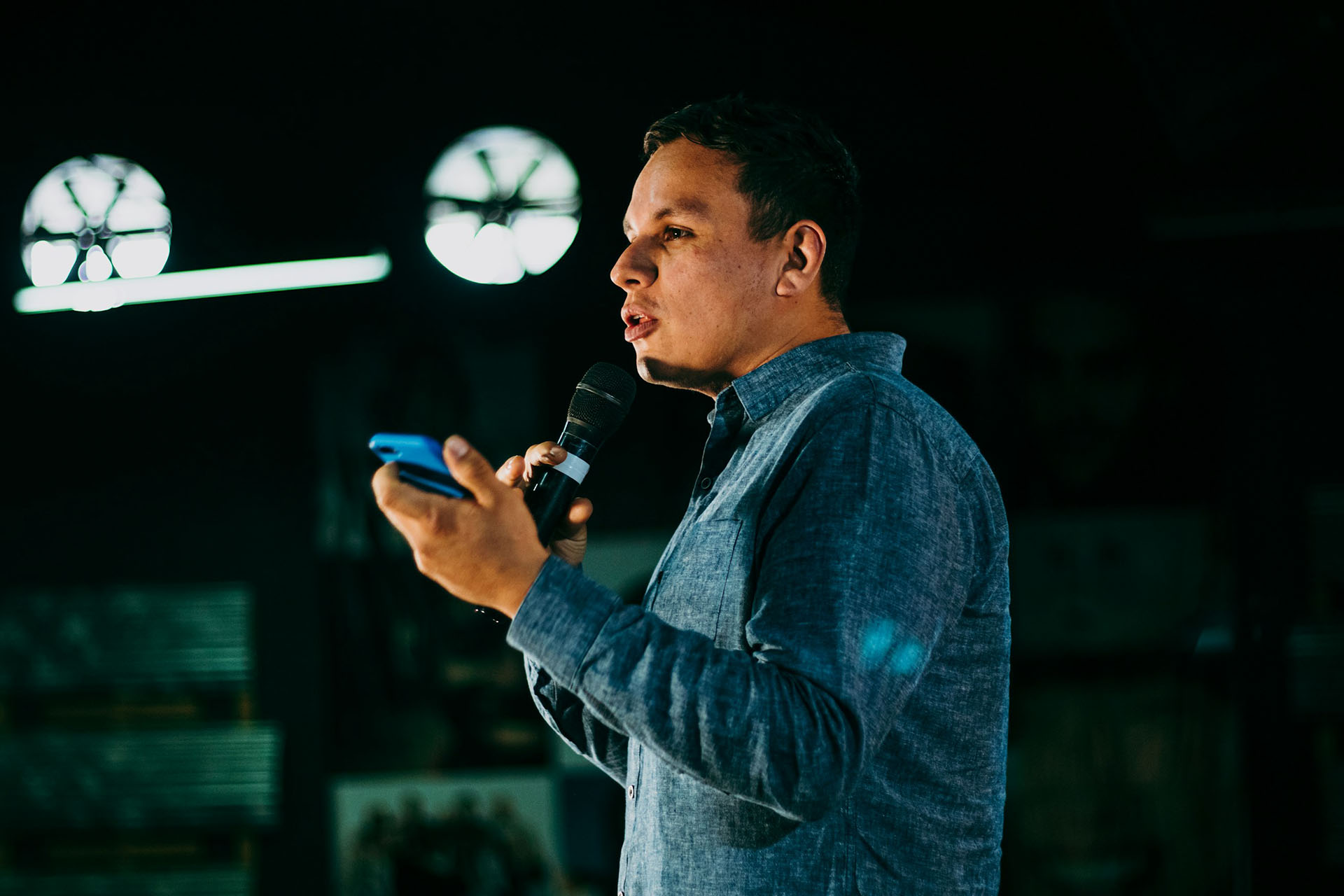
Hello, welcome and happy New Year. My name is Mark, one of the TLC pastors. Thank you, Miss Yolanda, Nicole. Thank you, Adrian, for reminding us that we need to be prepared for communion a little bit later. That's going to be great.
And as you can see here in the Twin Lakes Auditorium, we still have the Christmas trees up, which means I'm preaching to you today from a veritable death trap. But I think we're going to make it through. I'm just glad to be able to say that 2020 is over. Yes, 2020, the year that we all wish we could forget, and we never will. But I'm super grateful that you've joined us today because we're kicking off a brand new message series called Calm in Chaos.
Let's face it. We just came through a year where we slept less and we worried more. And so we're going to take a deep dive into one of the most go-to passages in Scripture. It's in the Apostle Paul's letter to Philippians 4:6-7, where he says this, "Be anxious for nothing, but in everything by prayer and supplication. With thanksgiving, let your requests be made known to God. And the peace of God, which surpasses all understanding, will guard your hearts and minds in Christ Jesus." And again, for the next four weeks, we are going to soak in these verses because imagine having less panic and more peace. Wouldn't that be a welcome change? Or how about being less like Eeyore and more like Tigger? I mean, I need this. You need this. So join me by plunging into this series.
Now, I want to say something at the top because I know that some of us struggle with anxiety in more difficult ways. And maybe you need medication for that or therapy. But whether you suffer from some kind of anxiety disorder or it's just garden variety worry, what Scripture says here is it's for all of us because there are massive benefits to having less fret and more faith. Because there's really an inverse relationship between these two things. And our focus today is obviously going to be on having more faith.
If you haven't picked up the book by Max Lucado called "Anxious for Nothing," I encourage you to do that. It's a great companion to this series. It's a great read. And you can either come by the TLC office Monday through Thursday, 9 through 4. You can order it from us online by going to TLC.org/com. Or you can check out your regular book sources. But Max Lucado begins this book by stating this, that the United States is the most anxious nation in the world. This is according to the National Institute of Mental Health. So despite all we have, we are number one in anxiety.
Well, when I read this, I was curious as to where Lucado was getting his information. And so I followed his footnote to an article by a guy named Taylor Clark. Taylor Clark has written a book as well as a number of articles about the science of anxiety. And in a piece he wrote for Slate, it says this. It says, "According to the 2000 World Mental Health Survey, people in developing world countries, such as Nigeria, are up to five times less likely to show clinically significant anxiety levels than Americans." It's an amazing statistic. And he says, "What's more, when these less anxious developing world citizens emigrate to the United States, they tend to get just as anxious as Americans." So in addition to offering more opportunity, we also offer more anxiety.
As Clark concludes, "Something about our particular way of life then is making us less calm and composed." Now I want you to check this out because he wrote this article in 2011. You have to believe we are even more anxious now. And so today I want to address one simple question. But this is a question that has massive implications for our quality of life. Here it is. How do I live with less fret and more faith? Because like I said, these two are like, you know, on a teeter-totter. When one's up, the other's down.
And I want to be clear about something. Faith is more than just something that we agree with, you know, things that we would hold in our head. In the Bible, the word for faith is often a verb. It's active. It's about actively trusting, putting my confidence in Jesus Christ. Now again, mental health issues can make this more difficult. But even so, having an active faith, whoever you are, it provides a massive antidote to anxiety, a powerful one.
For example, let's take a look at the Apostle Paul. Because when he wrote, "Be anxious for nothing," you know he was in chains, waiting trial before Nero, who was a bona fide psychopath. Paul knows all too well that the verdict could lead to his execution. Meanwhile, this church that he dearly loves in Philippi, it's going through struggles of its own. He alludes in chapter 1 to persecution, suffering that they're facing from the outside. And also, it's clear that there is relational strife on the inside that he addresses throughout the letter that could pull this church apart.
And so Paul could spend all his time while in prison worrying, "What if this church just crumbles under the pressure of persecution? What if they become so divided they just implode from within? Hey, what if Nero feeds me to the lions?" As Max Lucado mentions in the book, anxiety is really about "what if." What if this? What if that? And whereas fear identifies a threat right in front of us, anxiety imagines one.
But I have to be honest, this morning I'm thinking not so much about people who imagine "what if." I'm thinking about people who don't have to imagine your problems because you're living them right now. People anxious because they've had to close down their business. Anxious for employees that they've had to lay off. Former employees worrying about their future. Or how about those of us? You have someone who's ill in the hospital. You can't even see them right now.
Just this last Sunday I was in the parking lot outside of the emergency room at our local hospital. I was there with my mom and my sister because my dad was being treated in the ER for an irregular heartbeat. Now he's fine, praise God, but we were part of this cohort of people sprinkled throughout the parking lot with our masks and our winter coats. And what we had in common is that we're all longing to hear word, get a new update about someone inside whom we dearly loved but we couldn't see. It's not a fun place to be.
And what Paul tells us to not be anxious here. He's not saying that we should become immune to all concern or worry as if the goal was to become some kind of detached robot. That's not what he means. In fact, in chapter 2 of this same letter to the Philippians, he talks about a guy named Epaphroditus. Epaphroditus is from the church in Philippi. He's loved by the congregation there, but he's serving alongside Paul when he gets sick. In fact, he almost dies.
And after he recovers, Paul writes this. He says, "But God had mercy on him, and not only on him only, but also on me to spare me sorrow upon sorrow. Therefore, I am all the more eager to send him." Send him back to you in Philippi. "So that when you see him again, you may be glad, and I may have what? Less anxiety." So what does that mean then when Paul says be anxious for nothing when he arrives in chapter 4?
Well, in this instance, Paul uses a word in the Greek. It's a common word in Scripture, and he uses a verb, and he puts it in the present active tense, which has to do with continuous action, something that we're doing over and over again. And it's kind of like when your anxious thoughts become like hamsters on a wheel. You know, they're just spinning and spinning round and round and over and over and over. And you know what? Just like these guys, we never really get anywhere. We just become completely exhausted and wrung out.
Jesus uses the same word for worry when he says in Matthew 6, he says, "Don't worry about tomorrow. Each day has enough trouble of its own." And in context, Jesus is saying, "You don't have to worry because God is God." He's talking about God's provision, his watch care over our lives, and how he meets us with each day's needs. And he's saying, you know, God is God, no matter what comes in the future.
Some of you are facing real uncertainty right now, right now. But no matter what our circumstances, the choice before all of us is, do I spend my time fretting about that, about what might happen tomorrow, or do I place my active faith in the one who holds tomorrow in his hands? In other words, I make it my desire, my active desire to rely on Jesus for everything to come, whatever it might be. I mean, the future is all in his hands anyway. And when we embrace this, it has a dramatic impact on our lives.
I want you to look at the Apostle Paul's perspective here at the end of chapter 3. And I'm jumping around to a couple different parts in Philippians because I want us to get a sense of context so that when we get into chapter 4, we have a sense of what he's saying. But right at the end of chapter 3, just before chapter 4, he says that instead of being anxious about the things that may happen, Paul's focus is going to be on the things that he knows to be true. Watch this.
He says, "But we are citizens of heaven, where the Lord Jesus Christ lives, and we are eagerly waiting." That's his focus for him to return as our Savior. And you know, if Jesus is your Savior, you've put your faith in him, you're a citizen of heaven, not someday, right now. And because of that, as Paul says, someday he will take our weak, mortal bodies and change them into glorious bodies like his own, using the same power with which he will bring everything under his control. Wow. What an amazing truth.
Reminds me of someone who lived this out in a powerful way. He's one of my heroes. He's a pastor named Richard Sibbes. Richard Sibbes lived over 400 years ago. But when I read his writings, he's so wise and winsome, so encouraging. And after he died, it was... Someone paid tribute to him, and they said this about Richard Sibbes. They said, "Heaven was in him before he was in heaven." Isn't that great? I would love that to be said of me because Richard Sibbes, he lived like a citizen of heaven even before he arrived there, and that's your calling. That's my calling as well.
In fact, it's exactly what Jesus is talking about when the New Testament says that he preached that the kingdom of heaven was in our midst, or the kingdom of heaven is at hand. He's saying, "Live within that reality." And it's also key to understanding Paul here because that's the very same perspective he has. Look at this at the beginning of... In Philippians 4, where he says right at verse 1, he says, "Therefore, my brothers and sisters..." Therefore what? Well, what we just saw in chapter 3 talking about all we have in Christ in our glorious future, he says, "Therefore, with that in view, stand firm in the Lord in this way." Well, what way is that? It's with confidence that Jesus has the last word.
Trusting, "I don't have to worry about what might get me in life. I can stand firm knowing that Jesus has already got me." In fact, you can do that right now by choosing to rely on Jesus for everything to come. Maybe even you just, in your heart, utter a simple prayer that says, "Lord Jesus, this year, every day, I want to rely on you for everything I have, everything I need. So give me the faith to do that, to live by faith, as opposed to fretting over every conceivable thing that comes my way." And as for the burdens that you're facing right now, you know, the ones that are camped out right on your doorstep, well, the response is pretty much the same because in response to those things, I rely on Jesus for everything today, right now, in this moment.
You know, so much anxiety comes down to trying to control the things that we cannot control. And yet, that's what we do. It's our nature. Max Lucado shares a fascinating thing in the book about during World War II, the foot soldiers, the infantrymen suffered far more anxiety than fighter pilots did, even though the chances for the fighter pilots to get killed were much higher than those that were on the ground. So why were they less stressed? Why were they less anxious? In fact, some of them were quite happy with the role that they had.
The reason is because they literally had the stick to the airplane in their hands. They felt a sense of control that the soldiers on the ground never had. Well, when Paul writes this letter and writes these words, he has next to no control over his life. And yet, I want you to see how calm he is in these next verses. This is verses 12 and 13 from chapter 4, when he says, "I know what it is to be in need, and I know what it is to have plenty. I have learned the secret of being content in any and every situation." Now, note this. It's not some situations. He's not just content in the ones that he can control and manage. It's in any and every situation.
He goes on to say, "Whether well fed or hungry, whether living in plenty or in want, here it is. I can do all this through him who gives me strength." It's by relying on Jesus that Paul has the strength, and he's content no matter what his situation is. It reminds me, years ago, perhaps you recall, this bumper sticker said, "God is my co-pilot." I remember seeing these around town. And I get the sentiment, but if you really think about it, Jesus really isn't interested in being our co-pilot. He doesn't want to be our life coach. Jesus is Lord. He's our life. He is the only one who can give us strength in any and every situation, no matter what.
Along these lines, a pastor named Andrew Murray wrote these words when he said, "God is ready to assume full responsibility for the life wholly yielded to him." Andrew Murray wrote these words a hundred years ago, and yet they are just as true today. That God is willing to assume full responsibility for the life wholly yielded to him. Where's your life today? Because if you want to find calm in the midst of chaos, it happens when we surrender ourself to him and rely on him.
In fact, this is really essentially our focus. In the next four weeks to come, we're going to break this down, especially in verses 4 through 8 of Philippians 4. And this is where the book is such a great resource. Max Lucado really makes us very applicable, very accessible and practical to us. And so I really again encourage you to get it. But he basically outlines this process, this daily practice through an acrostic that he calls calm. C-A-L-M, calm.
Where C stands for celebrate God's goodness, as it says in verse 4, "Rejoice in the Lord always." Because when we rejoice, our perspective is expanded, it's lifted up. And rather than just having this anxious focus on the little circumstances of our lives, we're reminded God's in control. God is good. God loves me. God promises to be there for me.
A stands for ask God for help. Verse 6 says, "Let your request be made known to God." And you know what? God never gets tired of hearing from his children. And even when we ask him things that he answers differently, doesn't always say yes to. He always answers in love, in perfect wisdom, and according to his best plans for our life and for his grand purposes in the world.
L stands for leave your concerns with him. In verse 6 it also says, "With thanksgiving, we gratefully leave these requests in his hands." And you know what? There's something so wonderful about being able to do that, to just lay it on him and say, "Lord, this is too big for me, but it's not too big for you." And you know what? I know this from my own life. You know, if things are kind of calm and stuff, you may not experience this kind of supernatural strength. But when you are in the depth of crisis, God shows up in ways that are miraculous, amazing. I could tell you again from times in my own life, and I know so many of you could do the same. So we have that confidence that we can leave these things with God.
And then M stands for meditate on good things. As it says in verse 8, "Think about things that are good and worthy of praise." Because you know this. Human nature is to fixate on the negative. Our brains are wired to do this. And anxiety essentially is negative meditation. But to choose to meditate on things that are good and worthy of praise, again, it's an active choice to reset my perspective.
And you know, if you're watching this right now, you survived 2020. So congratulations. But I bet you can look back, even in the midst of hardship, and see things that God did that were good, that are worthy of praise. Or how about even now, in a moment, we're going to have an opportunity to share in communion together. And what a wonderful time to meditate on this amazing truth that God loves us so much. He sent His Son for us, to us, to take our sin, our punishment, our death, and to give us life. And not just a forgiven life, a forever life. A life full of joy and peace.
So again, I just encourage you to be all in for this series. Get the companion book. And get into a small group so that you can share this experience with others. And if you're not one of our online small groups, you can do so. You can sign up by going to TLC.org/calm. And again, it's going to be a rich experience, something that blesses all of us.
Because here's the thing. In the days, months, and years ahead, every day for the rest of your life, there will be unexpected events, little surprises. And most of them are going to be ordinary moments. But in those moments, you will have the opportunity, you will have to make the choice to either fret your way through it or to faith your way through it.
And so along these lines, I want to close with a little story from my own life this past week. Back in the fall, my youngest child, my daughter Anna, turned 16. My baby turned 16. And she was all geared up to get her license. And whenever the DMV actually gives driving tests again, that's what she's going to do. Which means I will have one more reason, or at least opportunity to be anxious, as my little baby is driving a car.
Well, we've been getting a car ready for her. And we got it used, but it's from a very reliable source. And we've been kind of, you know, breaking it in and this and that. And just the other morning, Wednesday morning, I was taking one of our other cars to the service station, and Laura was going to pick me up in Anna's car. But when she arrives in a different vehicle in the Spurlock fleet, she opens the door. I open the door and she says to me, "I think Anna's car is something really, really wrong with it." She says, "I started it up, and it made this loud squeal, and then it starts smoking, and then a couple seconds later I hear this loud pop." And that's when I shut it off and took this car instead.
While I'm thinking about this on the way home, my mind is starting to turn on what could possibly have happened to Anna's car. I think it must be the main engine belt. It failed. And if that's the case, we're going to have to get it towed. And will insurance pay for the tow? And then there's the cost of the repair. And before I even knew it, the hamsters were in full sprint in my head, starting to just spin and spin and spin about all these little details.
But I was also reminded that I had a sermon to preach this week about less fret and more faith. And so I uttered the prayer in my mind, "Jesus, I want to rely on you for everything that may come and everything today in the moments ahead." And so we get home, and I pop the hood on the car, and I noticed that the engine belt is fine. It's totally intact. I checked the fluids, and they're all fine. And so we turn it on, and it just purrs like a kitten, like it always had.
And so it was at that point I turned to Laura, and I said, "Honey, how in the world did you almost destroy a perfectly good vehicle?" No, I didn't say that. I'm not that stupid. But it was at that time that the puzzle pieces to this mystery started to come together, and I'm looking around by the belt and all the little pulleys that it turns, and I notice there's the cap that goes on the engine for where you put oil in. There's a cap down there, and at least part of it, about two-thirds of it. And I see that there's a newer one on the top of the engine, and so I go, "Okay, the previous owner lost the original cap, set it aside, and just ended up replacing it." They thought it was gone, but all the while it was like a little stowaway in the engine compartment, at least until Wednesday morning when Laura went to start it, and it fell down, wedged itself next to the belt in the pulley where it squealed and smoked and popped as it broke.
And I know this because we found the other pieces in the driveway, and it was one of these, "Phew," you know, tragedy averted moments. Well, you know what? Sometimes our problems are just like that. They're all smoke and noise, but there's not a whole lot else to them. Other times, storms of life descend upon us in ways that we can't even imagine, and we find ourselves completely overwhelmed at a loss, but I want you to know God's never at a loss. God's never surprised. He's never pushed back on His heels, and He is always with us.
Now, let me ask you something. Can you rest in this right now? Can you make it your desire to live this way, going forward? Because here's the thing. We can either swing from one anxious moment to the next, or we can spend our lives relying on Jesus for everything to come and for everything today. In fact, I invite you to do that with me right now as we go to Him in prayer, asking Him to apply these things to our lives and to also prepare us for communion. Would you pray with me right now?
Heavenly Father, I thank You for this opportunity that we have to just rest in Your presence. And Lord, I'm mindful of folks right now who are struggling because they're anxious over the well-being of somebody else, somebody they dearly love, someone who may be ill, or they have a chronic condition. Or Lord, they're anxious because their job has been so unstable, their business has been opened and closed and opened and closed during this pandemic. There's been disruption in their lives. Father, would You meet them in this moment? Would You assure them through Your Spirit that You are with them and that no matter what happens, You will be there for them. You will be their God and their Good Shepherd.
And Lord, as we prepare our hearts for communion, I pray that it would be a powerful reminder of Your love that You would not even spare Your own Son, but You would send Him to us to live the life we could never live and to die in our place so that we could have life with You now and forevermore. And so Lord, I pray You bless the remainder of our time together. And I ask this in Jesus' name. Amen.
Sermons
Join us this Sunday at Twin Lakes Church for authentic community, powerful worship, and a place to belong.