Redwood Tree Faith
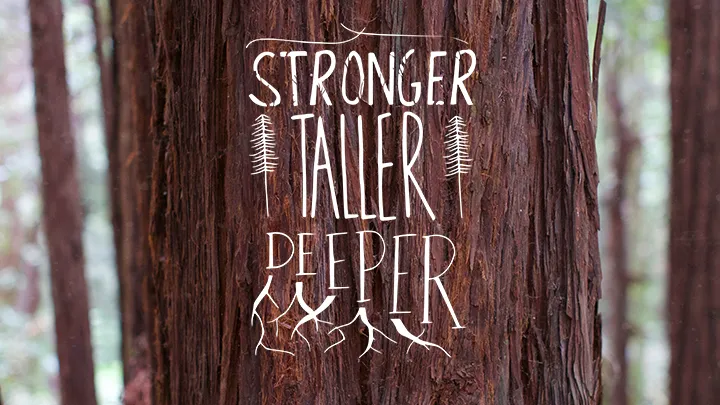
Explore how to cultivate enduring faith like a redwood tree.
Transcript
This transcript was generated automatically. There may be errors. Refer to the video and/or audio for accuracy.
And good morning! Whether you're joining us here in the auditorium or online or watching over in the venue services, we are so glad that you guys could join us this morning. And I want to ask you to take out your message notes that look like this. You got them in the bulletins as you came in to help you follow along, and let's talk about growing Redwood tree faith.
I just want to do a little poll here. How many of you, one of your favorite things about living here on the Central Coast, is the redwood trees? How many of you love the redwoods? Aren't they amazing? Here is just how amazing they are: some facts about redwood trees. Officially, the oldest living Coastal redwood—that's the kind of redwoods we have around our house—is at least 2200 years old. That's a living thing that is before the time of Christ. It's mind-blowing!
But what I discovered this last week that I didn't know before is that foresters believe that actually some of our own coastal redwoods in our own forests may be much older. But they can't know, of course, until they count the rings for sure. But they think that there are older trees than this. What about their height? The tallest tree on earth, the tallest, is 379 feet high. That's a coastal redwood. To put that in perspective, that is taller than the tallest sequoia, the Statue of Liberty, and the United States Capitol building. It's a living thing that's taller than those things. It's amazing!
What about their weight? The biggest trees weigh over 1500 tons, and yet they come from the smallest seeds. It would take 125,000 coastal redwood seeds just to make one pound. Can you believe that? So how do the tiniest seeds turn into the most amazing, huge, long-lasting tree? Let's talk about it. How do you get these trees that endure drought and fire and pests and all these other attacks? I want to be a redwood tree spiritually. I don't want to be a weed spiritually. I don't want to be poison oak spiritually. I don't want to be a prune spiritually. I want to be a redwood tree.
So this morning, let's talk about how to grow redwood tree faith. And you know what I mean by that, right? I mean big faith. Some of you are looking at me with blank stares. Here's what I mean. Imagine this: imagine that you had absolute perfect confidence in God, in a personal God who knows your name, who hears your prayers moment by moment, even when life was rocky, even when you fell, even when things weren't going your way, even when circumstances only kept getting worse. Imagine if the natural response in your mind and in your heart would be, 'God is in control, and he is a gracious and sovereign God, and he is going to work things out.' He always, always leverages bad for good in my life. So I will wait with confidence and see what good things he has for me even in this.
Just think how different your daily life would be. Imagine all your insecurities being replaced by confidence. Imagine always being calm in every crisis. Imagine being consistent for your whole life, enduring through drought and storm and fire. That's what I mean by redwood tree faith. And I know it is possible because I have known people like that. Have you ever known somebody with kind of redwood tree faith? Are you thinking of somebody right now? How many have known somebody like this with redwood tree faith?
You know who I picture in my mind? I picture my wife's Grandma Grace. Grandma Grace, this is a picture of her. She has this amazing combination of sweetness and strength. She just recently passed away at 103 years old. She was 103 when we celebrated her birthday here—so godly and also so witty. She lived in Arkansas, where it's kind of the home of Walmart over there, right? So it's true. Grandma Grace walked into a Walmart. You know, they always have the greeters there at the door, and they're always older gentlemen. So she walks in, and she was 101 when this happened, and the greeter, there's about a 75-year-old guy, and he says, 'Hey, beautiful.' And she says, 'Are you flirting with me?' And he says, 'Yeah, how about a date?' And she says this: 'Date you? I should adopt you!' I love that. True story!
I want to be like Grandma Grace. She was such an awesome spiritual giant as well. So how do I get there? How do I be like that? I did a little research this past Wednesday. I posted a question on my Facebook page: 'Name one thing that has grown your faith substantially.' I got dozens and dozens—last I checked, over 62 responses from you guys. And what I want to do is kind of reveal this research today because every single one of the responses fell into four categories that I'm going to cover today. And listen, I just want to make this promise: if you work these four potentially into your life, you are going to see yourself grow stronger, taller, deeper. You will have redwood tree faith, not because of your own self-effort, not because you're trying harder to grow, but by doing these simple things, you're going to put yourself in a place. You're going to foster an environment in your soul that God will use to grow you.
I'll show you what I'm talking about. Number one: one of the reasons redwoods live so long and grow so tall is because they are almost impervious to rot, to pests, to drought, to fire. In fact, until recently, the San Francisco City Building Code required redwood to be used in the foundations of San Francisco residential buildings. Why is redwood so strong? Well, part of the reason is a redwood's bark. It can be one foot thick, and it contains tannin, which protects the tree. So I asked myself, what is the spiritual equivalent of redwood bark for you and me? What can both protect and nourish us spiritually? Well, Jesus talked a lot about this. Jot this down: number one is practical Bible teaching—not just Bible teaching, like not just head knowledge, but practical Bible teaching that makes a difference in your daily life.
This was the second biggest response to my Facebook question: 'What does God use to grow your faith?' People said things like studying my Bible daily, devotional Bible reading every day. One person said, 'The Bible in-depth study.' There is nothing that surpasses the Word of God. What are they so enthusiastic about? Well, in Matthew 7, at the end of the Sermon on the Mount, Jesus says, 'All who listen to my instructions and follow them'—now stop right there and circle 'follow them'—'are wise like a man who builds his house on solid rock.' Why? What happens? Well, like redwood tree bark, though the rain comes in torrents and the floods rise and the storm winds beat against that house, it will not collapse, for it is built on rock. This is just true!
I just saw this this week in a book. Researchers at the University of Toronto and York, in a joint study, concluded that people who were very religious, as measured not just by church attendance but also daily Bible reading, were substantially less affected by stress and had—listen to this—better decision-making skills in crises, exactly like this verse says. Now, reading the Bible probably is not a new idea to you, but do you do it every day? 'I've tried, but I don't understand a thing I'm reading.' Well, we're going to help you with that—more on that in a minute.
But what's the second thing that God uses to grow your faith into redwood tree faith? Well, redwoods are the tallest tree on earth, but their root system is also the shallowest. It's only six to twelve feet deep. So why don't they fall over all the time? Well, I want to show you why this is what's happening in a redwood grove. The roots are shallow, but they're wide. They extend out up to a hundred feet from the trunk. In groves where their roots intertwine and fuse together, you see this picture? The roots are actually holding hands. The roots have fused together, and this is how the redwood trees, though they're tall and have shallow roots, don't topple over. They have this incredible underground cantilevered connected root system so that actually the whole grove, the whole circle, is holding up each tree. It's fantastic!
And the same truth is true of you spiritually. Jot this down: point number two is positive relationships. Positive relationships live in a grove. You thrive in a grove. God's not just growing individual trees in this church; he's growing a forest. You know the Bible says in Proverbs 13:20, in fact, let's read this verse together. Can you read this out loud with me? 'Be with the wise and become wise; be with the evil and become evil.' This verse is saying is there is—listen—there is always a spiritual component to relationships. Always. Every relationship will either lift you up or bring you down spiritually. So what are you going to do with that principle? Well, you have to be intentional about putting yourself in positive relationships, about planting yourself in a grove where you can keep each other supported.
And here's one way to do that in your life. Don't miss this; this is huge. I love the picture this next verse paints of the early Christians: 'All the believers met together constantly and shared everything with each other. They worshipped together regularly at the temple each day, met in small groups in homes for communion, and shared their French press coffee and crock-pot roast beef with great joy and thankfulness.' Now I want you to circle an interesting phrase there: 'small groups in homes.' This is biblical. When you not only meet as they did in the temple courts in a big group—there were about 3,000 of them in the early days meeting together—but then they also met in small groups in homes. What that does is it takes everything about church and makes it better.
And don't take my word for it. I want you to watch some friends of mine here at TLC, Michelle and Peter Moyer and Mike and Kelly Catlin. And here's what they say about their experience with small groups at Twin Lakes Church. Watch this.
When we first started coming to Twin Lakes, we felt a little lost because of the size of the congregation. And we started getting into small groups. It really helped us form our tight-knit bonds that we still have with people over several years. We have a group of six couples right now, and we are lifelong friends. We've been together for almost 12 years, and we just love to get together and study the Bible and hear what God has to say to us. And when you're in a small group, you have that companionship with others, and they're doing the same thing you're doing. The goal is you're learning God's Word. You're praying together. You're praying for each other.
One of my biggest worries about being in a small group was sharing personal information, and I quickly found out that my biggest fear was not even an issue. So what is said in the small group stays in the small group. And to just pray about it and sign up for one, and there's a small group for everybody. You know, if you're afraid of a small group, that's one reason to get in one, because you'll grow and you'll be able to let go of those fears. Show up, open heart, open mind, let God do all the work. It also gives you other people to lean on when you need help, other people to share your happiness with. We've grown so much as a family. I mean, we talk a lot about us, but our children are watching us and learning from us. I mean, there's something for everybody, and there really is—and coffee after and cheese, so that's always a bonus!
Well, I'm so excited about small groups that I like if someone wants to be in a small group and our group is full, I will help them find a small group. I will put one together. I will find people that I think they would enjoy being with and help them put a group together. I just—I wish it would start this week. I'm just so excited!
What are you waiting for? I love that. I love how Kelly goes, 'And there's dessert and coffee after and cheese.' Like, you know, this one fact may sway it for you—there's cheese! So listen, right outside today, you can sign up. We got the tables arranged geographically. We got brand new, just seven-week commitment small groups for you. It is worth a try. You can find one near where you live.
Now number three: how do you get redwood tree faith? Watch this. I saw this California coastal redwood tree in Germany in a big garden there. It's actually a garden owned by the Swedish royal family in Germany. Now, this redwood tree has the exact same DNA as our trees here have. It is all the same potential, yet it's not nearly as tall as our trees. It's 139 feet tall, and it has stopped growing. Now, why hasn't it grown to 320 feet like our trees? Why did it stop at 139 feet? There's nothing wrong with this tree.
Well, it turns out that redwoods need a certain environment, a certain amount of fog, a certain kind of forest to activate the potential in their DNA. And the same exact thing is true of you. But unlike the redwood, you can control your environment. Because I'm talking about your mental environment, your spiritual environment. What is your environment, kind of the fog, the atmosphere you're surrounding yourself with? Is it thoughts of Jesus and his sacrifice for you? Is it thoughts of the Father and his fatherly love for you? Is it thoughts of the Holy Spirit and his daily empowering of you? Or is it thoughts of fear about the world? Is it thoughts of anxiety about your future? Is it thoughts of anger or jealousy or envy or frustration with friends of yours? You can't control that completely. You have a responsibility to take control of it. The Bible commands us to take our thoughts captive. How? Through number three: personal disciplines.
Personal disciplines. Now I know that discipline is kind of a negative word. Discipline, when I hear the word discipline, I think punishment, right? I think I'm going to get disciplined, and I think of all the stuff I'm supposed to do but I don't want to do. But I want you to look at this. Look up here. When people talked about this responding to my question on my Facebook page, I got these responses and so many more like this: 'What has grown your faith? Daily devotionals, prayer, and the cross. I read my Bible daily and pray daily. Taking my thoughts captive every day. Time daily in private worship.' Did you notice a word that popped up again and again? What word? What word? Daily! This is huge!
Because these things are like daily exercises—daily prayer, daily devotional time, daily meditation. But most of us resist daily discipline. We might be weekend warriors and go out for a jog on Saturday morning, but daily we resist it, even though we know it's good for us. We just resist it. But listen, you know, I didn't call this talk 'How to Grow a Backyard Full of Spiritual Weeds' because nobody needs instruction on that. You can grow weeds without doing a single thing. In fact, if you don't do this daily, that is all you will grow in your soul: anxiety and fear and greed and arrogance. You don't have to nurture them carefully. In fact, you have to trim them back daily.
It's kind of like your physical health. You know, at my age, I used to be able to get away with not doing things daily, but at my age, if I don't exercise daily, I start to fall apart pretty fast. And not just build stuff into my life, trim stuff out, trim stuff back. Like, I don't want to be gross, but if I don't groom myself, I mean, I don't know if you ever thought to yourself, 'God, ear hair? Why, Lord? Why is it a result of the fall? Why did God create ear hair?' If I don't take care of it every day, the air what I have sprouting—and I'm not talking about hair; I'm talking about like cables coming out of the top of my ear. Anybody relate to that? You could suspend the Golden Gate Bridge on the cables that grow out at the top of my ears!
But anyway, my point is this: it has to be daily or it just gets out of control. And Jesus did this. Jesus talked about it. He said it is so worth it. In the Sermon on the Mount, he talks about three personal disciplines, right? He talks about prayer, he talks about fasting, he talks about giving, and he says, 'Your Father who sees in secret will reward you.' There is reward. And another regular discipline you need to be intentional about is giving of yourself. The Bible says, 'God has given each of you some special abilities. Be sure to use them to help each other, passing on to others God's many kinds of blessings.' When you use what God has given you, what happens is it grows you, it stretches you, and it blesses others too, right?
Look at this Facebook response: 'Every time my faith has grown, I've been asked to make a leap of faith. And every time my faith is tested, and every time I do this, I see God show up bigger and brighter than I ever imagined.' Can you relate to this? You ever had a moment in your life where you've been faced with an opportunity to serve or maybe to give to something, something big, something far greater than anything you could do alone, and you feel this inner voice prompting you saying, 'Go for it,' even though you feel inadequate and unprepared? And so with fear and trembling, you step out, you get involved, and then something happened.
And then eventually you step back and you see the results of, say, the food drive, where you see the results of the mission trip, or you see the results of the 2020 vision, what we're doing at the orphanage in India and here with our own children's building, and you go, 'Look what God did through me, through us! God is great! God is amazing!' And you grow a little taller and a little more willing to take that risk the next time.
Now, before I get to the last point, I want to address something here because maybe you're thinking, 'Read the Bible, join a small group, be disciplined to pray daily and serve—that's it, René? You know, I thought you were going to tell me something new. I've heard all this stuff in Sunday school since I was eight years old.' In fact, some of you are going, 'René, these are the same exact things. I can't stand! They seem so churchy. They seem so legalistic. They seem so old-fashioned.' Well, all these things—reading the Bible, praying daily, serving—they can become a legalistic burden if you misunderstand how they work.
You know, I'll be honest. I used to think that God was up there watching to see if I read my Bible and if I prayed and if I went to church, if I served, and if I did those things, he blessed me somehow, like there was an equivalency. He gave me one answered prayer for every verse I memorized or something like that. That is primitive. It's a childish, it's a magical—dare I say it?—it's a pagan way of looking at religion. You go to the temple and you do your duty religiously so that the gods look upon your request with favor. That's not what this is. This is not magic. These are simply intentional ways that you put your soul in touch with God daily, and then he does the work in you.
Specifically, these are always—listen, we talked about this last weekend—these are always about abiding in Christ, of allowing your imagination to be captured by the crucified Christ and the risen Christ who is with you now, living with you, empowering you. And when the presence of Christ captures your thoughts, captures your imagination in these intentional ways, then he changes you. You don't change yourself. God changes you from the inside out into that spiritual redwood tree, just, you know, one growth ring at a time.
And one more, the fourth way God grows your faith that you might not want to know about this one. Because here's a picture of a prescribed burn in the Giant Forest of Sequoia National Park recently. Scientists have actually reintroduced fire to the redwood forest ecosystem. Now, why in the world would they do that? Shout it out if you know—why would they start fires in redwood forests? Why? Because redwoods need fire! As it turns out, some of the cones won't even open and release their seeds unless there is fire.
Well, guess what? I am so sorry about this, but it turns out the same exact thing is true of us spiritually. The fourth thing God uses to grow you into a spiritual redwood is what I call pivotal circumstances. Pivotal circumstances. This was mentioned by far more than any other thing when I asked, 'What has God used to grow your faith?' I want you to look at some of the things people said. I think of the stories behind these words: tragedy, crisis, my illness, the loss of everything in a fire. I thought I knew God until I saw him working in my life and my family's lives when I was diagnosed with cancer. A job loss, when my dad died, my terminal cancer, and my husband's death, going through cancer and my husband's near death—tragedies for sure. I could show you another 40 of these.
One of the reasons I think my wife's Grandma Grace was a spiritual redwood was all the tragedy in her own life. It was full of tragedy. I'm not saying that God causes these tragedies, but listen: God never wastes a hurt. God never wastes a hurt. You know, there's two narratives that you could use when framing bad things in your life: the catastrophe narrative, when you say, 'Yep, just like always, when things start to go good in my life, there's some catastrophe. Here we go again,' or the redemption narrative, where you say, 'In my life, God has always—as he's always done in history—redeemed bad things, even death, for his glory, and I can't wait to see how he's going to do that even in this.'
The story of Jesus' friend Lazarus's death in the Bible is one of the best examples of this in the Word of God. Jesus, if you remember the story, gets word that one of his best friends, Lazarus, is sick. And to everybody's confusion, Jesus delays going to see Lazarus when with a touch he could have healed him, when he could have healed him long distance. And instead, he waits until Lazarus is what? Dead. And his disciples go, 'Why did you wait?' And when he gets there, Mary and Martha ask him, 'Why did you wait?' You ever ask God that? 'Why did you wait? Why am I going through this chaos?' Jesus says in John 11:14, 'Lazarus is dead. Look at this: this will give you another opportunity to believe in me.' Just look at that verse for a minute. He didn't say he caused Lazarus's death. We live in a fallen world where death happens. But he said, 'This will give you another opportunity to believe in me.' Listen, no matter what happens, no matter what happens, that sentence is always true for you.
Job loss? Jesus is saying, 'This will give you another opportunity to believe in me.' Relationships strain? 'This will give you another opportunity to believe in me.' Illness? 'This will give you another opportunity to believe in me.' Why? Because you see, once again—and we have to keep learning this lesson—that when you come to the end of yourself, you're only at the beginning of God.
Well, soon after he says this, Jesus turns a funeral into a party, turns a wake into a revival, turns a dirge into a cheer as he raises Lazarus from the dead, proving he is the resurrection and the life. And Jesus can do the same in your life, even with what you are going through right now. Whatever's causing tension in your life, whatever's straining you, Jesus plunges into that situation and can work through it. That's why I called these pivotal circumstances—not painful circumstances. They are painful, but more to the point, they're pivotal because they're pivots in your life. You can pivot either toward God and toward relationships with others, or you can pivot away.
One huge example: if you were in church last Sunday morning, you heard me talk about the Huffington Post article that was posted last Sunday morning about Bola Taylor. This was the headline: 'Bola Taylor's Last Concert: Singer Teaches Her Fans How to Live and How to Die.' We support Bola as a church. She and her husband, Ken, are ministers. They have a music ministry, a church planting ministry. Well, Bola has inoperable cancer. There's nothing that the doctors can do, and she is going to be performing what appears to be her final concert tomorrow, Monday. It'll be 1:30 in the morning our time. You can watch the final concert live. It's going to be streamed on the internet. We'll have the URL on our website, TLC.org, and it'll be archived for a month, so you can watch it if you're not up at 1:30 in the morning.
But this horrible circumstance has really revealed a towering redwood in Bola. We asked her this week, you know, here's what we're talking about this weekend: 'How are you? What is helping you to be so strong through all this?' And with no prompting from me, look at what Bola said. She said, 'I think it's because for years now, for 20 or 30 years, every day I started my day by reading God's Word.' And then she listened to gospel music daily, got into a space of worship. And then she said, 'I had kind of a habit. As I folded laundry, I would pray for my kids or my husband, whose clothes she was folding. She prayed for them.' And then she said, 'Almost every night, Ken and I were out leading choirs and fellowshipping with our small groups.'
Do you see something about those quotes? That's exactly what we've been talking about this morning. Incrementally, daily, it got her into the habit of just abiding in Christ. And does it make a difference now that she's faced with the biggest challenge of her life? I want you to watch this. Susie Jocelyn, the wife of one of our pastors here, Jim Jocelyn, Susie was in Japan this last week with her own Japanese family, and while she was there, she made time to go to Bola's house. I asked Susie to give Bola a chance to talk to you for a couple of minutes and to address the question: 'What is the ultimate thing that is helping you in your trial?' Susie just videoed the answer as Bola was in her bed there at her house, and she videoed it on her iPhone and sent it to us. Now I want you to see this because this is a human redwood tree here. Now, Bola's voice is very quiet. She's very ill. You have to listen carefully. But this is a sacred, completely honest moment. Watch this.
We are thankful that God did not turn us into robots of himself and that his love enables us to actively make choices in our lives. And this last six months, I have actively chosen Jesus, whether it's to worry, whether it's to fuss about stuff, whether it's being patient, whether it's to be grumpy, you know, to all my pains. When I was in pain, I would be so reminded about the cross and how he suffered for my sake. I didn't dare complain. Just the gravity of the physicality of his agony on the cross just slaps me back to reality. It's like, what are you complaining about? All your suffering is not being able to breathe. I mean, try being hung on the cross. Oh, it just is very sobering. Once I focused back on Christ and everything that he has done for me and my sake, so it's good to make your choices moment by moment, and it's a great thing that we have that choice. And it's an option that we should take. Choose Christ in all that we do because that is the best choice.
That is a redwood tree! That is a—
In fact, let's just pray for Bola. Let's pray for her to have strength as in just a few hours really from now she'll be doing that final concert. God, we just pray for our dear, lovely friend Bola, and that you would give her strength—more strength than she thinks she could ever have to do that last concert. I'm sure she'll be receiving a lot of tributes from people who love her there in Tokyo. But God, I pray that your word would also go out and that everybody there would realize that they have a choice too, that God has given them the option to choose to abide in Christ. In Jesus' name, we pray. Amen.
As your pastor, personally, I am committed to helping you incorporate these things into your life so you can have a redwood tree style faith. And I gotta tell you, there is no other reason than these four things that we've been talking about today. That is the reason that next week and every fall we have these fully immersive seven-week churchwide Bible studies. This year, it'll be one that we're calling 'The Seven.' But what it is, is a verse-by-verse study through Revelation chapters 1, 2, and 3. Honestly, it's in some ways the deepest study that we've ever done together here as a church. And if you decide not just to come on Sunday morning but to really commit to this, you'll find all four of the things that we've talked about today bolstered in your life.
In fact, I'm going to ask you to prayerfully consider committing to this. Would you grab this little blue card out of your bulletins? See, it says 'The Seven' on top. And what I want to ask you to do—don't turn it in, but keep this as a reminder. Put it somewhere as a personal reminder if you decide to commit to this. Commit to what? Look at this card: 'During this fall series, to the best of my ability, I commit myself to practical Bible teaching, attending weekly services to receive teaching based on Revelation 1 through 3.' And you know what? I just want to reassure you, we are not studying the book of Revelation to get head knowledge about the identity of the Antichrist and the date of the apocalypse and the address of the closest army surplus store so you can buy your own bomb shelter or something crazy. We are studying the book of Revelation because it is intended to give practical benefit to your daily life and how you handle daily struggles.
All right, and there's a book that I wrote called 'The Seven.' You can get it outside right now. And if you don't have the $10 donation, just take a book. We want a book in everybody's hand, and neither I nor anybody else gets a dime from that book. All the proceeds go to this church. And then second, I commit to positive relationships, getting into a small group that meets weekly. Try it just for seven weeks. Again, you can sign up at a table outside. And by the way, the small groups—why should I get in a small group? In addition to the relationships, the small groups, and only the small groups, will see videos that we filmed last fall on the seven archaeological sites mentioned in these seven letters of the book of Revelation. So that's kind of an extra that the small groups get.
And if you're going, 'I don't know anything about the Bible. I'd be intimidated going to a small group.' Listen, first, nobody knows anything about the book of Revelation. It confuses everybody, so you're all on an equal playing field. And secondly, in the videos, I kind of give you what you need for the discussion, so nobody's going to be left in the dark. Then personal disciplines: reading each day's chapter in the Bible and the book and praying. Pivotal circumstances: staying open to seeing each event in my life as an opportunity to grow spiritually. Take this card, put it somewhere to remind you of your commitments.
Now, why do I keep saying commitment? Why is that so important? Look up here for a second. Adrian Moreno, one of our pastors here that we all know and love, last month did this daily fitness program, and every day he posted pictures of himself working out. Every day on his Instagram account, it was actually kind of inspiring. He really got into shape; he lost a lot of weight. Well, at the start of this month, Adrian goes to the staff and he says, 'Who would like to join me for the next month where every day together we're going to be working out?' I mean, everybody at their own houses, but we're going to keep each other accountable. Now, I've never done anything like this before. I was kind of intimidated, but because it was just a one-month commitment and not lifelong, I thought, 'I can do this for a month.' And because every day there's a video explaining the workout, and because every day we're doing it together and we can keep each other encouraged, well, that's exactly what this fall series will be for you if you're committed to it.
And listen, you may feel like a spiritual lightweight right now, like you don't have a lot of potential right now. But remember those redwood seeds—so tiny it takes 125,000 of them to make one pound. But they've got redwood tree potential in their DNA. You have redwood tree potential in your DNA. How do I know? Because you're a redeemed child of God. So will you simply be intentional about creating a spiritual environment in your life that can lead to the kind of spiritual growth you've been longing for in your life and in this church?
Well, let's pray about it. Would you bow your heads with me? With our heads bowed, I just want to say he is your strength when you have no strength. So don't worry about your current weakness. Intentionally choose him moment by moment, including in this moment. Pray in your heart, 'Lord, I choose you. I choose to trust in you daily. Help me to intentionally create an environment in my life that's conducive to the growth you want to produce.' And Lord, I pray that if anybody here wants to, for the first time, commit their lives to you, that they would simply pray to you silently, 'Now I choose to trust in you, the crucified and risen and living Lord Jesus. Now grow me from the inside out, starting today.' And I pray this in Jesus' name. Amen.
Join us this Sunday at Twin Lakes Church for authentic community, powerful worship, and a place to belong.