When the Church Becomes a Bridge

Ephraim shares how the church can be a bridge in a divided world.
Transcript
This transcript was generated automatically. There may be errors. Refer to the video and/or audio for accuracy.
One of my favorite things about summers here at Twin Lakes Church is that we get to hear from guest speakers. I'll be back next weekend to continue our series in the book of James called everyday sacred. But today we're having one of my favorite speakers, Dr. Ephraim Smith. He is an author, a pastor, a CEO, and a motivational speaker. He's married to his beautiful wife, Denisha. They have two wonderful daughters. He is the co-pastor of one of my favorite churches, Bayside Midtown. I brought my whole family there. We've enjoyed the worship. It's just a beautiful, beautiful place. And he's the author of five books. Listen to these titles: Raising Up Young Heroes, The Hip-Hop Church, Jump, The Post Black and Post White Church, Killing Us Softly. Great books. I recommend them all. I just read Jump. It's really super, super good. I just loved it. And big news! Get this: two weeks ago, Ephraim received his doctorate from the prestigious Fuller Seminary. Please join me in welcoming Ephraim Smith.
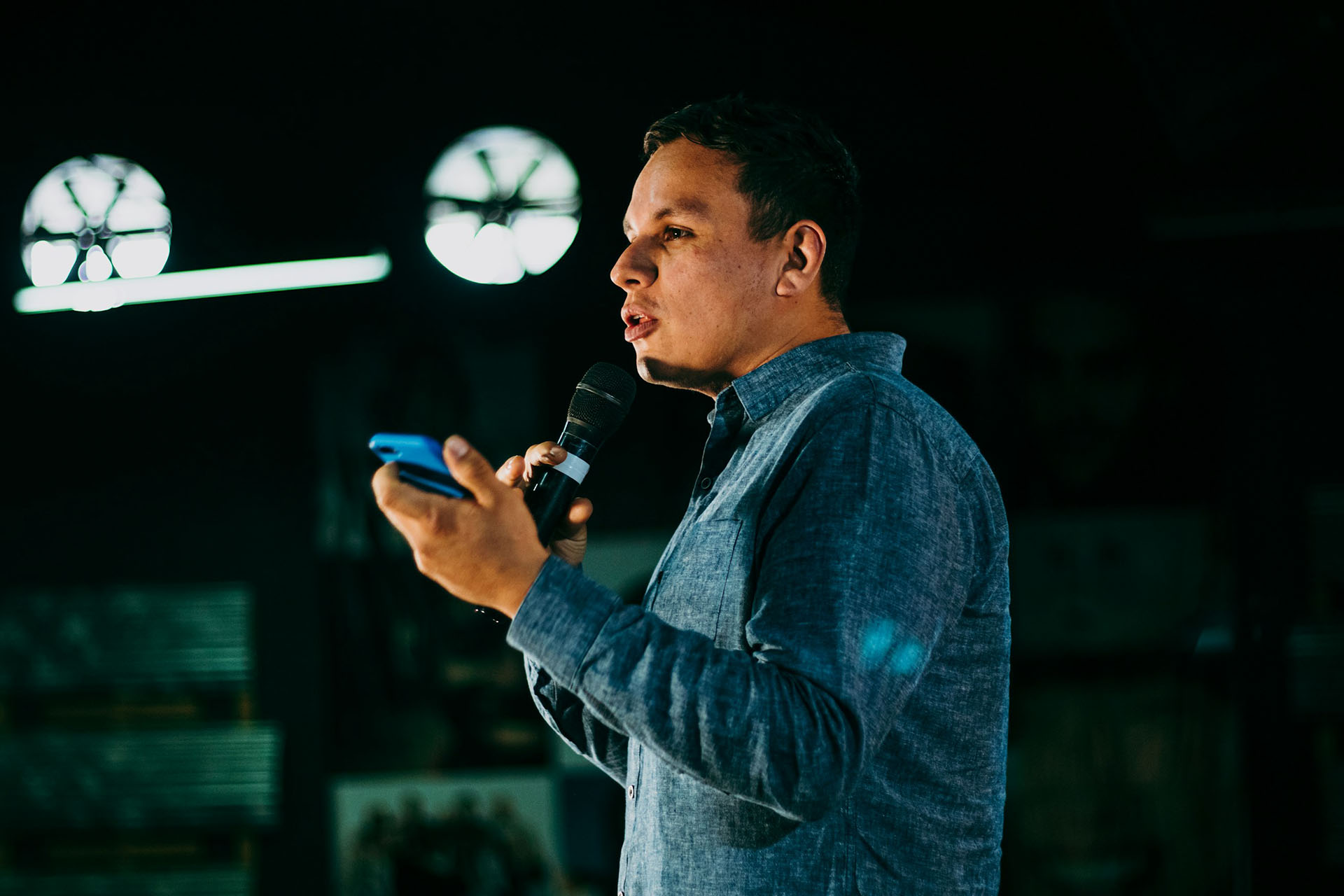
Wow, well, Pastor René, it is an honor to be back here at Twin Lakes Church, and I'm glad that my wife Denisha was able to join me this time. And so awesome! I want to read to you from the book of Acts, chapter 10, beginning with verse 1. There's a word for us in the book of Acts, chapter 10, beginning with verse 1. At Caesarea, there was a man named Cornelius, a centurion in what was known as the Italian regiment. He and all his family were devout and God-fearing. He gave generously to those in need and prayed to God regularly. One day at about three in the afternoon, he had a vision. He distinctly saw an angel of God who came to him and said, 'Cornelius.' Cornelius stared at him in fear. 'What is it, Lord?' he asked. The angel answered, 'Your prayers and gifts to the poor have come up as a memorial offering before God. Now send men to Joppa to bring back a man named Simon who is called Peter. He is staying with Simon the tanner whose house is by the sea.' When the angel who spoke to him had gone, Cornelius called two of his servants and a devout soldier who was one of his attendants. He told them everything that had happened and sent them to Joppa.
About noon the following day, as they were on their journey and approaching the city, Peter went up on the roof to pray. He became hungry and wanted something to eat, and while the meal was being prepared, he fell into a trance. He saw heaven opened and something like a large sheet being let down to earth by its four corners. It contained all kinds of four-footed animals, as well as reptiles and birds. Then a voice told him, 'Get up, Peter, kill and eat.' 'Surely not, Lord!' Peter replied. 'I've never eaten anything impure or unclean.' The voice spoke to him a second time, 'Do not call anything impure that God has made clean.' This happened three times, and immediately the sheet was taken back to heaven. While Peter was wondering about the meaning of the vision, the men sent by Cornelius found out where Simon's house was and stopped at the gate. They called out, asking if Simon who was known as Peter was staying there. While Peter was still thinking about the vision, the Spirit said to him, 'Simon, three men are looking for you. So get up and go downstairs. Do not hesitate to go with them, for I have sent them.'
From this text, I want to speak to you on the title When the Church Becomes a Bridge. God, I pray that this would be your message, that ultimately you would be speaking and I would just be the vessel, the vehicle that you have decided to use to say what you want to say to these, your beloved children, my sisters and brothers. God, I desire to be obedient to your word. So, please let it be done in Jesus' name. Amen.
When the church becomes a bridge. My wife Denise and I, with our two daughters, have lived in California now going on nine years, but Denise and I are originally from Minneapolis, Minnesota. This is where we are born and raised. In Minneapolis, every winter we thank God that we're in California. We go, 'Man, I don't know how we got received this favor, but praise God for it.' I remember when we originally moved to the Bay Area in 2010, and our first winter we were downtown San Francisco, and it was 48 and raining lightly. There was a couple in front of us just shivering, and they were saying, 'This is the worst winter we've had in years.' We were thinking, 'This is great! Praise the Lord!' Because the last winter we experienced in Minneapolis, we went the whole month of January, and it never went above 15 degrees. I mean, when the weather person comes on and she says, 'You know what? We are finally out of the month of January. Today the high will be 21.' No!
So every winter we go, 'Oh my gosh, praise the Lord that we're here!' Now, we have a lot of fond memories from growing up in Minnesota, and we were fortunate. We were part of planting a church where I served as senior pastor for eight years. But I will never forget August 1st, 2007. On August 1st, 2007, in the late afternoon, the I-35W bridge that connects the Twin Cities of St. Paul and Minneapolis collapsed. It was a tragic, tragic moment. This eight-lane, 77-foot-long I-35W highway bridge over the Mississippi River collapsed. 1,000 feet of the deck truss collapsed, with about 456 feet of the main span falling 108 feet into the 15-foot-deep Mississippi River. 111 vehicles were on the part of that bridge that collapsed. 13 people died, and 145 people were seriously injured. In the midst of this tragic moment, something I guess you could describe as miraculous—I can't really fully explain it—there was a school bus carrying elementary-age kids. But instead of that bus falling into the Mississippi River, somehow miraculously it landed on the banks of the Mississippi River. It's almost like part of the collapsed bridge became some kind of ramp to where it landed. Though there were some bruises and some cuts and scrapes, all the kids on that bus survived.
There was a young man named Nate who was working not far from that collapse site, from the tragedy. In the midst of the cries and the screams, the tears, the brokenness, the death, and the injuries, he ran towards where the collapsed bridge took place, and he helped kids get off the school bus. The governor would later honor him, acknowledge his heroic effort in helping these kids off of the bus. He ran to the devastation, to the brokenness, to the pain, to the tragedy. As I transition to a metaphor, I do not in any way want to make light of what happened on that day. There are families in Minnesota that are still recovering from that tragic day. But as I thought more about the collapse of the I-35W bridge between St. Paul and Minneapolis, it made me think of other ways in our society, on this planet, where bridges have collapsed. They may not be physical highway bridges; they may be spiritual bridges, social bridges.
But in this ever-increasing diverse yet deeply divided world in which we live, we see so many social and spiritual signs that there are bridges that have collapsed. Bridges that ought to get us to a destination that is flourishing and thriving. Bridges that ought to keep families together. Bridges that ought to support institutions that serve communities well. Bridges that sustain reconciliation. Even though our skin color might be different, our physical features are different, our accent might be different, our slang may be different, who we voted for might be different. But we ought to be able to live in a world where there are these stable, strong structures that keep us whole; they keep us unified. But there are far too many examples where we see brokenness, where we see collapse, where we see devastation, where we see sustained anger, where we see discrimination, where we see prejudice, where we see unforgiveness. I wonder if it's these very moments that are a call to the church, that the church must become a bridge.
That in a world of brokenness, division, and pain, the church must be a bridge—a bridge of reconciliation, a bridge of God's love, a bridge of God's grace, a bridge of God's forgiveness, a bridge of God's truth, a bridge of God's justice, a bridge of God's holiness. What if the church decided missionally, in a broken world, to be a bridge? This is what we find here in the book of Acts, chapter 10. I believe this story of the bridge that God builds between Peter and Cornelius, between Jew and Gentile, between one representing systems and structures of oppression and one being the object of that oppression. In this story, we see God build a bridge between Cornelius and Peter, and maybe this is a great opportunity for you and I to find our place, to find our life purpose as a bridge in a broken world.
Acts chapter 10, beginning with verse 1 again: At Caesarea, there was a man named Cornelius, a centurion in what was known as the Italian regiment. He and all his family were devout and God-fearing. He gave generously to those in need and prayed to God regularly. One day at about three in the afternoon, he had a vision. He distinctly saw an angel of God who came to him and said, 'Cornelius.' Cornelius stared at him in fear. 'What is it, Lord?' he asked. The angel answered, 'Your prayers and gifts to the poor have come up as a memorial offering before God. Now send men to Joppa to bring back a man named Simon who is called Peter. He is staying with Simon the tanner whose house is by the sea.' When the angel who spoke to him had gone, Cornelius called two of his servants and a devout soldier who was one of his attendants. He told them everything that had happened and sent them to Joppa.
Here's point one: God builds bridges. Here, what we are seeing is God building a bridge to an unexpected place, to a place that would cause the people of God, at least the people that believed they were the people of God, to go, 'Why is God building a bridge there?' To really help you understand the context, we've got to understand this is one who is a centurion in the Italian regiment. What this is helping us see is that Cornelius actually represents the systems, the structures, the institutions that are actually oppressing the followers of Jesus that have put the people of God in a place of second-class citizenship. They've marginalized them. This is the Roman Empire. This is power over a people in an oppressive way. Why would God build a bridge here? Isn't this enemy territory? Isn't this the negative systems? Up to this point, most of the time what you're seeing is God working through God's people. But every once in a while, we see something incredible, revolutionary, that God will build a bridge to a place, to a position, to an office of power that we wouldn't think God would build a bridge there.
Yeah, God will build a bridge to people that are unqualified, that have done wrong. God will build bridges to the sinner, to the unrighteous, to the idolatrous. God will do this. We see this when God builds a bridge to one named Abram. He changes his name to Abraham, makes a covenant with him, the people of God. What would be the nation of God, the people through which God would fulfill a promise and reach out to all of humanity, begins with a guy named Abram that when God built a bridge to him, he was actually worshiping the moon. I mean, he was not walking in intimate relationship with the one true God, the creator of the universe, and yet God builds a bridge into his life to set off something supernatural, something significant, something that you and I as believers have been grafted into. He builds a bridge in unexpected places.
God built a bridge into the palace of King Artaxerxes and reached a young lady named Esther who, though she had a throne, felt she had no voice, no value, could only speak if the king called upon her. And yet she's the one that, through her prayers, her fasting, her courage, saves the lives of all of her people. God builds bridges. And so, yes, it is possible that God can go into the institutions, into the systems, into the places that we see as the enemy, as the other, as the oppressor, and God will go in there and raise up Cornelius. He will take a centurion and turn him into a devout, prayerful, compassionate, generous person. God builds bridges.
God also expands bridges. Yeah. And so, you know, if you're driving into San Francisco, at least come in the direction that I would drive into from Sacramento. As you get ready to hit the Bay Bridge, I mean, there's a bunch of lanes. I don't know, it seems like they keep adding them. It's like four or five lanes or more. But you can still get in the traffic jam. I don't understand. I mean, you can have four or five lanes, and you're still sitting there bumper to bumper, going nowhere, waiting to get on the Bay Bridge. But if you have somebody else in the car with you, you can get into the carpool lane. Now, it has to be a real person. Now, it can't be a mannequin. It can't be your cat or dog. No, it's got to be another human. But there used to be a time where you could get in that carpool lane, and all you needed was one other person. Now you have to have a total of three people in your vehicle to get into that carpool lane. But if you have a total of three people, more than just you navigating the road, you can get into that carpool lane, and you have the opportunity to get to your destination faster than other people driving alone.
Could it be that God not only wants to build a bridge into your life, but God wants to get you spiritually into the carpool lane? Which means that maybe some of us are stuck in a traffic jam because we're trying to figure out how to be a husband, how to be a wife, how to be a mother, how to be a father, how to be single, how to live out a career, how to handle finances, how to deal with stress, how to deal with pain—all by ourselves. We're in a lane all alone, in isolation, thinking we're smart enough, we're strong enough, we can do it on our own, and you are in a traffic jam of life. God wants to put additional people in your community, in your proximity, in your life, and get you into the carpool lane so that you can get to peace and joy and unity and maturity quicker in a new, revolutionary way.
And what if the people God wants to put in the vehicle of your life don't look like you, didn't grow up where you grew up, don't have the same slang as you? Could it be that God wants to build a bridge to you? But God wants to make a bridge out of you by expanding, changing the lane of your life as it currently is situated. God builds bridges, God expands bridges, and God rebuilds bridges. There is still, in the first point here, God in the bridge-building process. He might expand your bridge, and you may need God to rebuild your bridge. Maybe you've lost your joy. Maybe you feel the weight of the world on your back, and you need God to rebuild a bridge of peace, of strength, of forgiveness towards you and in you. God builds bridges. This is what we see with Cornelius.
But here's point two: God raises up bridge people. God raises up bridge people. Let's go back to Acts chapter 10, beginning with verse 9. About noon the following day, as they were on their journey and approaching the city, Peter went up on the roof to pray. He became hungry and wanted something to eat, and while the meal was being prepared, he fell into a trance. He saw heaven opened and something like a large sheet being let down to earth by its four corners. It contained all kinds of four-footed animals, as well as reptiles and birds. Then a voice told him, 'Get up, Peter, kill and eat.' 'Surely not, Lord!' Peter replied. 'I've never eaten anything impure or unclean.' The voice spoke to him a second time, 'Do not call anything impure that God has made clean.' This happened three times, and immediately the sheet was taken back to heaven. While Peter was wondering about the meaning of the vision, the men sent by Cornelius found out where Simon's house was and stopped at the gate. They called out, asking if Simon who was known as Peter was staying there. While Peter was still thinking about the vision, the Spirit said to him, 'Simon, three men are looking for you. So get up and go downstairs. Do not hesitate to go with them, for I have sent them.'
God raises up bridge people. God will go into so-called enemy territory. God will go to those in oppressive, broken, dysfunctional systems, institutions, and structures and change hearts. Do something revolutionary on the inside of somebody. But God also raises up bridge people within the communities where we're supposed to assume the righteous are already there. That's Peter. Peter walked with Jesus. Peter is the one that when Jesus said, 'Who do you say I am?' he gave the correct answer. But he's also the one who denied Jesus three times. He cut off the ear of a soldier when they arrested Jesus. But Jesus went back to Peter. The resurrected Jesus didn't give up on Peter because it is possible to be forgiven and not be a forgiver. It's possible to receive God's grace and not to consistently extend God's grace. It is possible to be transformed and showered by God's love but not consistently be a vehicle of God's unconditional love to lost people, to broken people. And so God has to still build bridges and work on people that are already godly, that are already saved, that are already righteous.
Because you and I are righteous and on the road of being righteous at the same time. You and I, through Christ Jesus, are made holy, but we're on the road of becoming more holy every day. That is the reality of our life, which means you have not arrived. You just need to keep on the journey of God working on you. And what we find here is that God is still working on Peter. God is still raising up Peter. God is still pulling some things out of Peter. God is still deconstructing some things in Peter. So here's Peter at a tanner's house. So he's not there getting a tan. Just so you know, I mean, in that culture, you could just walk outside down the road and get a tan; you wouldn't need to go to the tanning place. And so the tanner, this was an occupation of someone who was overseeing the process of taking animal skins and preparing them to get to the place where they can be used to be created products, things that we would see high value in that we want to buy. I mean, they take the animal skins—a very gory, bloody, messy job. You got to take the skins off the animal, and then you got to clean through the blood and all that stuff, and then you got to prepare them so that they become products that people would want to go into the marketplace and purchase. And so this is a dirty place. It's kind of a nasty place. Why is Peter there? Why is he in a quote-unquote unclean place? Now, it could be that he was kind of hiding out there because this is a time where, for following Christ, you could be arrested, beaten publicly, crucified like Jesus, crucified upside down, beheaded. This is what could happen to someone following Jesus. So maybe Peter is here in a place where nobody would expect him to be, waiting for what God would call him to do next.
While he's there, he goes up on the roof to pray, and while he's up there, he gets hungry, and the food is not ready yet. So he may have then moved from hungry to hangry, and Snicker bars weren't invented yet. So he has to wait for the meal to finish. Maybe he's thinking, 'Man, I'm so hungry. I don't want to get an attitude. I don't want to treat people funny, so I'm just going to stay up here and pray. Maybe I'll take a nap.' And in the midst of that, he receives a vision from God. In the vision, all these animals come down—birds and reptiles—and the voice says to Peter, 'You're hungry. Kill and eat. Don't wait for them to prepare a meal for you. You go ahead, kill these animals, you prepare, fix it right here, eat all you want.' He's like, 'No!' I mean, I'm paraphrasing. He'd be like, 'I have some experience in preparing fish to eat, but not all this. I mean, birds and reptiles?' It's like God is saying, 'Yep, go ahead and have a lizard po' boy. Go ahead, have a gecko submarine sandwich on me. Go ahead.' He's like, 'I can't eat this.' When God is raising you and I up as bridge people, He has to transform us spiritually, socially. He may have to change our taste buds.
You know, my dad is from Louisiana. So when I was growing up, my younger brother Tremaine and I would go down to this small town where my dad grew up outside of a city in northern Louisiana called Monroe. And so we would go and stay with my grandparents. We would stay with some of our other cousins. And so I had an adult cousin. Her name was O'Rale. That's not her last name; that's her first name. O'Rale, my cousin, oh, could she cook! Oh my goodness! And so one summer, my younger brother and I were at cousin O'Rale's house, and she's grilling some food. It smells so good. I'm standing right by the grill. I'm salivating. I cannot wait for this meat to be ready that is on the grill. And she keeps walking by saying, 'Now Ephraim, be careful. Don't touch that grill. It's hot. Don't get too close to that grill now.' And then she would walk away, and I would just inch closer and closer to that grill. It smelled so good. When she wasn't there, I took a piece of the meat from the grill, and I ate it. It was so good. I closed my eyes. Ever eat something? It was so good, you close your eyes when you were chewing it. When I opened my eyes, my cousin O'Rale was standing right there over me. 'Did I not tell you not to get too close to that grill?' 'But is that meat good?' I said, 'Yes, cousin O'Rale, this is the best chicken I have ever had in my life.' She said, 'Boy, that's not chicken. That's armadillo.'
Now, last time I checked, you cannot get armadillo at Safeway or Whole Foods or Raley's or Nugget. There's only three ways really you can get armadillo. First, you have to leave California, and then you either have to hunt it or hit it. That's the only way you are getting armadillo. Have you seen an armadillo before? It's beyond turtle. It's like some kind of lizard-looking Jurassic Park-like miniature animal with a big shell on it, and they're not too fast. That's why a lot of them get hit and end up at my cousin O'Rale's house. I'm thinking I'm chewing armadillo, but it was too late because I'd already said it was good.
When Denise and I were in Minneapolis, we were part of a church plant called Sanctuary Covenant Church. It's still going. I was able to serve there as senior pastor. And when we first started, when it was just a small group of us, we were very diverse. Even though we were small, we were very diverse. And so we would have these meals where we would invite people to bring a dish, to bring something that represented their culture, their upbringing, and it was awesome because, I mean, we would have the enchiladas next to the fried rice next to the fried catfish next to the collard greens next to the lasagna next to the pot roast. I mean, it was awesome. I mean, it was so supernatural and revolutionary. We had pumpkin pie and sweet potato pie in the same room! Wow!
Now, there were two items that we outlawed to this meal: lutefisk and chitlins. You know, no! Now I know some of y'all are like, 'Well, I don't even know what lutefisk and chitlins are.' Well, praise God! Let me talk about these two evil forces of food. So lutefisk, I guess, kind of in the Midwest Scandinavian Norwegian kind of culture, it's a boiled fish. Yeah, mm-hmm. That's not right. Nobody said amen or nothing like that after I said it's a boiled fish. And you just eat it. Now, if you put it on mashed potatoes and put some warm butter over it, it's a little better. Chitlins are pig intestines, and you have to clean them for days. And then you boil them real good, but then after that, you put some hot sauce and relish on them, and it's supposed to be good. But no, those two smells should not be in the same room. Evil spirits will rise up if you bring those two things together. Separate maybe, but not together. So we—but what I really want to say about that story is that when we were eating those diverse dishes from the various cultures in the room, I would say to my brothers and sisters, the same way that we're digesting one another's foods, we have to be willing to digest one another's stories, one another's pain, one another's dreams, one another's joys. We have to be willing to absorb one another's lives, to not just be so quick to just turn somebody's story or experience away in a Christ-centered, prayerful, loving way.
We must be willing to sit in a diverse room and absorb, digest one another's stories so that we can be the kind of bridge-building community that God has called us to be. That's what God was doing with Peter. He was changing his taste buds. God was preparing him to say, 'What you have thought was unclean, I get to decide. You don't get to decide to draw lines of prejudice and discrimination and isolation and rejection. You don't get to do that. I, God, get to tell you what is clean and what is unclean. I will build the bridge; you walk on it.' This is what God was doing in the life of Peter. God raises up bridge people.
And three, God provides bridges of reconciliation. As soon as Peter came out of that dream, that vision, the men that Cornelius sent arrived where he was. Can you imagine? He comes out of that vision, and the Bible says at first he was still thinking about it. 'What was that about? Why did I have to eat a snake sandwich? Why did I have to eat lizard and pasta to understand something from God? What is God trying to say?' And then men representing his enemy, men representing the institutions and structures that oppress his people, show up. And the Spirit says, 'When they show up, go with them.' 'I don't go to that part of town. I don't hang out there. Those are not my people. Do you know how many years we've been divided and against each other?' And God is saying, 'I'm building a bridge to Cornelius's house. Walk on that bridge.' God will provide the bridge. All you have to do is be available. All you have to do is surrender. All you have to do is say yes, God, and God will build the bridge, and you can walk on it.
Because finally, God is a bridge over troubled water. Yes, He is! When God sent Jesus down here, the Messiah, the Son of God, God in human form, truly God, truly human, that was a bridge. That was a bridge of life and healing and empowerment to the blind, to the paralyzed, to the diseased, to the left for dead, to those filled with evil spirits, to those facing the death penalty, to those that had been rejected, to those that were living upside down, to those that were arrogant and prideful and idolatrous. Jesus was a bridge. When Jesus died on the cross, it's like the cross tipped sideways and became a bridge between heaven and here, between the horrific and the holy, between torture and testimony, between brokenness and blessedness. God is a bridge over troubled waters, and this is what the church should be in a broken world today. That's what God wants to do at your marriage. That's what God wants to do at your single life. That's what God wants to do at your career. That's what God wants to do at your schooling. That's what God wants to do with your insights and your talents and your passions. God wants to make a bridge over troubled waters out of you, over the troubled waters of human trafficking, over the troubled waters of homelessness, over the troubled waters of the economic and political divides and polarization, over racism and sexism, over all the troubled broken waters in our land that keep us divided and dysfunctional. God wants to make a bridge out of you and I.
God doesn't want us just to be a bridge over troubled waters. God wants us to get in the water. That's what Jesus did. He stepped into the waters of sin and brokenness and rebellion and rejection of trouble. So I dare you to get in trouble in Jesus' name this year. Get in troubled waters and see those waters purified and let God take your life, equip you to be love and grace and peace and unity and truth in a broken world that needs it so much. God bless you.
Sermons
Join us this Sunday at Twin Lakes Church for authentic community, powerful worship, and a place to belong.