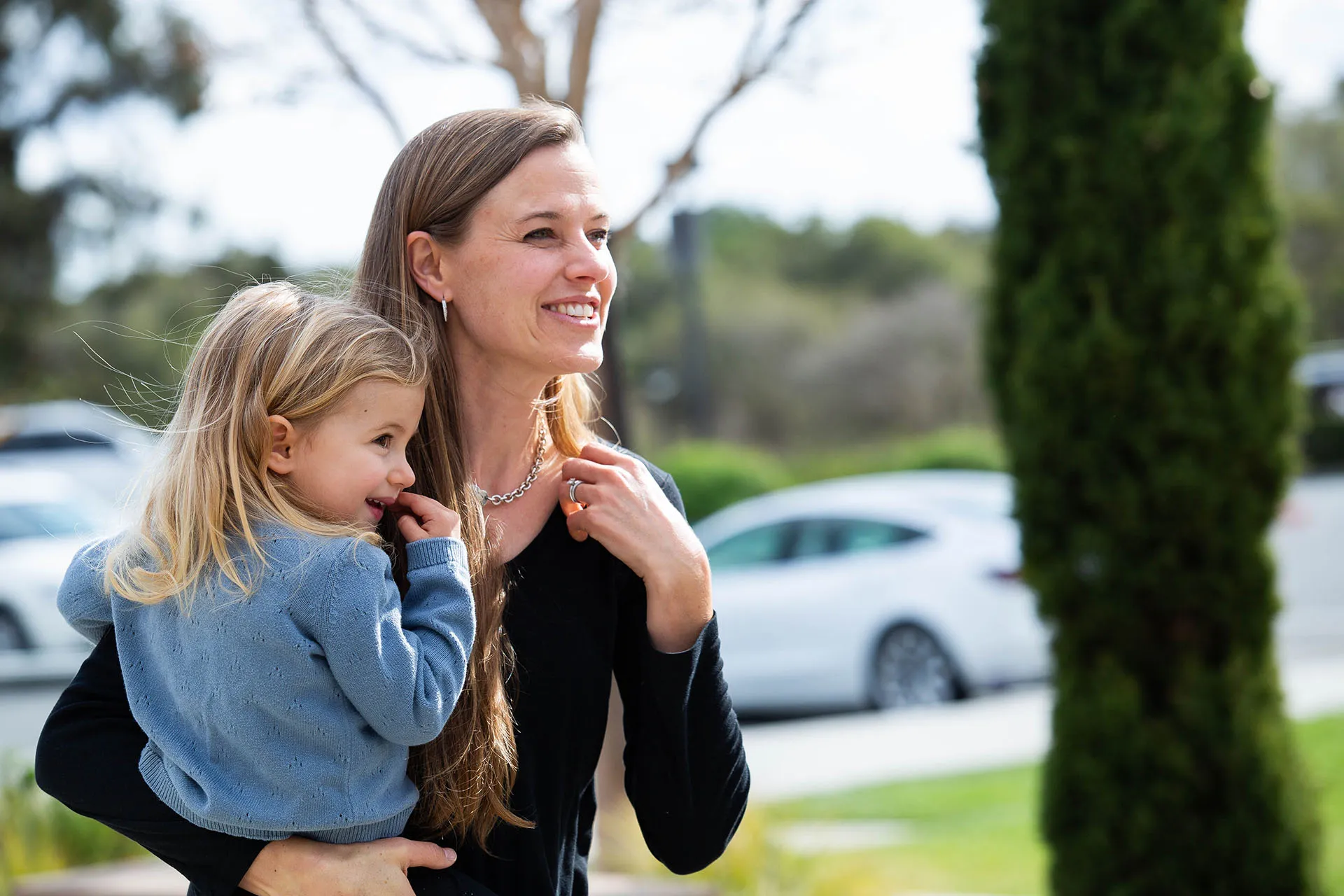
Scouting the Divine

Margaret shares her journey of discovering God through everyday life.
Transcript
This transcript was generated automatically. There may be errors. Refer to the video and/or audio for accuracy.
She has been lauded with many honors, and she's considered to be one of the up-and-coming people in the country. But one thing I have grown to appreciate about her over the course of the weekend is her heart for telling the story of God's Word and explaining it in a story form. It's so refreshing, and the things that I've learned over the course of this weekend—and like Albert and Ray who were here the previous weekends—Margaret has a tremendous love for the church and for those of us who are in the pews every week, studying the Bible and wanting to grow. She has a tremendous love and a desire to help us in that journey. So would you please welcome Margaret Feinberg?
I know this is the second service of the morning, so I was just kind of wondering, would it be okay if I took off my shoes? Okay. Because more and more I find God's Spirit simply saying, you be you and you be mine. When I am most fully myself and most fully His, I am in the best possible place.
This morning, what I wanted to do was share a little bit of a journey that I've been on over the course of the last few years that actually began more than a decade ago. I was living in my home state in Colorado when I got a call from my aunt up in Sitka, Alaska. Then my uncle had gone out scuba diving, and when he came to the surface, he was dead, and it turned her world upside down. She desperately needed help from someone in the family with her B&B. Being one of the only people with a flexible schedule, I traveled up to help her several summers, and during those summers, I met some rather unforgettable people.
One of whom was a tall, strapping six-foot-eight Alaskan by the name of Lafe. You see, I was signing books in a church café when he walked in, and he bought two copies. While he totally noticed me, I didn't really notice him because I'm kind of like Dory from Finding Nemo. But eventually, I caught on to the fact that wherever I went in Sitka, there was Lafe. It might have been a little bit uncomfortable, awkward, downright creepy, except that in Sitka, Alaska, there's only about 14 miles of road end to end. This is one of those small towns where people live in a kind of fishbowl existence. You see the same people at the gas station, the post office, the grocery store. I mean, this is a town so small that when people register for their wedding, they register at True Value.
So here I am hanging out with Lafe because I keep running into him everywhere, and we become friends. After only knowing him about six or seven weeks, it's time for me to pack up and head back to Colorado. But before I do, he sits me down, looks me in the eye, and says, "Margaret, I would like to ask you to consider moving to Alaska to pursue a relationship to become my wife." Wow! Way to let it all hang out. And I remember sitting there and thinking, ooh, I am so not moving to Alaska for a boy. I mean, they make movies out of people who do things like that, starring Sandra Bullock.
So I packed up and headed back to Colorado. But Lafe continued to call and pursue me. I remember a couple of months later, my cousin was getting married off an island off the coast of Washington, and my mom had come in for the wedding. Lafe had come down for a few days beforehand, and for the first time, my mom got to meet Lafe. We enjoyed a long lunch together, and at the end of that meal, my mom looked at me and she said, "Margaret, this guy is amazing, and you are a fool if you don't give this relationship a chance." So I listened to my mom. I packed up, I moved to Alaska, and about ten months later, I married my stalker. The tall six-foot-eight Alaskan, whom you'll see by the book table on your way out, is the man whom I love and I serve and I adore.
But the second unforgettable person I met during those summers in Alaska was one of the guests who came through the bed and breakfast, and her name was Lynn. One morning, over fresh salmon berry scones and hot coffee, we were talking about life when I randomly asked her what she did in her free time. She said, "I am a shepherdess." I was like, a what? And she said, "A shepherdess, like you take care of sheep?" Yeah, in your backyard? I'm trying to imagine what does this look like, and she began to describe how near her home in Portland, Oregon, she had both an upper and a lower field, and she took care of several dozen sheep. This was her passion, her pastime, what she loved to do.
As she is talking, I am instantly having several scriptures flashed through my mind, but I so don't want to sound like one of those people. So I'm trying to land the plane of conversation smoothly, and I just opt for the crash landing. I'm like, sometimes I read this book called the Bible, and in it there is this author named John, and around chapter 10, he describes how God is like a shepherd and we're like sheep. Just as a shepherd cries out to the sheep and the sheep come running, so too God cries out to us, and we have the opportunity to respond in obedience. Does that really happen when you're spending time with your flock? And she says yes, and then she begins to describe the day-in, day-out care for her animals. As she is talking, my spirit is just coming alive.
Well, that morning conversation eventually came to a close, and it was time for her to go on to the next stop in her tour of southeast Alaska. But before she left the bed and breakfast, she looked at me and she said, "Margaret, you seem to be really interested in this whole concept of sheep and shepherding and spirituality, and I've actually been collecting magazine and newspaper articles on this very topic. Would you like me to send them to you?" I said yes, but I honestly thought that she would forget because how often have I made well-meaning promises and completely dropped the ball? Yet about four weeks later, I received an envelope in the mail, and when I opened it, there was this manila folder inside with this collection of articles and news clippings. As I am reading them, again my spirit is coming alive.
As I'm reading and as I'm studying, I'm thinking one day I have got to write about this. Well, that was more than a decade ago. Multiple moves for Lafe and I, not only within the great state of Alaska but also back to my home state of Colorado, where I can honestly say it's good to be back in America. A couple of springs ago, I was going through one of the drawers in my office desk when I stumbled upon that file of articles from Lynn. As I began reading them, I thought now is the time to write about this. But how to track down Lynn? I mean, how to track down a woman who I had only met once more than a decade ago? Well, I decided to use a little device invented by Al Gore, better known as the internet, and a search engine by the name of Google. I managed to track down Lynn, find her phone number, and I cold-called her.
The conversation sounded something like this: "Hi, my name is Margaret, and I met you more than a decade ago when you were touring through southeast Alaska and you stayed in my aunt's bed and breakfast in Sitka. Over hot scones and coffee, we talked about sheep. Do you remember me?" She's like, no. And I'm thinking, awesome! But by the end of that conversation, she was gracious enough to extend an invitation for my husband Lafe and I to travel up and spend time with her and her flock at her home outside of Portland. From there, we traveled to Nebraska to spend time with a farmer, to southern Colorado to spend time with a beekeeper, and finally to Napa Valley, California, where we spent time with a vintner or a grape grower.
With each of these individuals, I opened up the scripture and I asked, how do you read these passages not as theologians, but in light of what you do every day? Their answers changed the way that I read the Bible forever. Time and time again, I found myself asking how did I grow up in the church? How did I become a religion major focusing on New Testament studies, and nobody told me these things? This journey became the foundation for a book and a Bible study called Scouting the Divine: My Search for God in Wine, Wool, and Wild Honey. Why scout the divine? Because I don't know about you, but there are a whole lot of mornings that I go to read this book, and I study the stories and I read the passages, and I want to connect, really I do, and yet they feel thousands of years old, thousands of miles away, distant cultures. As much as I want to connect, all too often I find myself closing the book more spiritually hungry than when I began reading.
The picture that I have in my mind's eye is of that of a huge panel of stained glass, and it's like over time the dust has collected, and how desperately I need the Holy Spirit to come in and to wipe away that dust so that I can once again stand in wonder and awe of all of who our God is and all that He has done. So this morning, I just wanted to share just a couple of the gems that I discovered in my journey of scouting the divine. The first came rather early because I knew that before I ever got on a plane to go and spend time with Lynn, I had some homework to do. I began looking in the scripture and searching out the nearly 700 references to sheep and shepherds and flocks throughout the Bible, and what I began to discover is literally that sheep graze through the pages of Scripture.
From the very beginning in Genesis, we discover that the original conflict between Cain and Abel was one of an offering—one the gift of the field versus that which was the gift of the flock. Though the Bible doesn't explicitly say that Noah placed sheep on the ark, I have a hunch that he did. Why? Because many of his descendants, some of Israel's greatest leaders, all took care of sheep: Abraham, Isaac, Jacob, Moses, Joseph, not to mention that shepherd boy King David. Sheep and shepherding imagery appear throughout the Old Testament right into the New, where at the birth of Christ, it's the shepherds who are on that very short RSVP list to the infant's birth. When that infant Jesus grows up and He enters into three years of earthly ministry, time and time again in the parables that He tells, the stories that He teaches, He draws on the story of sheep and shepherds. This continues through His death, His resurrection, and during the expectation of His imminent return when the church is birthed, and those who lead her are encouraged to pastor or pasture the flock of God. It runs all the way through to the closing of Revelation, where we find John on the island of Patmos, and he's having these psychedelic apocalyptic visions, and time and time again, he keeps talking about seeing a lamb.
With so many mentions of sheep throughout the scripture, that raises the question that maybe, just maybe, I need to get to know more about these wooly creatures. So I got on a plane to go and spend time with Lynn, and after a warm greeting at the door, she invited me to go and see her sheep. As I spent time with them, I had a familiar passage come alive in a whole new way. It's found in John 10, and those of you who have your Bibles, I would love for you to go to John 10. Those of you who have your iPhones or iPads, you can go there as well because there is an app for that.
As we lead into John 10, in John 9, we're seeing Jesus surrounded by the religious leaders of the day, and they're looking at Him and they're asking, "We're not blind, are we? Are we really blind?" And Jesus basically says, "Yepers." In order to open their spiritual eyes, He draws on shepherding imagery. In John 10, verse 1, He says, "Truly, truly, I say to you, he who does not enter the door into the fold of the sheep but climbs up some other way, he is a thief and a robber. But he who enters by the door is a shepherd of the sheep. To him, the doorkeeper opens, and the sheep hear his voice, and he calls his own sheep by name and leads them out. When he puts forth all his own, he goes before them, and the sheep follow him because they know his voice. A stranger they simply will not follow, but will flee from him because they do not know the voice of strangers."
When I arrived at Lynn's, she looked at me before we went outside to go to visit her sheep, and she looked at my feet and she said, "Margaret, that is not going to work," because I was wearing these cheap flimsy sneakers. She said, "You know, this is Oregon, it rains all the time. You need boots." So I put on this thick pair of boots, and I started walking beside her and talking as we walked up this muddy path. As we're walking, I'm watching her. She carefully opens each gate, and when she passes through, she closes it and double-checks to make sure it's securely closed behind us. We're walking and talking and repeating this process until finally we reach the very top of the trail. We look out on this wide grassy expanse. There are these sheep that are dotting the landscape like large cotton balls, and all of a sudden, Lynn looks at me and she starts whispering. I looked at her and I go, "Lynn, why are we whispering?" And she says, "Margaret, because at the very first sound of my voice, they will all come running." With that, she simply said, "Sheep, sheep, sheep," and the entire flock bolted toward her.
In that moment, I recognize that John chapter 10 is not just a metaphor; it is not just a word picture. It is the way that sheep are wired. You see, a sheep is wired, it is designed, it is created to respond to the voice of its shepherd, just as you and I are wired and designed and created to respond to the voice of God in our lives. Are there things that we can do to make it more difficult to hear from God? Absolutely. We can choose to run to the far edge of the field. We can choose to poke our head through the mesh gate. We can choose to bury our noses in the tall grass. But if you and I are actively seeking to hear God's voice in our life, then as the good shepherd, He will make sure that we do not miss a single word. Indeed, our God is the good shepherd.
But it's not just that He's a good shepherd; there's more. Because you see, after spending time with Lynn outside of Portland, I traveled to southern Colorado to spend time with a beekeeper. Now, some of you may be thinking, "Margaret, I can totally understand spending time with a shepherd or a shepherdess, but why would you go spend time with a beekeeper? I mean, what is the buzz about all of the bees?" Well, if you look in the Bible, you will find that there are nearly 70 references to honey and bees and honeycomb throughout the scripture. We see that throughout the Bible, honey was often given as a gift. But of the 70 references, nearly 20 of them all refer to the same thing. They refer to the promised land as a land flowing with milk and particularly with honey, which I always find very interesting.
Because the very first time that it appears in the scriptures is actually in Exodus 3. Those of you who have your Bibles, let's go there because in Exodus 3, which is one of my favorite chapters, we read about Moses, and he's getting his marching orders from God. Moses is out pasturing the flock of Jethro, his father-in-law, the priest of Midian. So he's out there with the sheep when all of a sudden he comes upon a bush that is on fire, but it is not burning up, and he chooses to turn aside. In that place, God meets him in a profound way, and He tells Moses, "I'm going to use you in order to set the Israelites free from the wicked rule of Pharaoh." But in God's love, He doesn't just tell Moses where He's going to take His people out of; He tells them where He's going to take them to. In Exodus 3:8, it says, "So I have come down to deliver them from the power of the Egyptians and to bring them up from that land to a good and spacious land, to a land flowing with milk and honey." Now this description of the promised land as a land flowing with milk and honey becomes like the marquee, the hallmark descriptor of the promised land, which is intriguing because if you flip forward to Numbers 13, when Moses finally gets out of the wilderness and is right on the edge, the border of the promised land, he suddenly becomes like a savvy real estate broker. He takes some spies and he sends them into the land. He says, "I want to know everything about the land. I want to know the square footage, number of bedrooms, bathrooms, closet space. Oh, and could you bring back some samples?"
As you keep reading, what you'll find is that there is a scene when the spies come back, and there are two of them, and they have this large wooden pole that is hung between them. There's a gargantuan dripping of grapes, and they show up, and they have like these state fair prize-winning pomegranates, and they have these uber sweet figs. It is a fabulous scene, except for one problem: there's not a drop of honey or milk between them, which raises the question, why then is the promised land described as a land flowing with milk and with honey? Well, in order to understand this, I traveled to southern Colorado to spend time with a beekeeper by the name of Gary. This was a guy who had been taking care of beehives for more than 40 years. He knew the inside of a hive inside and out, and he'd recently survived something called colony collapse disorder. Are any of you familiar with that? That is the dying off of bees that is taking place not only within the United States but around the world.
Now, for those of you who may be allergic to bees, you're thinking, "They're dying? Whoop whoop!" And I would totally be with you, except for one little problem: bees are essential to many of our food supplies. So for instance, without bees, we don't get almonds, which is painful here in California. Or without bees, we don't get many of the beans or the berries that we enjoy. Without bees, we don't even get like the guacamole at our favorite Mexican restaurant, and that one hurts. I love me some guacamole. So when I met Gary two years earlier, he had had almost half of his hives die in a single winter, and the next winter he'd had another third die, and so he was in the process of rebuilding.
So I sit down with him, and I look at this passage, and I ask him, "Gary, why do you think the promised land is described as a land flowing with milk and with honey?" And he says, "Margaret, in order to understand that, you need to understand something about the inner workings of a beehive." And so I would like for you all to turn on the discovery channel of your brains. Don't go to the history channel too far. In a modern beehive, one of those white framed boxes that you see when you're driving down the road, there are somewhere between 50 and 75 thousand bees. Now, the most famous of all of these bees is the queen bee, and she's not called the queen because she rules over all of the other bees. She is called the queen because she has babies all day, every day. Shortly after she is born, she goes on her maiden voyage in which she is impregnated by the boy or the drone bees of the hive. Then she returns to the hive and begins laying eggs. At that point, the boy or the drone bees have served their purpose in the hive, and so they are kicked out. No spiritual parallels there.
But there are still tens of thousands of other bees. For instance, you have the queen attendant bees whose sole purpose is to take care of the needs of the queen. You have the nurse bees whose job is to take care of the baby larva. You also have the hunter-gatherer bees who fly far and wide in order to bring the pollen and the nectar back to the hive. You also have the water-gathering bees, which I've always found intriguing because I've never seen a bee flying with like a five-gallon bucket. So if your job is to gather water and you're a bee, you fly out, find a water source, drink as much as you possibly can, and then you come back to the hive and you go, and you hope that the five-second rule doesn't apply.
But then there are the fanning bees, and these are the bees who will stand in front of that little pool of water, and they will flap their wings, and on a particularly hot day, they will create a natural air conditioning system. On a particularly cold day, they will stand there, not in front of that pool of water, and they will create a natural heating system, which is why if you go and you visit a beehive in the cold winters of Alaska or in the hot summer sun of Phoenix, Arizona, you will always find the interior of a beehive being maintained at about 96 degrees. And all I'm thinking is how awesome is our God?
But that's not all, because there are other bees. For instance, some of my favorite are what they call the guard bees or what I have appropriately nicknamed the Charlie's Angels bees. These are the bees that hang outside of a hive, and they protect the golden treasure from intruders who might want to steal it. There are also my absolute favorite bees, which are the mortuary bees. I imagine these guys like black capes and black hats and like the junior birdman outfit on, and their sole purpose is to remove the death and the disease from the hive. As Gary is talking about all these bees and their roles, I'm instantly seeing the parallels to the body of Christ. How just as within a beehive, when each bee fulfills the role that it's been given, how it naturally produces a sweetness. So too, when you and I, as members of the body of Christ, fulfill the role and the function that God has given us, how we naturally flavor the world with the goodness of Jesus Christ.
But as I'm sitting there listening to all of this from Gary, I'm thinking this is awesome, but Gary, what does this have to do with Exodus chapter 3? And so turn off the discovery channels of your mind because Gary says, "Margaret, in order for a land to flow with honey, it means that all of the bees in each of the hives are all working within their proper order and function." And that's not just happening with each bee and with each hive; it's actually happening throughout the land. Because for a land to flow with honey, it means that the winter snows didn't come too late, nor did they come too early. It means that the summer sun didn't beat down so hot and hard that none of the small flowers and vegetation could survive, nor was it so cloudy that they could not come alive. But that in a land that is flowing with honey, everything is working in its proper order.
And when Gary said that, I had a shift in my own heart. Because growing up and listening to the ideas about the promised land, I always just kind of assumed that the promised land was a land where God wanted to give me more. Gary said, "No, Margaret, the promised land is a land where any sense of more is a byproduct of things working in their proper order. And the promised land that God calls each of us to is a land where we are fulfilling the role and the function that God has uniquely given us." That maybe if we wake up and we're in an age or a stage of singleness, we would leverage this time to pursue God with wholehearted abandon. Then maybe if we look and we're in an age or stage of raising young kids, we would be grateful for the opportunity to raise them up in the ways of the Lord. And maybe if we're facing empty nesting or retirement, we would recognize this as a time to give back and build up God's kingdom. That no matter what age or stage we find ourselves in, we are invited to live in a promised land where things are working in their proper order and function before God.
The final place that I wanted to share on my journey of scouting the divine was spending time with a vintner in Napa Valley, California. Now, some of you may be saying, "Margaret, why go and spend time in Napa Valley?" For any of you who haven't been there, it is beautiful. But according to the scripture, there are more than 300 references to vineyards and vines and wine throughout the Bible. In the book of Genesis, we read that shortly after Noah got off of the ark, he fell off of a wagon. He planted a vineyard and he drank too much. Throughout the Old Testament, we see many leaders, including David, Uzziah, Solomon, as well as his lover, all either caring for vineyards or have people who worked for them caring for them. Also, throughout the Old Testament, we see that often it's the prophets who draw on vine and vineyard imagery in order to communicate God's message to the people, which is a little bit intriguing because the Bible makes it explicitly clear that drunkenness is forbidden. So why would God use vine and vineyard imagery to communicate His heart to His people when drunkenness is forbidden?
Well, it's interesting because modern archaeologists have found that in the ancient plots of land where the Israelites lived, there are often traces of vines right in the land. So in other words, when God was drawing on the vine and vineyard imagery, it would be like God talking to us about our tomato plants or the very flowers that grow in our front or backyards or our neighborhoods. But I think of all of the scriptural references to the vineyard, I think none is more potent than that found in John 15. I mean, in this passage of scripture, we find that Jesus actually takes on the imagery of the vine and the vineyard not just for Himself but for His Father. In John 15, verse 1, Jesus says, "I am the true vine, and my Father is the vine dresser. Every branch in me that does not bear fruit He takes away, and every branch that bears fruit He prunes it that it may bear more fruit. You are already clean because of the word which I have spoken to you. Abide in me, and I in you. As the branch cannot bear fruit of itself unless it abides in the vine, so neither can you unless you abide in me. I am the vine; you are the branches. He who abides in me and I in him, he bears much fruit, for apart from me you can do nothing."
In order to understand this passage and others, I went and I spent time with a guy by the name of Christophe, who manages a handful of small boutique vineyards in the region of Napa Valley. We sat down and we looked at this passage and others, and I admitted to him that there's something in this that I kind of struggle with, and that is the idea of pruning. I mean, I don't know about you guys, but when somebody starts to talk about pruning, like I am not the girl who's at the front of the class like, "Yeah, yeah, me, me!" Like I'm the one who's slowly doing the moonwalk out the back door. When it comes to pruning, I'm like, "No, I don't want that." Because if I'm really honest, when I start to think about the whole imagery of pruning, the thing that comes to mind is honestly that God is going to prune me with something like this.
And so if here I am and I am this vine that's growing up before the Lord, then He's going to look and be like, "Whoa, Aria, sin wack! There's another one, whack!" And He's going to see like there's that wild branch, "Cut that off!" and "I don't know what that's doing there," and "Let's just cut that back and cut that back and cut that back." And by the time that God is done with me, I will be nothing more than this short, stubby little vine thing, and maybe, just maybe then God can do something good with me. And when I described this to Christophe, he looked at me and he said, "Margaret, that is not how we prune vines in Napa Valley." He said, "When we want to prune a vine in Napa Valley, we actually use something like this." When he pulled them out, I looked and I thought, "Wow, cuticle clippers!" I mean, and he began to describe how in the boutique vineyards that he manages, he walks through the vineyards multiple times during a growing season. In fact, he will handle every single cluster of grapes three to four times by hand, and he'll come through and he'll cut off just a branch or just a leaf so that every grape on that cluster gets just the right amount of sunlight and the perfect amount of celebration, not just for maximum fruitfulness, but maximum flavor.
When Christophe described that, I began to say, "Lord, have Your way with me! If this is what You mean by pruning, then cut me back, trim me back. I want to be fruitful and flavorful for You!" But it's not just that image of pruning that's found in John chapter 15. It's also the image of abiding. Growing up in the church and reading about abiding and listening to sermons, I always picture kind of the vine growing up and there were the grapes and the branches and the vine, and as long as everything kind of stayed connected, as long as I stayed kind of plugged into Jesus, then it was all okay. While that's true, as I spent time with Christophe and began to understand more about viticulture, the art and science of growing grapes, I began to see things from a little bit of a different perspective.
Understanding a little bit more of the depth of what it means to abide in Christ, Christophe explained to me that if you want to grow great grapes, you want to start a vineyard, that you actually don't use seeds; you use shoots of previous vines. That very first year when you're going to grow a vineyard, you go and you plant those shoots, and they start to grow up. At the end of that year, you go through and despite their height and their progress, you cut them back. The second year, those vines grow up just a little bit taller, but again, at the end of the year, you go through and you cut them back. The third year, those vines go even taller and they start to produce some grapes, but you don't take them; you go and you cut them back. It's not until the fourth year that those vines will grow up and they will produce a harvest, and you actually take that harvest and then process it and bottle it. Christophe says that it's actually not until year seven that he gets to taste the very first fruits of his labor.
Because of the high cost of land in Napa Valley, there isn't even a financial break-even point until you're 16, 18, or 20. But once that initial investment and that hard work is done, that vineyard will continue to produce fruit for 40, 50, and 60 years. When Christophe described that, I began to understand the long-term nature and perspective that God has of us when He calls us to abide in Him. Because I don't know about you guys, but there are days that I look at God and I go, "God, why am I not more fruitful? God, why am I not more productive?" And God looks at me and He says, "Margaret, because the harvest that I want to bring forth in you is not for another 10 or 20 years. But will you remain faithful and abide in me?" And again, I find myself saying, "Lord, have Your way with me! Give me the courage to abide in You, not just for today or tomorrow, but for the long haul."
But that image of abiding isn't just true with what's going on above the soil; it's actually true with what's going on inside of the soil as well. Because I always thought that if I wanted to grow really great grapes, the kind that are just world-class, that I would go down to True Value, where I registered for my wedding, and I would buy one of those huge bags of miracle-growth soil, the kind where you stick your fingers in and they grow three inches instantly. And I described this to Christophe again. He said, "Margaret, that is not how we grow grapes in Napa Valley." He said, "If you want to grow incredible grapes, the kind that the critics will love, the very best grapes in the world, you do not want rich, lush soil; you actually want rocky, difficult, stony soil. Because there's stones and the rocks that put the strain on the roots that give the grapes their incredibly rich flavor." Did you know that there is a winery over in France in which they grow their grapes in 95% gravel? There are days that the vintner will go out, he'll look at the vine, and he will say, "It is not rocky enough," and he will actually take a stone and plant it next to the vine.
When Christophe described this, I began to look at my own life. Because I don't know about you, but I know that I have stones in my life. I have those difficult areas, those places where I have cried out to God. I have begged God a thousand times over to make the stone go away, and it does not budge. And it's like in those moments, the Holy Spirit is saying to me, "Margaret, do you not know that that stone, that difficult area, it's the very thing I'm going to use to produce the flavor of my Son in you?" And again, I find myself saying, "Lord, have Your way with me! You are the master vintner. Prune me! Remind me of the importance of abiding in You."
Why does God reveal Himself in so many different metaphors? I think one of the reasons is simply that there is no single metaphor that can contain our awesome and marvelous God. But I think a second reason that God reveals Himself in so many different metaphors is, I don't know about you, but there are a whole lot of days that I need to know God in each of these ways. There are days that I need to be reminded that God is the good shepherd, that I was wired and designed and created to hear His voice and that I need to know that He hears mine. There are days in life and in ministry that, like the beehive, I just feel like I am flapping my wings, and I need to be reminded that if I will just stay true to the role and the function that God has given me, that He is doing something greater through the body of believers than I can ever imagine.
And there are other days that I need to be encouraged to submit to the pruning that God wants to do in my life—the cutting back, the trimming that, though it seems painful for the moment, is that which brings forth a harvest of righteousness. And savor the reminder that abiding in Christ is not just for today or tomorrow, but it is for an entire lifetime.
So my hope and my prayer for you is that you too will scout the divine in your own lives. That you will open up the scripture and cry out to God that He would bring alive passages and scriptures, both familiar and unfamiliar, in a whole new way. That as you dive in, you would find the scripture coming alive like a pop-up book, and then in the process, the Holy Spirit would blow through your life and wipe away any dust so that you can once again see the wonder and the beauty and the majesty of our God.
Let's pray. Heavenly Father, we thank You and we praise You that You are a God who invites us into a deeper relationship with You, that You invite us to scout You, to seek You, and You reward those who seek You. Heavenly Father, stir up the hunger in our own hearts to know You and to know Your Word. Give us eyes to see the ways that You are moving in our lives. Give us ears to hear Your voice, and give us hearts that be passionately after You. We thank You and we praise You for being our God, for allowing us to be Your kids. In Jesus' name, Amen.
Sermons
Join us this Sunday at Twin Lakes Church for authentic community, powerful worship, and a place to belong.